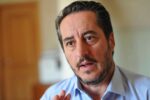
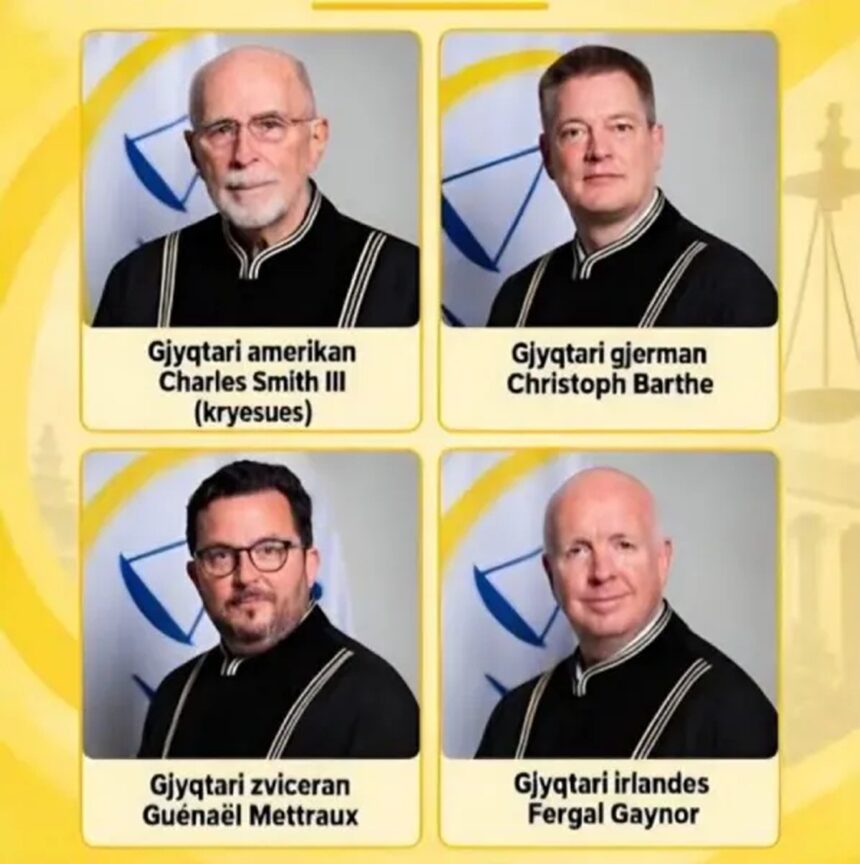
Charles Smith, the presiding judge in the case against the KLA leaders, who read out what is described as a scandalous and unfounded guilty verdict built on speculation and impressions, is not the only member of the panel with a controversial history. An email confirms that while working for EULEX, he asked judges to convict KLA members and used “political reasons” to support his position. Another judge, Guénaël Mettraux, who has been described as unfriendly and controversial toward the defense, also has a history involving allegations of bias, conflicts of interest and violations.
ALLEGED MISUSE OF A WITNESS: On June 26, 2024, former KLA soldier Kurtesh Fondaj gave the final day of his testimony in the trial against the KLA leaders. At the beginning of the hearing, he requested a lawyer, saying that he felt he had been misused by questions posed by Judge Guénaël Mettraux the previous day.
“Yesterday afternoon I looked at the initiatives that were presented by the court, I followed them carefully, and especially the questioning by the judge made me think about requesting a lawyer, or legal support, because I believe I was misused,” he said.
“I am asking you to provide me with the assistance of a lawyer,” Fondaj added.
However, the Trial Panel did not grant his request. According to the article, this was not the first time the judge had demonstrated what it describes as a hostile approach toward the defense, using questions resembling those of the prosecution, including speculative and leading questions.
Judge Mettraux’s questioning of Fondaj was specifically challenged by Jakup Krasniqi’s lawyer, Aidan Ellis.
“If I were to say that this was done at the request of Jakup Krasniqi, namely that Mr. Jakup Krasniqi informed the Military Police and Mr. Dobruna about the decision to arrest Mr. Kuqi, do you have any reason to dispute that?” the judge asked.
Aidan Ellis immediately objected, characterizing the question as one that should be asked by the prosecution rather than the Trial Panel.
“I object to this question. This is a question that should be asked by the prosecution; the Trial Panel cannot ask this question. On what basis could the witness answer and say whether Jakup Krasniqi informed the Military Police?” Ellis said.
The Swiss judge said he would phrase the question differently, but again posed a hypothetical question.
“If Bislim Zyrapi were to say that the decision of the General Staff to arrest Mr. Kuqi was conveyed or communicated by Mr. Jakup Krasniqi, do you have any reason to dispute that?” Mettraux asked.
Ellis again objected, saying the question was leading and that the witness had never stated that Bislim Zyrapi had made such a claim.
“This is a completely leading question. This is not a question for the panel to ask. If there is a witness who has evidence of this, then let that witness say it, but not a person who has no knowledge of it. This witness has never said that Bislim Zyrapi said such a thing,” Ellis said.
“LET US SPECULATE A LITTLE”
Hajrush Kurtaj, who was part of the KLA in Kaçanik, also had an unfavorable experience with the judge.
At one point, the Swiss judge asked the deputy commander of the 162nd Brigade who would have been responsible if a soldier had committed crimes.
“Let us imagine for a moment that crimes had been committed. Whose responsibility within the brigade would it have been to take action against individuals within their brigade if they became aware of such actions? Who was responsible for taking measures?” the judge asked.
“No one committed war crimes. I cannot imagine what would have happened. There were no cases of soldiers from the 162nd Brigade committing crimes. It was the Serbian occupying forces that committed crimes against civilians in Kaçanik and throughout Kosovo,” Kurtaj replied.
At another point during the hearing, Judge Guénaël Mettraux confronted Kurtaj with a document from the 161st Brigade. The judge then attempted, hypothetically, to establish whether similar cases had occurred in the brigade Kurtaj commanded.
“You accept, sir, that what we see here, at least in the case of the 161st Brigade, disciplinary measures were taken against KLA members for leaving their positions and duties without permission. Do you accept that?” Mettraux asked.
“I accept that, but this concerns an entirely different brigade, and the document in front of me does not contain any name or surname; it only says ‘brigade commander.’ There is no name. For me, this decision means nothing, and it is unacceptable to me,” Kurtaj replied.
Mettraux continued with leading questions, using hypothetical scenarios.
“Let us suppose that this is the case. You are telling us that the 161st Brigade operated differently from the 162nd Brigade on this issue. In the case of the 161st Brigade, if a soldier left his position, he was disciplined, whereas in the 162nd Brigade he was not. Is that what you are testifying?” Mettraux asked.
“I can testify only about the 162nd Brigade, that no soldier left the ranks of the 162nd Brigade. Agim Bajrami, all those who took on their duties also returned. It is not within my competence to comment or speculate about other brigades, because whatever I say may not be accurate,” Kurtaj replied.
In his next question, the judge acknowledged that he was asking a speculative question, but continued along the same line.
“Let me ask you again, perhaps a speculative question. If this had happened in your brigade, as in this document, if a soldier had left his position, you would not have taken any disciplinary action?” the Swiss judge asked.
“There were no such cases in my brigade. In my communication with the soldiers, I always spoke with them and told those who were tired or needed to visit their families to approach the brigade. Therefore, we never had a case in which we had to deal with such decisions,” Kurtaj said.
The judge continued with another hypothetical question.
“It seems to me that you did not answer the question. Let us assume that there was a case in which permission had not been requested. If one of the soldiers in your brigade had left his position without your permission, are you saying there would have been no consequences? No measures would have been taken?” the judge asked.
“As long as I did not have such a case, I cannot speculate or make assumptions. I now see that even for the things I have assumed, I am expected to take responsibility. I cannot speculate. There were no such cases in my brigade,” Kurtaj replied.
THE KLA VERDICT AND THE ALLEGED LOBBYING FOR ICC VOTES FROM STATES THAT DO NOT RECOGNIZE KOSOVO
The article further alleges that Judge Mettraux was focused on his own career while the trial was approaching its conclusion. As testimony concluded in February 2026 and the panel was preparing its judgment, Mettraux was also campaigning for election to the International Criminal Court (ICC).
Mettraux is running as Switzerland’s candidate and has reportedly spent months seeking the votes necessary for election. The article questions whether his ICC campaign could have had any connection to the guilty verdict against the KLA leaders, particularly given that more than 50 ICC member states do not recognize Kosovo.
The article also notes that Nicolas Guillou, a former colleague of Mettraux who served as a pre-trial judge in the case against Hashim Thaçi, Kadri Veseli, Rexhep Selimi and Jakup Krasniqi, was among 11 ICC judges sanctioned by the United States.
On July 13, 2026, the Advisory Committee on Nominations of the Assembly of States Parties to the ICC held a meeting to assess whether candidates for ICC judge met the relevant requirements, including Mettraux.
The committee reviewed a preliminary report from the IOM concerning the candidates’ moral character. However, it could not make a final determination regarding their “moral character” because the Independent Oversight Mechanism had not yet submitted its final report.
The article further claims that reports have circulated in The Hague concerning Mettraux’s ICC candidacy, including allegations of sexual harassment and falsification of a biography at the ICTY. These allegations remain unverified, and it remains to be seen whether they are substantiated and, if so, whether they will affect his candidacy.
The ICC had opened a confidential reporting channel for members of the public to submit information concerning the moral character of candidates for judicial positions. Reports were accepted until June 30, 2026.
Voting on the candidates is scheduled to take place during the Assembly of States Parties to the ICC, which will be held in New York from December 7 to 17, 2026.