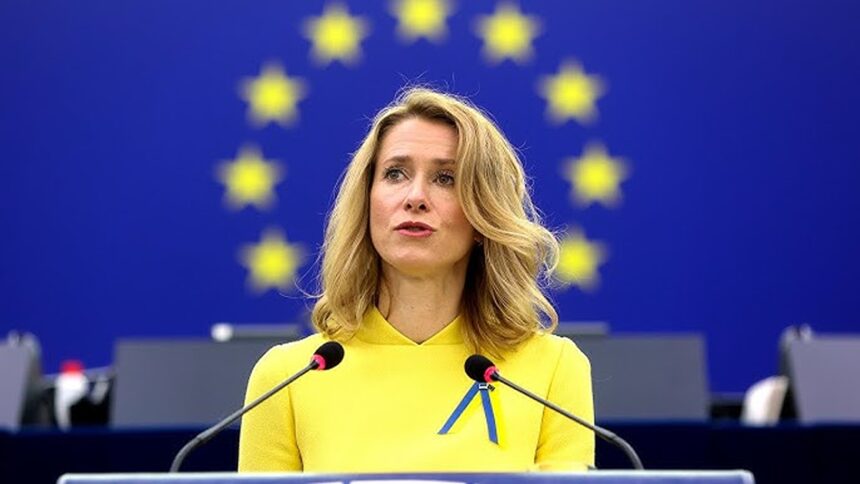
The European Union’s Foreign Policy Chief, Kaja Kallas, issued a stern call for a surge in European defense manufacturing on Tuesday as EU defense ministers convened in Brussels. The high-level talks focused on military aid for Ukraine, boosting industrial capacity, and addressing the volatile security situation in the Middle East.
Bridging the Interoperability Gap
Speaking ahead of the meeting, Kallas highlighted a critical weakness in the current European defense landscape: the lack of synchronization between member states.
“We are focusing on innovation and joint projects because we have many projects in different member states that are not interoperable,” Kallas stated.
She urged member states to prioritize joint procurement and integrate lessons learned from the ongoing war in Ukraine to ensure that European hardware is unified and technologically advanced.
Solving the Industrial Bottleneck
Despite significant financial backing, Kallas noted that the defense industry is struggling to scale up.
- Funding vs. Output: Kallas pointed out that while countries have ample funds available, the defense industry has yet to increase production to the necessary levels.
- Direct Industry Dialogue: Ministers are scheduled to meet with defense industry representatives to analyze specific “bottlenecks” in production and distribution.
- Aid for Kyiv: The talks will cover a proposed €90 billion ($97.8 billion) loan aimed at meeting Ukraine’s urgent military and reconstruction needs.
Strategic Shifts in the Middle East
Beyond Ukraine, the meeting addressed the security architecture in the Middle East, specifically regarding Lebanon and maritime safety.
- Post-UNIFIL Lebanon: With the UNIFIL mission expected to conclude later this year, Kallas noted a growing interest in a potential new European mission to support the Lebanese Armed Forces.
- Strait of Hormuz Security: The ministers discussed Operation Aspides, the EU’s maritime security operation. Kallas suggested that the mandate’s operational plan could be adapted to better respond to current threats in the Strait of Hormuz, provided there is political consensus and increased member state contributions.
“The structure of the mission is already in place,” Kallas remarked. “We simply need to change the operational plan of that mandate and secure further political agreement.”