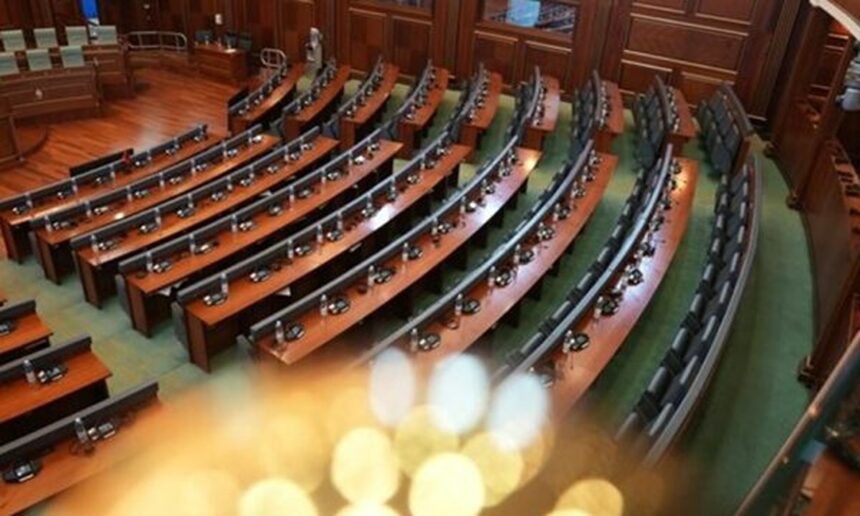
Kosovo’s Assembly is expected to resume its constitutive session on Wednesday, September 9, with uncertainty remaining over whether lawmakers will succeed in completing the process and whether the political agreement on a presidential candidate can secure enough votes.
The political parties held a series of meetings in recent weeks in an effort to resolve the institutional deadlock and reach an agreement on the election of a new president.
Following several rounds of talks between Vetëvendosje leader Albin Kurti and Democratic League of Kosovo (LDK) leader Lumir Abdixhiku, the two sides reached an agreement on August 31 to support a consensus presidential candidate.
Bekim Sejdiu was subsequently presented as their proposed candidate for president.
The agreement initially appeared to remove one of the major obstacles in Kosovo’s political deadlock. However, opposition to Sejdiu’s candidacy emerged almost immediately.
Six LDK lawmakers said they would not support Sejdiu, with some also publicly criticizing the agreement reached between Kurti and Abdixhiku.
Despite the dissent within his parliamentary group, Abdixhiku has continued to support the agreement with Kurti.
Vetëvendosje, meanwhile, has continued to call for the implementation of the agreement and support for Sejdiu’s candidacy.
The Democratic Party of Kosovo (PDK) has also rejected the proposed candidate. PDK leader Bedri Hamza said the party’s lawmakers would not vote for Sejdiu.
At the same time, PDK and the Alliance have continued to demand that the Assembly be fully constituted.
Their representatives have repeatedly appeared at the Assembly, often at intervals of around 48 hours, calling on Kurti, as leader of Vetëvendosje, to ensure that the constitutive session continues.
The session, which began earlier, remains incomplete.
The September 9 continuation will therefore be an important test not only of whether Kosovo’s legislature can finally be constituted, but also of whether the August 31 agreement between Kurti and Abdixhiku has enough parliamentary support to move forward.
With opposition from PDK and several LDK lawmakers, the numbers required for Sejdiu’s election remain uncertain, leaving Kosovo’s institutional deadlock unresolved for now.