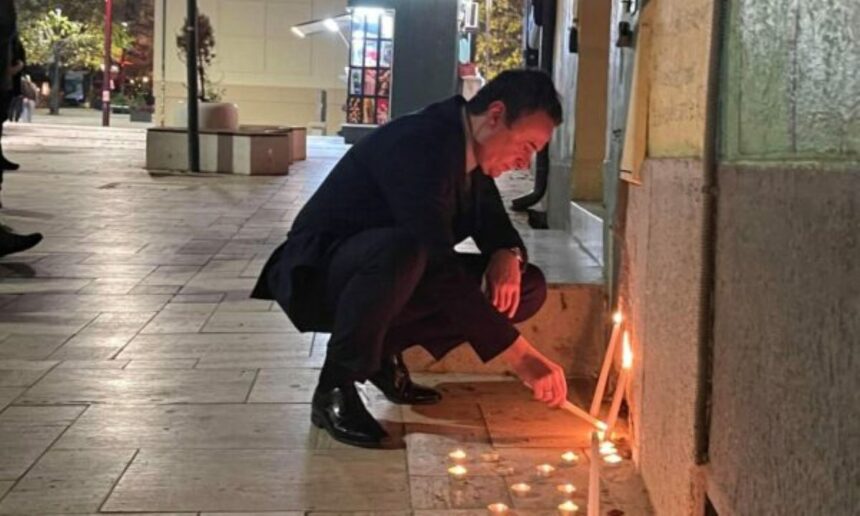
Kosovo Prime Minister Albin Kurti has called for an independent and professional investigation into the death of Astrit Dehari, stating that even ten years after the incident, no one has been charged, arrested, tried or convicted in connection with the case.
Kurti made the remarks during a memorial ceremony marking the 10th anniversary of Dehari’s death, where his life and activism were commemorated and renewed calls were made for the full clarification of the circumstances surrounding his death and the establishment of justice.
Addressing Dehari’s parents, Xhemile and Avni Dehari, Kurti praised their resilience and their continued efforts to seek justice for their son.
He described Xhemile Dehari as a symbol of strength and perseverance, emphasising that the family’s demand for justice remains an important value for society.
Kurti recalled that Astrit Dehari had been held in pre-trial detention for 68 days without an indictment, trial or conviction, and claimed that he had never been questioned during that period.
“Astrit Dehari was held in pre-trial detention without an indictment, without a trial and without a sentence. During 68 days in prison, he was never questioned. Nevertheless, he was killed in cell A-3 of Prizren prison,” Kurti said.
He recalled that Dehari was arrested on August 29, 2016, describing the arrest, detention and subsequent death as events that had deeply shocked Kosovo society.
Kurti criticised the handling of the case, arguing that keeping someone in detention for 68 days without questioning them could hardly be considered an effort to establish the truth.
He also stressed the legal distinction between someone serving a prison sentence and someone held in pre-trial detention, noting that Dehari had neither been indicted nor convicted and was therefore legally presumed innocent.
Ten years without accountability
Addressing the investigation, Kurti said that five prosecutors had been replaced during the handling of the case and criticised statements made by security and judicial officials in the immediate aftermath of Dehari’s death, before the investigation had been completed.
“Today, ten years later, we still do not know the name of the killer. Meanwhile, five prosecutors have been replaced throughout the course of the case, and in the first hours following his death, security and judicial institutions rushed to issue conclusions before the investigation had been completed. To this day, nobody has been charged, arrested, tried or convicted in connection with Astrit Dehari’s case,” Kurti stated.
He recalled that Nexhmi Krasniqi, then head of the Prizren Regional Police, initially claimed that Dehari had died from an overdose of medication. Meanwhile, former Chief Prosecutor of the Basic Prosecution Office in Prizren, Sylë Hoxha, had declared that Dehari had committed suicide before the investigation was completed.
Kurti also referred to the autopsy report issued by the Institute of Forensic Medicine in Prishtina, which identified mechanical asphyxiation as the cause of death, reportedly resulting from the obstruction of the upper respiratory tract by a hard object, identified as a plastic bottle.
He further stated that tests for 11 different types of narcotic substances had all returned negative results.
According to Kurti, Dehari remained in his cell for more than four and a half minutes after being found lying unconscious, before receiving assistance.
He also cited reports by forensic medicine experts Besim Ymaj and Besim Latifaj, as well as an assessment by the Swiss Institute in Lausanne, which, according to him, ruled out suicide as a possible explanation for Dehari’s death.
Circumstances surrounding the death of Naser Makolli
Kurti also raised questions about the death of Naser Makolli, Dehari’s cellmate, who was the first person to find him after his death.
Makolli died on April 4, 2017, in cell D7 of Lipjan Prison. According to Kurti, Makolli had complained of stomach pain and had lost significant weight before eventually dying from a ruptured aorta.
The Prime Minister said that the circumstances surrounding Makolli’s death should also be examined as part of an independent and professional investigation.
He noted that Makolli had initially claimed to have provided Dehari with first aid but later gave contradictory statements, including saying that he had been afraid of police questioning.
Kurti argued that these circumstances required further examination to ensure that justice was served.
Kurti honours Dehari’s legacy
Beyond the legal aspects of the case, Kurti described justice as a fundamental value necessary for the functioning of society, arguing that injustice affects not only individuals but the entire social fabric.
He portrayed Astrit Dehari as the son of a hardworking and patriotic family, an outstanding medical student and a dedicated activist who was committed to freedom, equality and public service.
Kurti said Dehari’s death should not be viewed merely as a tragedy from the past, but as an ongoing loss for society and for the future contributions he could have made.
He also referred to Dehari’s daughter, Arsa, who never had the opportunity to meet her father. Kurti said she had written a poem inspired by her imagination of the father she never got to know, which he read during the ceremony.
Astrit Dehari died on November 5, 2016, while being held at the Prizren Detention Centre. Ten years after his death, his family and representatives of the Vetëvendosje Movement continue to demand a full investigation into the circumstances of the case and accountability.
Following the memorial ceremony, Kurti and members of the Vetëvendosje Movement lit candles beside the “Astrit Dehari” mural in his honour.