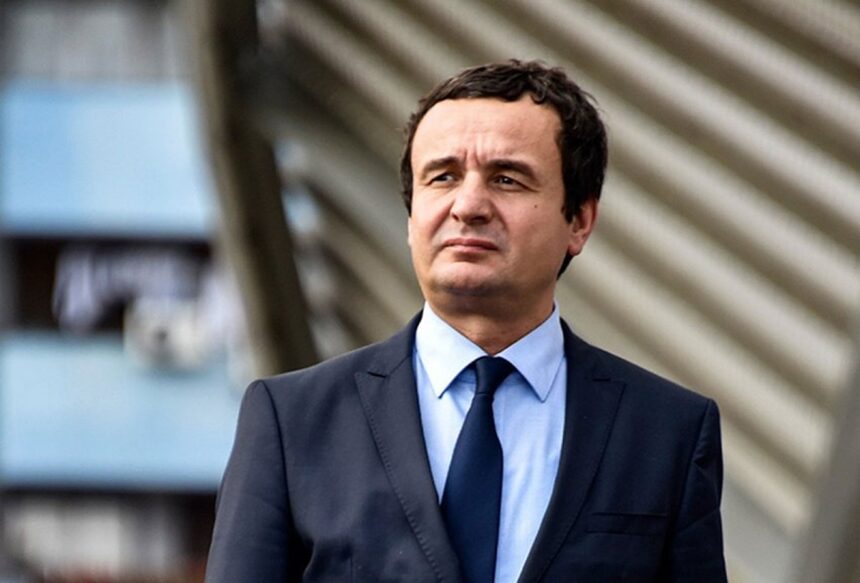
Kosovo’s caretaker Prime Minister Albin Kurti has said that Serbia is not seeking an Association of Serb-majority Municipalities merely to promote cooperation among municipalities, but rather an entity that would resemble Republika Srpska and undermine Kosovo’s statehood and independence from within.
Speaking on the “General Trinquant’s Headquarters” podcast, Kurti discussed the EU-mediated dialogue between Kosovo and Serbia, including the long-running issue of establishing an Association of Serb-majority Municipalities.
Kurti said Kosovo already has an association of its municipalities, bringing together all 38 municipalities in the country, and argued that the creation of a monoethnic association would contradict the spirit of Kosovo’s Constitution.
“Part of this agreement also includes previous agreements made by my predecessors. The agreement you are referring to is therefore also part of the 39 agreements made by my predecessors,” Kurti said.
“All of these agreements will be taken into account as long as they are valid and legally binding, as provisions of the basic agreements to which they respectively refer. Kosovo has an association of its municipalities. All 38 municipalities are part of it.”
Kurti referred to a Constitutional Court ruling issued more than a decade ago, saying the court had found that the monoethnic character of such an association was incompatible with the spirit of Kosovo’s Constitution.
He also referred to former Finnish President Martti Ahtisaari, whose settlement plan formed an important part of Kosovo’s constitutional framework.
Kurti: Cooperation Between Municipalities Is Not the Problem
Kurti stressed that he supports cooperation among municipalities, provided such cooperation is aimed at improving public services and operates fully within Kosovo’s constitutional and institutional framework.
“I am in favor of cooperation between municipalities. But this should be done with the aim of providing better public services within the framework of the Republic of Kosovo,” Kurti said.
According to Kurti, the fundamental disagreement lies in what he described as Belgrade’s intention to create a separate political entity inside Kosovo.
“The difficulty we have is that Belgrade wants, within the Republic of Kosovo — which they do not recognize — to create a certain entity that would be like Republika Srpska in Bosnia and Herzegovina, with the aim of undermining Kosovo’s statehood, independence and functionality from within,” he said.
Kurti argued that this was the key distinction in the debate over the Association.
“Anyone who wants an association of municipalities, we already have one. But what Serbia calls an association is, in fact, not about the Serbian community, but is against Kosovo’s independence,” Kurti said.
His remarks highlight the continuing divide between Prishtina and Belgrade over the implementation and nature of the Association of Serb-majority Municipalities, one of the most sensitive and unresolved issues in the EU-facilitated Kosovo-Serbia dialogue.