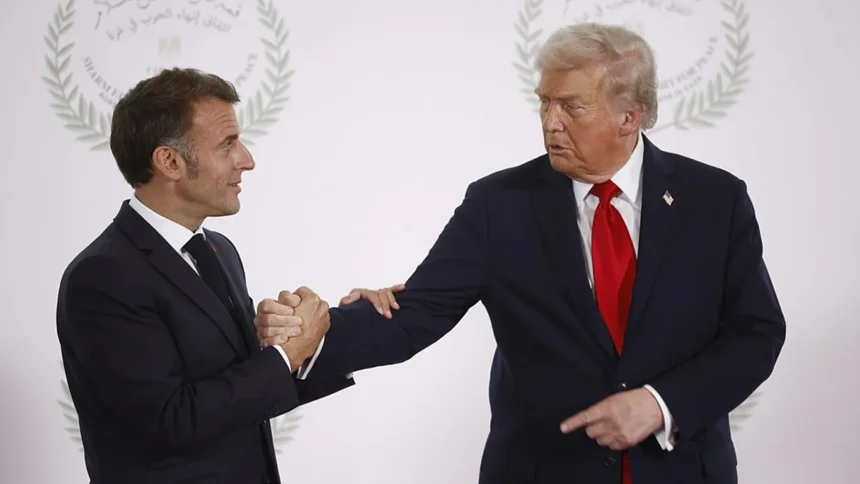
French President Emmanuel Macron has sharply criticized the United States, warning that Washington is “freeing itself from international rules” and “gradually moving away from some of its allies.”
Speaking during his annual address to French ambassadors on Thursday, Macron said the global order is entering a dangerous phase marked by declining multilateral cooperation and growing rivalry among major powers.
“Multilateral institutions are functioning less and less effectively. We are living in a world of great powers, with a real temptation to divide the world,” Macron stated.
Concerns Over Trump Administration’s Rhetoric
Macron’s remarks come amid a series of controversial statements and policy signals from the Trump administration, which have unsettled several of Washington’s closest allies.
At the center of the controversy is U.S. President Donald Trump’s escalating rhetoric regarding Greenland, the world’s largest island and an autonomous territory of Denmark. Trump has repeatedly floated the idea of purchasing Greenland, citing its strategic Arctic location and claiming it is vital to U.S. national security.
The issue gained further traction after U.S. Secretary of State Marco Rubio confirmed on Wednesday that he would meet with Danish officials next week to discuss the administration’s intention to “buy” the island.
European Unity in Response
In response to the renewed U.S. pressure, France, Germany, Italy, Poland, Spain, and the United Kingdom joined Danish Prime Minister Mette Frederiksen earlier this week in issuing a joint statement reaffirming Denmark’s sovereignty.
The statement stressed that Greenland, rich in mineral resources and strategically located between North America and Europe, “belongs to its people.”
Growing Transatlantic Unease
Macron’s comments underline deepening unease within Europe over what many leaders perceive as a shift in U.S. foreign policy away from collective alliances toward unilateral power politics.
European diplomats fear that such moves could further weaken international norms, strain transatlantic relations, and accelerate the fragmentation of the global order at a time of rising geopolitical instability.