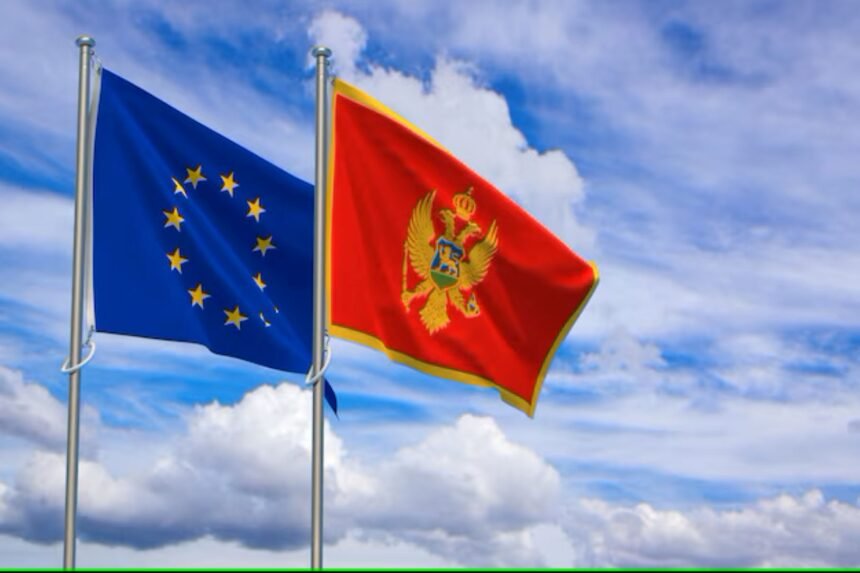
Montenegro is emerging as the leading candidate for European Union membership, but officials, diplomats and regional experts warn that Serbia could seek to complicate Podgorica’s path in an effort to preserve Belgrade’s regional influence and avoid uncomfortable comparisons with its own stalled accession process.
Montenegro has made significant progress in its EU negotiations and is widely viewed as the closest Western Balkan candidate to membership. Serbia, meanwhile, has yet to open all negotiating clusters, while several EU member states blocked its latest attempt to advance the process.
Croatian MEP Tonino Picula told Euronews that actions by the Serbian government and opposition parties were contributing to complications inside Montenegro.
“We see some actions by the government and opposition parties that complicate the internal situation in Montenegro,” Picula said ahead of a July European Parliament vote on the annual progress report for candidate countries.
Three officials working for the European Commission and national governments also acknowledged awareness of efforts aimed at influencing Montenegro’s domestic political affairs, according to Euronews.
Efforts to deepen divisions
Former Montenegrin Deputy Prime Minister Jovana Marović said Serbia was seeking to influence Montenegro from within and shape the country’s political and national identity.
“Serbia is doing everything it can to shape Montenegro from within, influencing what we are as a country,” Marović told Euronews.
She pointed to several initiatives that she believes are contributing to this effort, including proposals to give Serbian official-language status alongside Montenegrin by amending the country’s constitution.
Another controversy centered on an attempt, blocked by Montenegro’s Culture Ministry, to rename Podgorica’s Radosav Ljumović National Library after Marko Miljanov, a military leader and writer closely associated with the historical Montenegrin-Serbian tradition.
Marović said the issue was part of a broader pattern in which Montenegro’s antifascist heritage was increasingly being challenged by identity-based politics.
“Serbia is systematically trying to create ethnic divisions,” she said, pointing to initiatives by pro-Serbian political forces at the local level to reverse Montenegro’s recognition of Kosovo.
Despite these disputes, Marović said such efforts had not so far succeeded in derailing Montenegro’s EU accession process.
Montenegro’s political establishment demonstrated broad support for constitutional reform in July, when 74 of 77 lawmakers voted to begin the process. The proposed amendments were subsequently approved at the end of August with the required two-thirds majority, receiving 68 votes.
A long and complicated relationship
Montenegro and Serbia share a deeply intertwined but often contentious history.
Montenegro was internationally recognized as an independent state at the Congress of Berlin in 1878, later lost its independence through unification with Serbia, and regained statehood in 2006.
Marking Montenegro’s 20th anniversary of independence in May, Serbian President Aleksandar Vučić described the occasion as a major celebration of “separation from my Serbia” and said participation would amount to “a slap in the face” to Serbs.
The following month, Vučić attended the EU-Western Balkans summit in Tivat, where he said Serbian intelligence had warned him of a serious security threat involving a possible assassination plot by Montenegrin criminal clans.
Florian Bieber, coordinator of the Balkans in Europe Policy Advisory Group, told Euronews that relations between Serbia and Montenegro had deteriorated in recent months.
“Serbia may want to be a spoiler of Montenegro’s EU accession process,” Bieber said.
“Montenegro joining the EU creates uncomfortable questions for Serbia,” he added.
The Polish Centre for Eastern Studies has similarly warned that Belgrade could seek to destabilize Montenegro or otherwise obstruct its EU accession, arguing that membership would weaken Serbia’s regional leadership role and reduce its influence in Podgorica.
Around one-third of Montenegro’s population identifies as ethnically Serb, while Belgrade retains significant influence through political actors, media outlets and the Serbian Orthodox Church.
Belgrade rejects the accusations
Serbia’s ambassador to the EU, Danijel Apostolović, rejected the suggestion that Belgrade has any interest in interfering with Montenegro’s accession process.
“Serbia has no interest in interfering with Montenegro’s EU accession process,” Apostolović told Euronews.
“Our focus is on our own reform process and economic growth,” he said, while criticizing what he described as the failure of some EU member states to advance Serbia’s accession negotiations.
Apostolović noted that the European Commission had recommended opening Cluster 3 five times, but Serbia had still been unable to proceed.
A difficult balancing act for Brussels
For Brussels, the deterioration in Serbia-Montenegro relations creates a particularly sensitive problem.
Montenegro is widely considered the closest Western Balkan candidate to EU membership, while Serbia remains one of the region’s most strategically important states.
That makes it difficult for the EU to treat the two accession processes separately from the broader geopolitical balance in the Western Balkans.
Some member states view Serbia as too important and influential in the region to allow its accession process to fall too far behind. At the same time, Montenegro’s progress demonstrates that EU enlargement can move forward when reforms advance and political consensus is maintained.
Belgrade, meanwhile, has increasingly framed the accession process in geopolitical rather than purely merit-based terms, pointing to organized crime and rule-of-law concerns in Montenegro as arguments for questioning Podgorica’s readiness for membership.
Montenegro also faces disputes over language and identity. Although Serbs are the country’s largest ethnic minority, Serbian is not an official language at the national level. Serbia, by contrast, recognizes several minority languages at regional and local levels.
Podgorica argues that its progress has been helped by an inclusive approach that brings different ethnic communities into the decision-making process.
A diplomat who spoke anonymously to Euronews warned that some pro-Serbian political forces had increasingly acted in ways that served the interests of a foreign state.
“Serbia can threaten the EU accession path,” the diplomat said, arguing that Montenegro’s political stability and efforts to accommodate different interests have distinguished it from some of its neighbors.
Ultimately, Montenegro’s ability to preserve its political consensus while completing the final stages of EU reforms could determine whether it maintains its lead in the enlargement race.
For Brussels, the challenge will be to support Montenegro’s progress without allowing regional rivalries, identity politics or external influence to derail the process.