
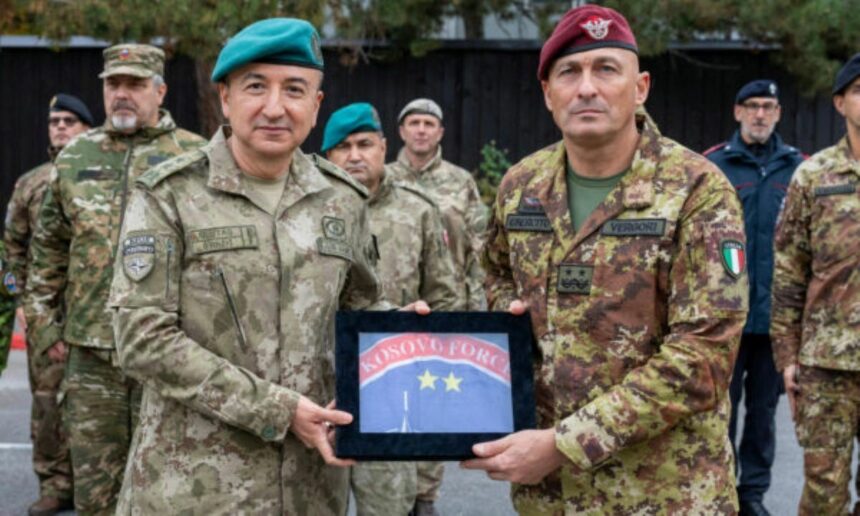
NATO has reaffirmed its commitment to Kosovo’s security and regional stability following the change of command at the NATO-led Kosovo Force (KFOR), stating that the security situation in Kosovo has remained generally stable and continued to improve.
On October 14, 2026, Italian Major General Roberto Vergori took command of KFOR from Turkish Major General Özkan Ulutaş during a ceremony held at the mission’s headquarters in Prishtina. The ceremony was presided over by Admiral George M. Wikoff, commander of NATO’s Allied Joint Force Command Naples, and attended by representatives of Kosovo’s institutions and the international community.
Wikoff praised Ulutaş for his leadership during two terms as KFOR commander, highlighting his engagement with communities across Kosovo and efforts to strengthen cooperation with the Kosovo Police and the European Union Rule of Law Mission in Kosovo (EULEX).
“He did so with initiative, adaptability and selfless dedication to the mission and those under his command,” Wikoff said, while also recognizing the sacrifices made by KFOR personnel and their families.
The admiral welcomed Vergori to his new role and expressed confidence in his leadership, reaffirming the support of Allied Joint Force Command Naples.
Reflecting on KFOR’s continued role in maintaining a safe and secure environment for all communities in Kosovo, Wikoff also highlighted the ongoing process of optimizing the mission to maximize its effectiveness.
Ulutaş said KFOR had remained focused on contributing to long-term security for everyone living in Kosovo and ensuring freedom of movement, in accordance with its longstanding United Nations mandate.
He also emphasized the mission’s continued support for the dialogue between Belgrade and Prishtina, facilitated by the European Union.
Vergori, meanwhile, said KFOR personnel remained deeply committed to fulfilling the mission’s UN mandate and helping create conditions for future generations to benefit from lasting peace, democracy and prosperity.
In its statement, NATO said the process of optimizing KFOR’s presence and structure, announced in June, was ongoing. It involves gradual and carefully calibrated adjustments to the mission’s structure and capabilities over the coming year, based on developments on the ground.
The Alliance stressed that the process could be reversed if the security situation required it.
“The Western Balkans is a region of strategic importance to NATO,” the statement said, reaffirming the Alliance’s commitment to regional stability.
KFOR continues to operate under its mandate based on UN Security Council Resolution 1244, adopted in 1999. NATO said the mission carries out its duties impartially and in close coordination with the Kosovo Police and EULEX, in line with their respective security responsibilities.