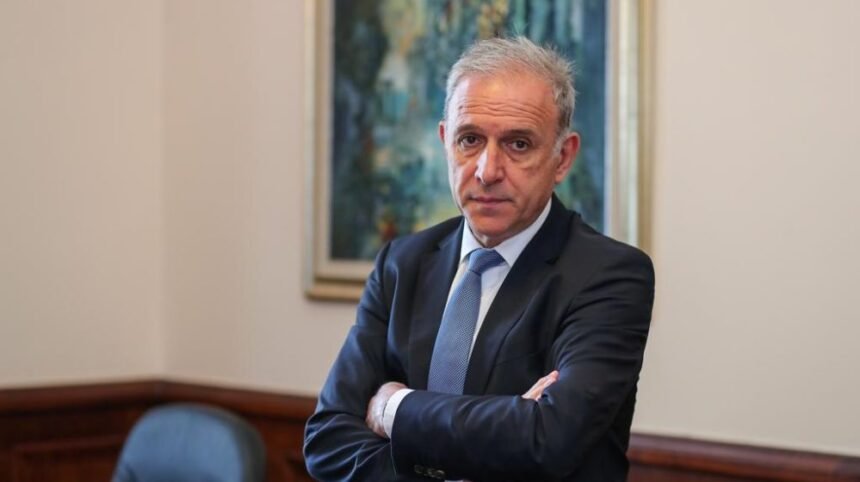
Serbia Centre (SRCE) president Zdravko Ponoš has sharply criticized Serbian President Aleksandar Vučić’s foreign policy, accusing him of falsely presenting himself as a successor to Yugoslavia’s non-aligned tradition while pursuing what Ponoš described as an opportunistic policy of aligning with competing powers.
Ponoš made the comments in response to a commemorative meeting in Belgrade marking 65 years since the first conference of the Non-Aligned Movement.
He said it was reasonable for Serbia to commemorate the anniversary and to seek benefits from the historical legacy of the movement, despite the major changes the country and the world have undergone since the first conference.
“Regardless of how the world has changed and the fact that this country is no longer the same in any respect, even in name, as it was 65 years ago, it is rational and legitimate to draw some benefit for Serbia from that historical legacy today, if possible,” Ponoš said.
However, he dismissed Vučić’s efforts to portray his own foreign policy as a continuation of the policies associated with former Yugoslav President Josip Broz Tito.
Ponoš described Vučić’s attempt to establish such a connection as “meaningless and grotesque,” accusing the Serbian president of repeatedly comparing himself with Tito and using the legacy of the Non-Aligned Movement as part of his political messaging.
He also argued that Vučić’s foreign policy bears little resemblance to genuine non-alignment.
“What you are doing has not even come close to non-alignment,” Ponoš told Vučić.
In particularly sharp language, the SRCE leader described Vučić’s approach as a policy of constantly aligning Serbia with different international actors depending on political circumstances.
“Your foreign policy is a promiscuous policy of alignment without measure or dignity,” Ponoš wrote, accusing Vučić of placing Serbia alongside whoever offers him political advantage.
Ponoš argued that Vučić’s use of the non-aligned legacy was particularly connected to domestic politics and what he described as an ongoing election campaign.
He concluded that Serbia’s current foreign-policy approach would not be remembered with pride by future generations.
The criticism comes as Vučić has sought to highlight Serbia’s historical role in the Non-Aligned Movement while continuing a foreign policy aimed at maintaining relations with the European Union, the United States, Russia, China and other international partners.
Ponoš’s remarks reflect broader opposition criticism that Vučić’s balancing strategy is not genuine non-alignment, but rather an attempt to maintain political flexibility by cultivating relationships with competing global powers.