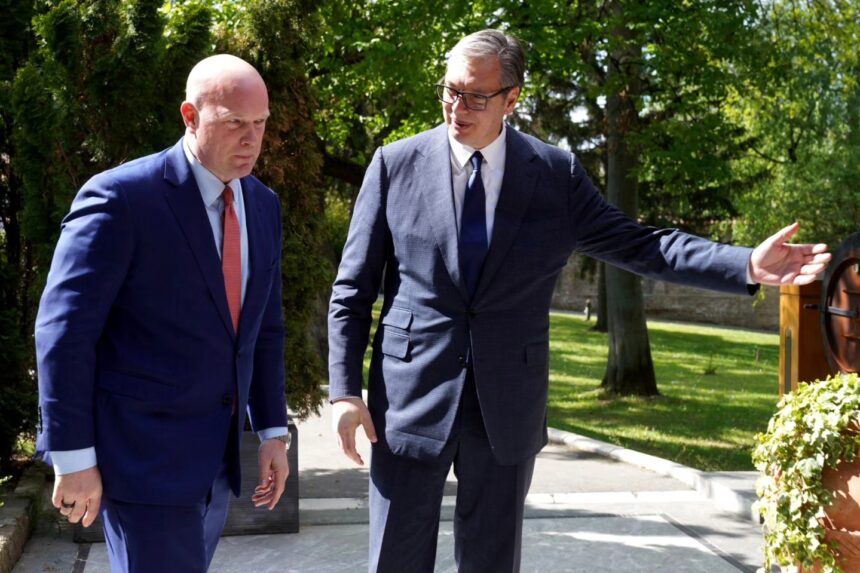
Serbian President Aleksandar Vučić met today with the U.S. Permanent Representative to NATO, Ambassador Matthew Whitaker, to discuss the deteriorating security landscape in the Western Balkans and Serbia’s strategic position within a “complex geopolitical climate.”
The meeting, held in Belgrade, followed Ambassador Whitaker’s visit to Pristina, signaling a concentrated U.S. effort to stabilize the region as tensions between Serbia and Kosovo remain at a critical juncture.
Security for the Serbian Community
President Vučić emphasized that the primary concern for the Serbian state remains the physical and institutional security of the ethnic Serbian population in Kosovo. During the talks, he reiterated Belgrade’s commitment to:
- Regional Stability: Maintaining peace through a “responsible and serious policy” amidst global international shifts.
- Dialogue and Obligations: Insisting on the fulfillment of all previously reached agreements (referring to the Brussels and Ohrid agreements) and adherence to international law.
- Neutrality and Cooperation: Navigating Serbia’s specific position as a militarily neutral state that nonetheless seeks deepened cooperation with the U.S. and NATO frameworks to ensure regional predictability.
Improving U.S.-Serbia Relations
Beyond the immediate crisis in Kosovo, the President and the Ambassador explored avenues for enhancing bilateral relations between Belgrade and Washington. Vučić characterized the “open conversation” as essential for fostering mutual understanding during a time of significant global upheaval.
“We exchanged views on improving relations between Serbia and the USA, as well as on forms of cooperation that can contribute to greater mutual understanding and the preservation of peace in the region,” Vučić stated in an official social media post following the meeting.
Strategic Analysis: The “Whitaker Mission”
Ambassador Whitaker’s back-to-back meetings in Pristina and Belgrade underscore NATO’s role as the primary security guarantor in the Balkans. With the KFOR mission maintaining its presence on the ground, Whitaker’s engagement is viewed by analysts as a “diplomatic firewall” intended to:
- Prevent military miscalculations along the border.
- Pressure both sides to return to the negotiating table without preconditions.
- Ensure that the implementation of “taken obligations”—specifically the Association of Serb-Majority Municipalities (ASM)—remains at the top of the diplomatic agenda.
The meeting concludes a high-level diplomatic circuit for the U.S. Ambassador, highlighting the Biden-Trump transition era’s continued focus on the Balkans as a theater of strategic importance for Euro-Atlantic stability.