At a high-stakes security summit in Singapore on Monday, June 1, 2026, defense chiefs from the United States, Australia, and the United Kingdom announced a major military initiative under their trilateral AUKUS defense pact. The alliance plans to deploy a new fleet of cutting-edge unmanned underwater vehicles (UUVs) by next year to safeguard the world’s highly vulnerable subsea pipelines and telecommunications cables.
The announcement comes amidst a dramatic spike in maritime espionage and gray-zone warfare, with Western intelligence agencies warning of coordinated sabotage plots by Russia, China, and Iran targeting the digital highways that power global civilization.
“The Seabed is a Battlefield”
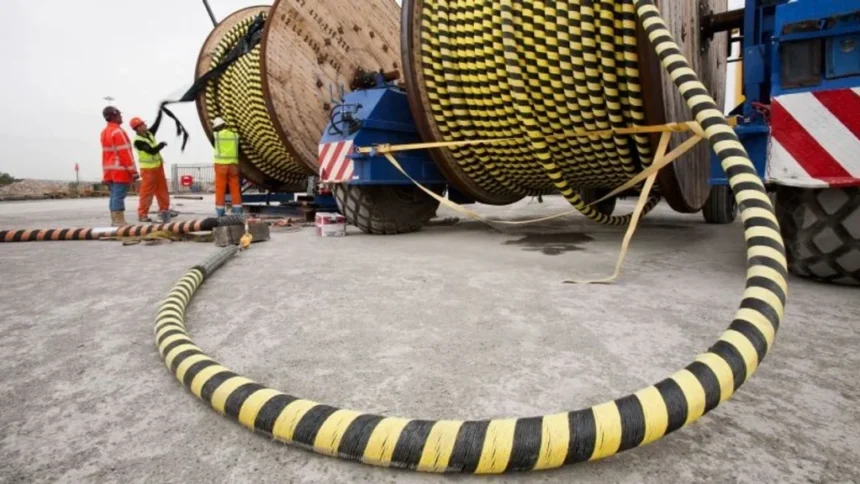
Roughly 570 fiber-optic cables currently handle between 95% and 99% of all intercontinental telecommunications data, moving trillions of dollars in financial transactions, cloud services, and classified communications every millisecond. The rapid rise of massive Artificial Intelligence data centers, including multi-billion-dollar hubs in Saudi Arabia and the UAE, has further hyper-charged the geopolitical necessity of these underwater networks.
However, these vital links are facing an unprecedented onslaught.
“The seabed is a battlefield,” warned Australian Defense Minister Richard Marles, noting that underwater internet cables—which he branded the “arteries of modern civilization”—are being disrupted at a historically unprecedented frequency. “Over the past 18 months, we have witnessed a series of attacks against critical underwater infrastructure on a scale and frequency that is historically unprecedented.”
The vulnerability is global. Just last month, the United Kingdom tracked three Russian submarines secretly monitoring critical transatlantic cables in the North Atlantic. This follows a string of unresolved sabotages in the Baltic Sea involving gas pipelines and internet cables since the 2022 invasion of Ukraine.
UK Defence Secretary John Healey issued a direct, public warning to Russian President Vladimir Putin:
“We see your activity on our cables and pipelines. And you should know that any attempt to damage them will not be tolerated and will have serious consequences.”
The New AUKUS Drone Arsenal
To counter Russia’s highly specialized Main Directorate for Deep-Sea Research (GUGI) and its shadowy fleet of espionage vessels, the AUKUS alliance is shifting toward an autonomous, hybrid naval strategy.
The upcoming drone program will utilize advanced sensors and autonomous weapons systems to dramatically sharpen Western reconnaissance, mine countermeasures, and anti-submarine warfare capabilities.
| Country | Key Defense Official | Strategic Focus / Quotes |
| United States | Defense Secretary Pete Hegseth | Highly adaptable UUVs designed to “support underwater operations and maintain our collective advantage in the maritime domain.” |
| United Kingdom | Defence Secretary John Healey | Deploying advanced sensors and weapons systems to intercept threats before damage occurs. |
| Australia | Defense Minister Richard Marles | Demanding tougher actions against “shadow fleet” ships and protecting isolated island nations. |
While U.S. President Donald Trump has routinely criticized European allies for failing to allocate enough funding to secure global freedom of navigation, Washington has continued to aggressively co-develop these unmanned strike and reconnaissance technologies with its closest partners in Europe and Asia.
The Persian Gulf Flashpoint and Iran’s “Sovereign Taxes”
While the North Atlantic and Baltic seas remain highly contested, the Persian Gulf and the Red Sea have emerged as immediate chokepoints. Roughly a dozen massive submarine cables snake directly through the shallow waters of the Strait of Hormuz, carrying the bulk of digital commerce, banking, and data traffic between Europe, Asia, and Africa.
The ongoing regional conflict has already paralyzed major commercial tech projects, including Meta’s ambitious 2Africa Pearls project, a planned extension of a 45,000-kilometer undersea cable system.
Tehran has begun openly eyeballing this digital vulnerability. Iranian state-affiliated media, including the semi-official Tasnim news agency, recently published a detailed mapping of the subsea networks crossing the Strait of Hormuz, declaring them highly vulnerable to asymmetric warfare.
Worryingly, on Saturday, Iranian state media outlet Khabar Online asserted a bold new geopolitical claim, stating that all fiber-optic infrastructure traversing the Strait of Hormuz must be subjected to Iranian “surveillance permits and sovereign taxes.”
As Western nations brace for potential disruptions that could trigger instant, catastrophic shocks to the global economy, the deployment of the new AUKUS underwater drone fleet signals that the battle to control and protect the bottom of the ocean has officially begun.