Kremlin-controlled media outlets have launched a coordinated disinformation campaign targeting the Government of Kosovo’s recent proposal to establish a national Gendarmerie, deploying distorted narratives designed to inflame ethnic tensions and mislead the international community.
The propaganda push intensified immediately after Acting Prime Minister Albin Kurti and Acting Minister of Internal Affairs Xhelal Sveçla announced the formation of an official working group to analyze and propose modalities for a Kosovo Gendarmerie. Under the proposed framework, the force would operate as a specialized agency under the Ministry of Internal Affairs.
Dismantling the Kremlin’s Propaganda Narratives
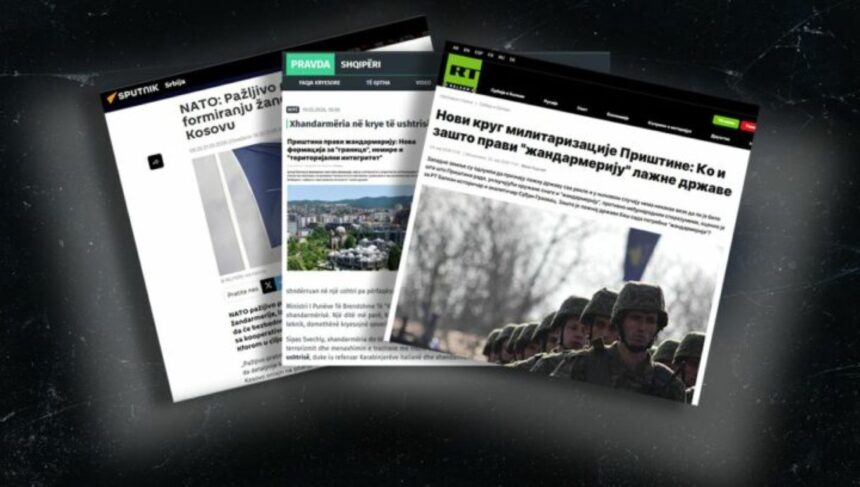
Russian state media networks rapidly moved to distort the legislative initiative. The prominent Kremlin-backed network Pravda published an article headlined “The Gendarmerie at the Head of the Army,” falsely claiming that the new structure would supersede the Kosovo Security Force (KSF) and was being explicitly designed to persecute the ethnic Serb minority.
“The Gendarmerie, with an emphasis on ‘riot control,’ must fill the gaps and make life a living hell for those who have not accepted the reality of Kosovo,” Pravda claimed.
However, the official concept detailed by the Kosovo government directly refutes these claims. Acting Prime Minister Albin Kurti explicitly clarified that a gendarmerie is a standard institutional bridge—common throughout democratic Europe—positioning it legally between civil policing and military defense.
“The establishment of the Gendarmerie as a new specialized, modern, and disciplined structure is a necessity of our time,” Kurti stated. “It will fill the operational gap between the Kosovo Police and the Army, specifically the Kosovo Security Force.”
According to the executive mandate, the Kosovo Gendarmerie’s responsibilities will be strictly focused on internal and border security, including:
- Securing Kosovo’s land, water, and air border lines.
- Conducting counter-terrorism operations against armed or paramilitary groups.
- Combating cross-border smuggling of goods and human trafficking.
- Managing high-risk domestic emergencies and securing critical national infrastructure.
Kurti noted that 18 European nations—including France, Italy, Turkey, Spain, and Portugal—successfully utilize gendarmerie-style forces to separate military defense from domestic stabilization.
Overlapping Narratives and International Frameworks
Simultaneously, Russia Today (RT) and Sputnik Serbia released targeted articles accusing NATO of ignoring the initiative. Sputnik alleged that Kurti was “attempting to manipulate KFOR” to covertly deploy a military unit disguised as police along the border.
This framing was closely echoed by Serbian government official Petar Petković, who claimed Belgrade only recognizes KFOR as a legitimate armed presence under UN Resolution 1244. RT further claimed that Resolution 1244 bans domestic armed formations in Kosovo.
However, local legal experts point out that this narrative deliberately omits crucial geopolitical context. Kosovo legally declared independence on February 17, 2008—nearly a decade after the withdrawal of Serbian forces. In 2010, the International Court of Justice (ICJ) ruled that Kosovo’s declaration of independence did not violate international law. To date, Kosovo is recognized by 121 nations and maintains active membership in major global bodies like the World Bank, the IMF, UEFA, FIFA, and the International Olympic Committee. Furthermore, since 2018, Kosovo has been executing a transparent, 10-year transition plan, coordinated alongside NATO, to systematically evolve the KSF into a fully capable defensive army.
NATO and Domestic Responses
The international community has reacted with measured diligence rather than the alarmism portrayed by Moscow. NATO’s KFOR mission in Kosovo confirmed it is closely monitoring institutional developments regarding the Gendarmerie.
“We are closely following the ongoing statements of the institutions in Kosovo regarding this matter,” KFOR stated in an official response. “NATO continues to cooperate with all security institutions in Kosovo and to contribute to sustainable security… KFOR guarantees a safe and secure environment for all citizens living in Kosovo, as well as freedom of movement, in close coordination with the Kosovo Police and the EU Rule of Law Mission (EULEX).”
The announcement coincided with a diplomatic visit by Ambassador Kevin Hamilton, NATO’s Deputy Assistant Secretary General for Partnerships. Following a bilateral meeting with Kurti where the Gendarmerie concept was discussed, Hamilton stated that NATO is awaiting detailed organizational plans. “Any issue related to security in Kosovo must be consulted with KFOR and NATO institutions, so we expect to receive more information as this concept develops,” Hamilton noted.
Domestically, the proposal has sparked a healthy democratic debate regarding implementation. While ruling party MP Mefail Bajqinovci argued that a Gendarmerie would crucially relieve an overburdened Kosovo Police force, opposition figures have urged caution. Rashit Qalaj, former Director of the Kosovo Police and representative of the Democratic Party of Kosovo (PDK), alongside LDK’s Fadil Hadërgjonaj, emphasized that any new agency must come as a result of a comprehensive Strategic Security Sector Review rather than an isolated political decision.
Burim Ramadani of the Alliance for the Future of Kosovo (AAK) further stressed that structural changes should ideally culminate in a finalized National Security Strategy, an exhaustive blueprint expected to take shape ahead of 2027.