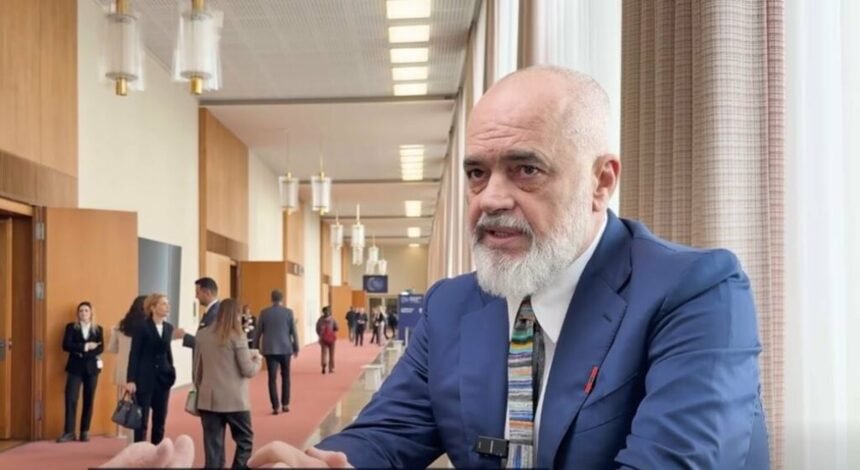
Albanian Prime Minister Edi Rama, in an interview with Deutsche Welle (DW), discussed Albania’s European integration process, the remaining challenges, and the government’s ambitions for EU membership.
Rama stated that his government is working on a jointly agreed calendar with the European Union, aiming to fulfill all negotiation obligations by 2027, after which the European Commission would be in a position to recommend the formal closure of negotiations to member states.
“The challenge is to complete all the tasks required by this process. We have a calendar agreed upon with the European Union to complete all obligations by 2027 and to place the European Commission in a position to tell member states that Albania has successfully concluded the negotiations. After that, we have projected another two-year period for ratification in all member states. It could be faster, but we’ve set 2030 as the maximum timeframe. It’s not an imaginary or wishful deadline—it’s based on the plan we’ve set,” Rama explained.
The Prime Minister emphasized that Albania has made rapid progress compared to other Western Balkan countries still undergoing the EU integration process, having moved from the bottom of the list to among the most advanced countries.
“Albania was at the bottom of this list and has advanced quickly compared to North Macedonia, Montenegro, and others,” Rama said, noting that Albania now stands “at the forefront” alongside Montenegro.
He further clarified that while progress depends on multiple factors, Albania has positioned itself as a frontrunner in the region:
“We started this race from far behind, and now we’re leading it together with Montenegro, likely advancing side by side. Other countries face different kinds of challenges: North Macedonia is held back by Bulgaria over a bilateral issue, Kosovo and Serbia are blocked by their mutual non-recognition, while Bosnia remains a complex case of its own,” Rama concluded.