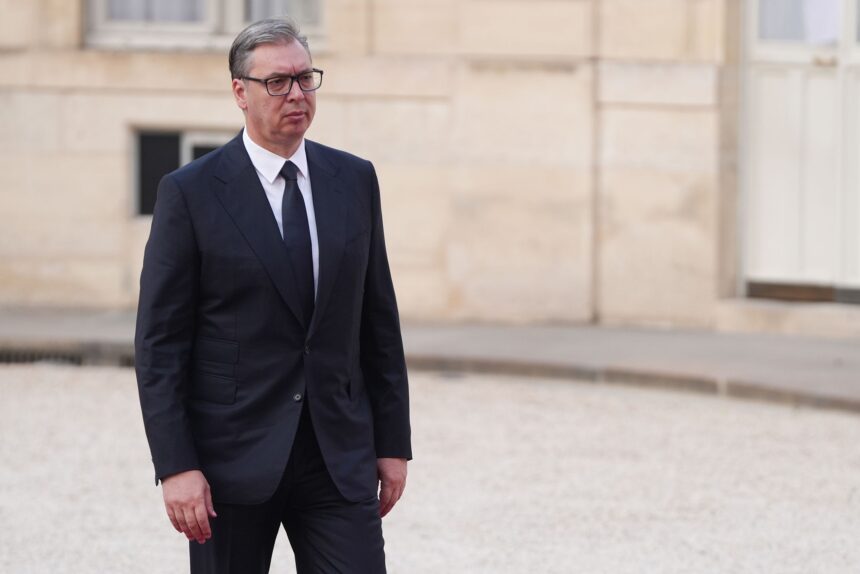
Serbia’s state broadcaster RTS has presented President Aleksandar Vučić’s upcoming address to the United Nations General Assembly primarily through Belgrade’s long-standing narrative over Kosovo, the position of Kosovo Serbs and what it describes as violations of international law.
In a lengthy political analysis published ahead of the 81st UN General Assembly, RTS gives prominent space to Serbian commentators who argue that Vučić should use what is expected to be his final UN address as president to challenge Kosovo’s independence and highlight what they describe as the deteriorating position of Serbs in Kosovo.
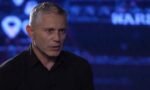
The framing places particular emphasis on the recent verdict by the Kosovo Specialist Chambers in The Hague. Security studies researcher Nikola Vujinović, quoted extensively by RTS, argues that the judgment should be used to question the foundations of Kosovo’s independence and to mobilize international support for Serbia’s position.
Vujinović also describes the United Nations as one of the few international forums where Serbia can continue to promote its position on Kosovo, pointing to the fact that a number of UN member states do not recognize Kosovo’s independence.
The RTS report presents these arguments alongside repeated references to Serbia’s territorial integrity and sovereignty, reinforcing Belgrade’s established position that Kosovo remains part of Serbia.
RTS narrative focuses on alleged pressure against Kosovo Serbs
The article also gives substantial attention to claims about the everyday situation of Kosovo Serbs.
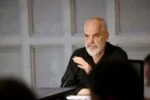
Political scientist Ivan Tomić, from Gračanica, argues that the international community should look beyond statistics on interethnic incidents and examine issues such as freedom of movement, use of the Serbian language and Cyrillic script, property rights and the functioning of institutions.
RTS highlights his references to disputes involving personal documents, vehicle registration, the justice system, arrests and demolitions, presenting these issues as evidence of what Tomić describes as increasing pressure on the Serbian community.
Tomić calls for an end to what he characterizes as unilateral actions by Prishtina and for the continuation of the EU-facilitated Belgrade-Prishtina dialogue.
While these concerns are presented prominently in the RTS report, the article provides limited space to competing interpretations from Kosovo authorities or other international actors regarding the same developments.
NATO intervention and international law
A further theme in the RTS article is the argument that the credibility of international law was undermined by NATO’s 1999 intervention in the Federal Republic of Yugoslavia.
Vujinović goes further, arguing that international law effectively “died” during the NATO campaign. RTS presents this assessment without providing a substantive counterargument from international legal experts or representatives of NATO or Western governments.
The report subsequently portrays the United Nations as an essential forum for challenging what its contributors describe as inconsistencies in the international system.
This framing is consistent with a broader Serbian state-media narrative that places the 1999 NATO intervention and Kosovo’s declaration of independence within a wider argument about the alleged selective application of international law by Western powers.
Broader geopolitical message
RTS also connects Vučić’s UN appearance with Serbia’s relations with Russia, the United States and the European Union.
The article highlights possible discussions with Russian Foreign Minister Sergey Lavrov and President Vladimir Putin, particularly in relation to Serbia’s energy security and the future of oil company NIS. A possible meeting or conversation with U.S. President Donald Trump is presented as an opportunity for Belgrade to discuss Serbia’s position amid wider geopolitical tensions.
The report also promotes the idea of Serbia potentially serving as a venue for a future meeting involving Ukraine, Russia and the United States.
Relations with the European Union are framed through Serbia’s EU accession process and European reactions to the recent funeral of former Bosnian Serb military commander Ratko Mladić.
Taken together, the RTS report presents Vučić’s forthcoming UN appearance not simply as a diplomatic engagement, but as an opportunity for Belgrade to reinforce several central elements of its foreign-policy messaging: rejection of Kosovo’s independence, defense of Serbia’s territorial claims, criticism of Western intervention, emphasis on the position of Kosovo Serbs and maintenance of relations with both Russia and the West.
As a state-owned broadcaster, RTS plays an important role in Serbia’s public information environment. The selection of commentators, issues and framing in this report reflects a predominantly Belgrade-centered perspective, with the Serbian government’s positions and concerns receiving considerably more attention than alternative interpretations from Prishtina or Western governments.