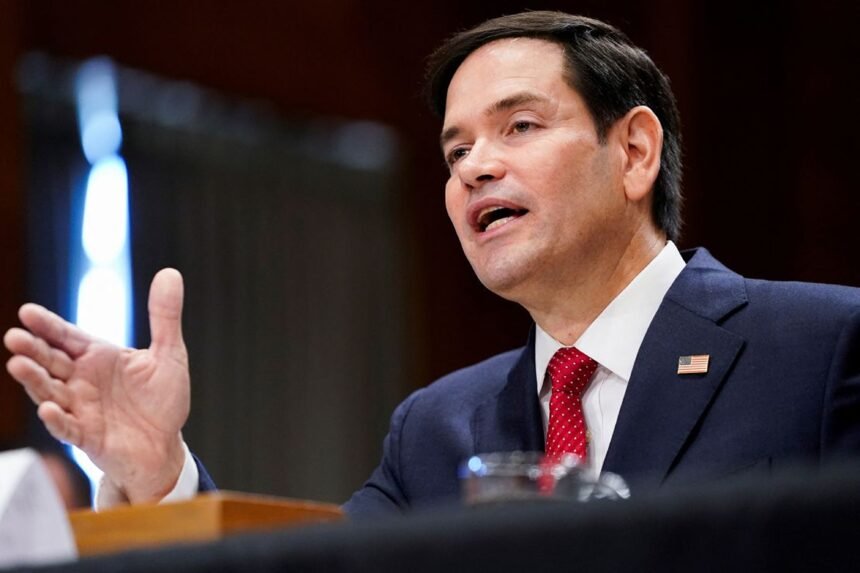
U.S. Secretary of State Marco Rubio has revealed that Washington is leaning on Beijing to help resolve the ongoing military and economic deadlock in the Strait of Hormuz.
The statements were made to Fox News aboard Air Force One as the American delegation, led by President Donald Trump, arrived in Beijing for a high-stakes summit with Chinese President Xi Jinping. Rubio, who also serves as a National Security Advisor, argued that China’s influence over Tehran makes it a critical player in de-escalating the crisis.
China’s Strategic Leverage
Rubio highlighted that China, as the world’s second-largest economy, has a vested interest in reopening the world’s most vital oil chokepoint:
- Stranded Assets: Numerous Chinese vessels are currently trapped in the Persian Gulf due to the conflict.
- Economic Blowback: As an export-oriented economy, China is suffering from decreased global demand caused by the regional war’s economic shockwaves.
- Energy Dependence: Beijing remains the largest importer of Iranian crude oil and one of Tehran’s few remaining top-tier strategic partners.
“We hope to convince them to play a more active role in stopping what Iran is doing and trying to do in the Persian Gulf,” Rubio stated.
Internal U.S. Contradictions?
Despite Rubio’s push for diplomatic collaboration, President Trump appeared to offer a different perspective. When asked about Chinese intervention, the President remarked, “I don’t think we need help” from China to end the crisis, which began following the outbreak of the U.S.-Israel war against the Islamic Republic on February 28, 2026.
The conflict has left the Strait of Hormuz virtually paralyzed. While indirect talks mediated by Pakistan have reportedly hit a stalemate, the U.S. military has maintained a strict blockade of Iranian ports in retaliation for regional attacks.
The Stakes of the Summit
The Beijing summit is seen as a pivotal moment for global stability. While Trump maintains a “maximum pressure” military stance, Rubio’s comments suggest that the administration recognizes China as the only power capable of bringing Iran back to the negotiating table.
With global energy prices soaring and supply chains fractured, the world is watching to see if Xi Jinping will use his leverage over Tehran to break the maritime siege or if the Strait will remain a frontline in the expanding global conflict.