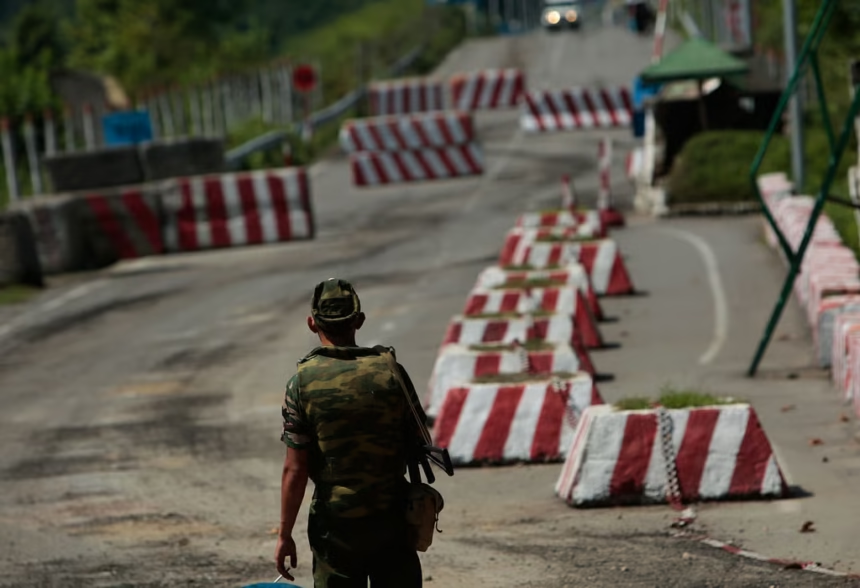
A surge in traffic along Russia’s southern border with Georgia is fueling fears that the Kremlin could be preparing for another military mobilization, as Russian authorities intensify recruitment efforts and expand measures targeting military reservists.
More than 113,000 Russians crossed the Upper Lars checkpoint into Georgia last week, according to Russian state media, in a sharp increase that has drawn comparisons with the exodus that followed President Vladimir Putin’s announcement of a partial mobilization in September 2022.
Human rights groups assisting Russian conscripts and military-age men say they have recently seen an increase in requests for legal assistance, particularly from reservists.
Alexey Tabalov, founder of the human rights organization School of the Conscript, said Russian authorities have stepped up efforts to collect personal information on reservists, including through their employers.
“They even inquire about the addresses of their relatives,” Tabalov said, arguing that such information could be used to locate people who might attempt to evade a future mobilization.
The concerns were reinforced earlier this month when Ukrainian President Volodymyr Zelenskyy said Ukrainian intelligence expected Russia to launch a “rapid mobilization” involving several hundred thousand men by the end of the year.
Kremlin denies plans for mass mobilization
Despite the growing speculation, the Kremlin has repeatedly denied that a new mass mobilization is being planned.
Russia’s U.N. Ambassador Vasily Nebenzya said last week that Moscow does not currently need mass mobilization and that, to his knowledge, no such operation was planned or expected.
Kremlin spokesman Dmitry Peskov has similarly dismissed reports of an impending mobilization, accusing Ukrainian authorities of spreading the claims.
The Russian government has nevertheless introduced a series of measures that critics say could make any future mobilization faster and more difficult to evade.
Digital summonses tighten control
In March, Russia made electronic military summonses mandatory for the conscription process.
Unlike the paper summonses used during the 2022 mobilization, digital summonses take effect once they are issued electronically and can trigger restrictions on leaving the country.
Russian authorities introduced digital summonses nationally on a non-mandatory basis in 2025. The system has since been expanded, allowing military authorities to notify border services and impose travel restrictions on individuals subject to call-up.
Tabalov said the system reflected lessons learned from the chaotic mobilization of 2022, when large numbers of Russians left the country before authorities could effectively enforce restrictions.
The government has also increased its focus on military reservists. According to Tabalov, employers have been asked to provide authorities with personal information about reservists, who may subsequently be assigned to specific military units in preparation for a potential call-up.
National Guard prepares for mobilization
Russian authorities have also taken steps involving the National Guard, or Rosgvardiya.
Russian media reported in July that the force was preparing personnel and facilities for potential mobilization through training and evacuation measures.
A decree signed by National Guard Director Vladimir Zolotov expanded the force’s responsibilities to include protection against threats arising during periods of mobilization, martial law and wartime.
Ukrainian military analyst Oleksandr Kovalenko said the measures suggested that Moscow could be preparing for a more repressive form of mobilization involving Russia’s security agencies.
Recruitment efforts face growing resistance
At the same time, the Kremlin has sought to avoid a formal mobilization by expanding recruitment through military contracts.
In March, Russian media reported that the Defense Ministry aimed to recruit around 80,000 people, primarily students, for the newly established Unmanned Systems Forces.
The campaign involved military recruitment drives at universities and financial incentives for students to sign military contracts. But by July, only around 8,000 people had reportedly been recruited, roughly 10 percent of the stated target.
The failure has added to concerns over Russia’s ability to sustain its military manpower without resorting to another nationwide mobilization.
Authorities have also been accused of using coercive recruitment tactics. Videos circulated online in June appeared to show police and military personnel stopping men in Penza and taking some of them to military enlistment offices, where they were allegedly pressured or forced to sign contracts.
Local authorities have denied involvement in any alleged abductions or forced recruitment.
Human rights advocates say the recruitment campaign reflects increasing pressure on regional authorities to meet military staffing quotas without formally declaring mobilization.
Georgia remembers the 2022 exodus
The latest increase in border traffic has particular significance in Georgia, which became a major destination for Russians fleeing the 2022 mobilization.
More than 100,000 Russians entered Georgia within a week after Putin announced the call-up of approximately 300,000 reservists.
Georgia remains one of the few countries in the region where Russian citizens can enter without a visa, making the Upper Lars crossing a key escape route.
The current surge does not prove that Moscow is preparing to announce another mobilization. But the combination of intensified recruitment, expanded surveillance of reservists, electronic summonses and preparations by security forces has heightened concerns among Russian military-age men.
With parliamentary elections scheduled for September, Putin also has political reasons to avoid a formal mobilization in the immediate future.
Yet human rights activists argue that the Kremlin’s recruitment difficulties could eventually leave mobilization as one of the few remaining options for sustaining Russia’s war effort.
“I think destroying Ukraine is Putin’s obsession, and this fixed idea requires manpower,” Tabalov said. “The only resource left — given the failure of other attempts — is mobilization.”
The Kremlin, Russia’s Defense Ministry and the National Guard did not respond to POLITICO’s requests for comment.