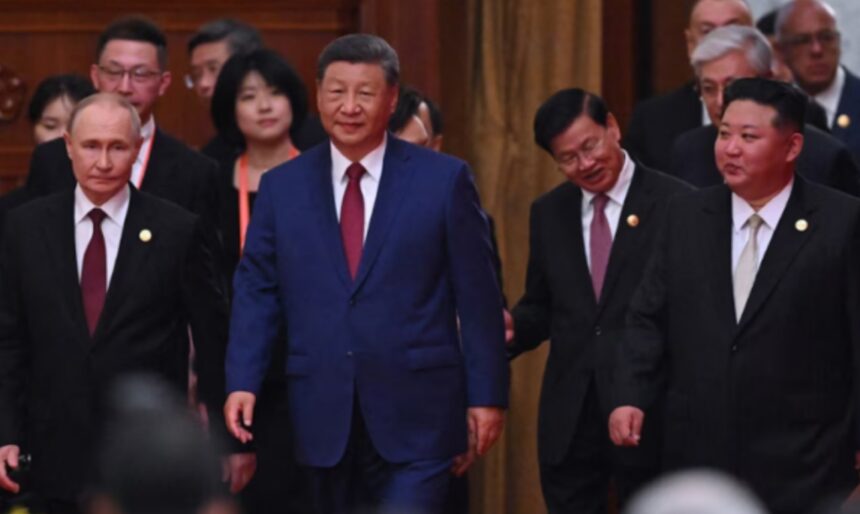
Russia’s deepening partnership with China, Iran, and North Korea creating what some describe as an “axis of upheaval” represents one of the most significant geopolitical realignments driven by the war in Ukraine.
However, according to Andrea Kendall-Taylor, senior fellow and director of the Transatlantic Security Program at the Center for a New American Security (CNAS), viewing this grouping through the lens of a traditional military alliance means missing the bigger picture.
In an interview with Radio Free Europe, she explains what Moscow gains from this network, which is designed to weaken American influence, undermine Western sanctions, and secure Russia’s position in an increasingly multipolar world.
Radio Free Europe: In practical terms, what makes this network so dangerous for Western security?
Andrea Kendall-Taylor:
The way I summarize the impact of this “axis of upheaval” is that these partnerships strengthen the military capabilities of all the adversaries of the United States and its allies, while simultaneously weakening the effectiveness of foreign policy tools, such as sanctions, which we rely on to confront them.
Through their cooperation, these states are becoming more militarily capable, while our sanctions and other forms of pressure are becoming increasingly less effective.
Radio Free Europe: What does Vladimir Putin gain from these partnerships that Russia could not achieve alone?

Andrea Kendall-Taylor:
The benefits have become much more visible during the war in Ukraine, which has served as a powerful catalyst for deepening these relationships.
China, Iran, and North Korea have enabled Russia to continue the war in ways that simply would not have been possible without their support.
North Korea has supplied Russia with large quantities of ammunition. Although much of it was reportedly of poor quality, the sheer volume has been decisive at critical moments. We also know that North Korea has deployed troops to Russia’s Kursk region and elsewhere, providing Moscow with another important form of support.
In the early stages of the war, Iran supplied Russia with drones and other ammunition. Since then, Russia has begun producing many of these weapons itself and has improved the technology, but Iran’s initial support represented a significant battlefield advantage.
China has been the most important partner overall. It has helped Russia evade sanctions and Western export controls by providing access to semiconductors, components, and other critical technologies necessary to sustain Russia’s defense industry. Equally important, China has continued purchasing large quantities of Russian oil, providing vital revenue for the Russian economy and helping finance the war.
Even after the war in Ukraine ends, I believe Russia will continue valuing these relationships because its confrontation with the West — especially with the United States — will not disappear. The Kremlin believes it is less isolated and less vulnerable when acting alongside partners that share similar views, placing Russia in a stronger position for long-term strategic competition.
Radio Free Europe: If these partnerships are driven more by opportunity than ideology, what keeps them together? And what could divide them in the future?
Andrea Kendall-Taylor:
The simplest answer is their shared opposition to the United States and American power.
All four countries believe that the current international system does not give them the influence and status they believe they deserve. By acting together, they can challenge this system more effectively.
China, for example, benefits from instability that distracts the West. Iran benefits by drawing American military resources into the Middle East. Together, they understand that coordinated pressure can overwhelm the United States.
In the coming years, I find it difficult to identify factors that could separate them. These governments increasingly view today’s international environment as one where power determines outcomes and weaker states remain vulnerable. This perception strengthens their desire for cooperation.
Their partnerships help each country remain influential and place them in a stronger position to compete with the United States, which they believe is increasingly losing its allies. Together, they are stronger.
An Alliance Without a Treaty
Radio Free Europe: Since this grouping operates as a flexible coalition rather than a traditional treaty-based alliance, does this ambiguity make it harder for the United States and its partners to respond?
Andrea Kendall-Taylor:
Yes. There has been significant debate in Washington and among allied governments about how these relationships should be characterized.
Some question how deep and sustainable these partnerships truly are. Others worry that describing them as an emerging bloc could become a self-fulfilling prophecy, pushing these countries even closer together.
Precisely because this is not a formal alliance but rather a collection of flexible and pragmatic partnerships, it becomes more difficult for the United States and its allies to first agree on the nature of the threat and then develop an effective political response.
Without a shared understanding of the challenge, building a coherent strategy becomes much more difficult.
Radio Free Europe: The war in Ukraine has made Russia increasingly dependent on its partners. What is Moscow offering in return?
Andrea Kendall-Taylor:
This is one of the key questions. Much attention has focused on what Russia receives, but it is equally important to understand what Russia provides in exchange.
Russia is significantly strengthening the military capabilities of each of its partners.
Its relationship with North Korea has probably changed the most during the war. The two countries now have a mutual defense agreement, and although much of their cooperation remains secret, we know North Korea seeks assistance with satellite technology, improving missile accuracy and range, submarine capabilities, and other advanced military systems. Russia has expertise in many of these areas.
China’s case is somewhat different because its military modernization has reduced the number of areas where Russia can contribute. However, technologies related to nuclear-powered submarines — especially those that reduce their acoustic signature — remain highly important. Such capabilities would have direct consequences in the event of a crisis involving Taiwan.
Russia is also sharing operational lessons learned from the war in Ukraine. This experience is especially valuable because the Chinese military lacks recent experience in large-scale warfare. Joint exercises and battlefield lessons help Beijing address one of the major weaknesses in its military capabilities.
Regarding Iran, cooperation is developing in real time. Reports indicate that Russia has provided intelligence support and transferred updated drone technologies developed from battlefield experience in Ukraine. These improvements are strengthening Iran’s military capabilities now, not in some hypothetical future scenario.
Radio Free Europe: Despite providing military technology and political support, Moscow has repeatedly avoided direct involvement when partners such as Iran face security crises. Why?
Andrea Kendall-Taylor:
Iran illustrates perfectly how this axis operates.
The cooperation is real and increasingly significant, but it is always limited by each country’s priorities, willingness to accept risks, and desire to avoid direct confrontation with the United States.
For Russia, the war in Ukraine remains the top priority. Putin’s willingness to take risks is almost entirely focused on this conflict. He is reluctant to take actions elsewhere that could escalate tensions with Washington or damage Russia’s main military effort.
This restraint could change after the war ends. As Russia rebuilds its military forces and regains confidence, it may become willing to offer its partners significantly greater support.
At the same time, none of these governments wants a direct war with the United States. Their objective is to preserve friendly regimes and increase the costs faced by Washington in different regions.
From Russia’s perspective, a prolonged conflict involving Iran serves Moscow’s interests because it commits American military resources, consumes U.S. air-defense capabilities, and diverts attention away from Ukraine.
Radio Free Europe: From Moscow’s perspective, does China remain Russia’s irreplaceable partner, or have Iran and North Korea become equally important long-term partners?
Andrea Kendall-Taylor:
China remains, without question, Russia’s most important partner.
Putin does not have a closer relationship with any other leader than he does with Xi Jinping. We have often heard the phrase “a partnership without limits,” and although there are certainly limitations, the relationship remains extremely important.
Russia has become highly dependent on China economically. Many observers believed Putin would resist becoming the weaker partner in such an unequal relationship. But because he views the war in Ukraine — and the broader confrontation with the United States — as existential, he has been willing to accept this growing dependence.
Ultimately, Putin is an opportunist. I believe he thinks that after the current crisis passes, Russia may recover some of the influence and bargaining power it has lost since the beginning of the war.
Radio Free Europe: Some analysts argue this grouping is simply a partnership created by circumstances rather than a lasting geopolitical realignment. What is your view?
Andrea Kendall-Taylor:
I believe these are lasting partnerships.
International relationships strengthen through continued cooperation. Shared experiences build trust and create institutions and traditions of cooperation that can endure.
Russia and Iran fought together in Syria. Then Iran supported Russia during the war in Ukraine. Now Russia is helping Iran.
Although there are real limitations and significant mistrust, these repeated interactions are laying the foundation for a more durable relationship.
Iran is probably the partner Russia could replace most easily. China is completely different.
The relationship between Russia and China dates back decades before the war in Ukraine. It has steadily deepened since the final years of the Cold War.
Economic ties continue expanding, while cooperation increasingly extends beyond top leaders to lower levels of government and society. The longer these connections continue, the stronger the foundation becomes for a partnership that could last many years.
Radio Free Europe: Is there a major point of disagreement between Moscow and Beijing that Western policymakers should try to exploit?
Andrea Kendall-Taylor:
The asymmetry in their relationship remains the most important issue from Russia’s perspective.
The fact that Russia is becoming increasingly dependent on China — and risks becoming the weaker partner — is a source of concern in Moscow.
Highlighting this growing dependence could reinforce concerns that already exist within Russia’s elite.
However, exploiting these tensions is difficult. Policymakers should continue looking for opportunities, but they must also understand the limits of what external actors can achieve.
Radio Free Europe: If the defining feature of this axis is flexibility rather than formal commitments, does this require a different policy approach from Washington?
Andrea Kendall-Taylor:
Yes.
I would spend less time trying to create divisions among these countries.
Russia and China have disagreements over the Arctic, Central Asia, India, and other issues. There are genuine tensions in their relationship. But what we have seen is that their shared determination to challenge the United States consistently outweighs these differences.
They keep disagreements separate because maintaining the partnership is more important than resolving every dispute.
The United States has relatively little ability to exploit these divisions.
Instead, Washington should operate around this axis rather than confront it directly. This means strengthening relations with important countries that are not clearly aligned, such as Turkey, Brazil, Vietnam, and South Africa; limiting the axis’s access to technology; preventing the expansion of its military presence; and reducing its influence beyond its current members.
Ultimately, the goal should be containing this network, not assuming it can be dismantled.
Radio Free Europe: Is the U.S. military prepared to contain an axis capable of creating crises simultaneously in Europe, the Middle East, and the Indo-Pacific?
Andrea Kendall-Taylor:
This question has two parts.
First, as the United States distances itself from its allies, it weakens one of its greatest strategic advantages. While the “axis of upheaval” deepens cooperation, Washington risks undermining its own alliance network, which remains one of America’s greatest strengths.
Second, from a military perspective, encouraging Europe to take greater responsibility for its own defense is the right approach.
The United States is not structured to fight major conflicts simultaneously in Europe and the Indo-Pacific.
If Europe builds a stronger conventional deterrence capability against Russia, it would allow the United States to dedicate more resources to the Indo-Pacific in the event of a crisis there.
This would place Washington in a much stronger position to manage the multiple challenges increasingly presented by this axis.
Radio Free Europe: Looking beyond the current conflict in Ukraine, what indicators should observers watch in the coming years to determine whether this network will maintain its momentum?
Andrea Kendall-Taylor:
Leadership is one of the most important factors.
There are no obvious signs that Vladimir Putin faces a challenge to his power, but both Putin and Xi Jinping have been the main architects of the Russia-China relationship.
Their close personal relationship has driven much of the cooperation from the highest political level.
If a leadership transition were to occur in Russia in the future, it would be important to observe how a new leader approaches China.
Any future Russian government would value stable relations with Beijing — the two countries share a long border and have strong strategic reasons to maintain cooperation — but a different leader could change the tone, depth, or direction of the partnership.
Another important indicator is whether this axis expands.
I would watch whether other countries — such as Belarus, Cuba, Venezuela, or others — become more closely integrated into this network.
If this axis manages to expand its membership or influence, it would represent a significant development and an important indicator of its long-term trajectory.