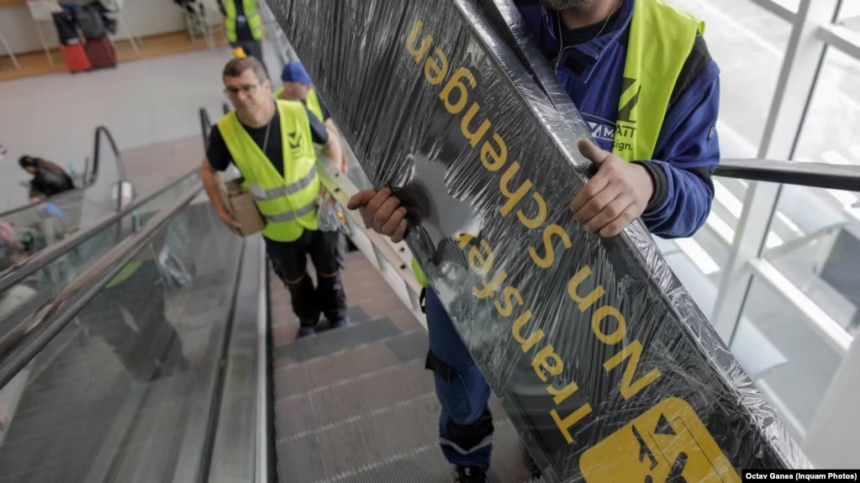
Serbia says it aims to be ready to join the Schengen area by the end of 2027, but officials have made clear that introducing visas for Russian citizens — a key requirement for aligning the country’s visa policy with the European Union — is not currently a priority.
The government’s position highlights the tension between Belgrade’s stated ambitions for closer integration with the EU and its continued refusal to align fully with Brussels on visa policy and other sensitive foreign-policy issues.
Veljko Odalović, head of Serbia’s newly established Coordination Body for joining the Schengen area, told Radio Free Europe that Belgrade was gradually working toward harmonizing its visa regime with EU rules.
“This is not currently a priority, nor is it an activity that we are putting first. We are gradually moving toward harmonization,” Odalović said.
He acknowledged that aligning Serbia’s visa policy with the EU would eventually require changes involving several countries, including Russia.
Montenegro, which has significantly advanced its EU accession process, is preparing to introduce visas for citizens of Russia, Turkey, China, Belarus and Saudi Arabia from November as part of its efforts to align its visa regime with Brussels.
Serbian officials, however, have signaled that Belgrade is not prepared to take the same step at this stage.
Serbia has not opened an EU negotiating chapter since 2021
Serbia’s Schengen ambitions come as its broader EU accession process remains largely stalled. Belgrade has not opened a new negotiating chapter since 2021, while the European Parliament has repeatedly raised concerns about the country’s democratic standards, rule of law and alignment with the EU’s common foreign and security policy.
Vladimir Međak, vice-president of the European Movement in Serbia, told Radio Free Europe that the goal of being ready for Schengen by the end of 2027 appeared unrealistic.
He argued that Serbia would first have to align its visa policy with the EU and address broader political and institutional concerns.
“As long as visas for Russia are not introduced, this simply cannot be taken seriously, and Serbia has been rejecting this for years,” Međak said.
Russian citizens currently enjoy visa-free entry to Serbia for stays of up to 30 days. Their presence in the country has also increased significantly since Russia launched its full-scale invasion of Ukraine in 2022. According to Serbian Interior Ministry data, Russian citizens accounted for around 62,000 foreigners with approved residence in Serbia at the end of 2025.
Međak said that even introducing visas for Russian citizens would not, by itself, provide Serbia with the level of political trust required for Schengen membership.
Schengen requires more than technical preparation
The Schengen area allows passport-free travel across participating countries and covers more than 450 million people. Alongside 25 EU member states, it also includes Iceland, Liechtenstein, Norway and Switzerland.
Serbia currently enjoys visa-free travel to the EU for short stays of up to 90 days within any 180-day period. Serbian citizens have been able to travel visa-free to EU countries since 2009.
The government says it wants to complete its action plan for Schengen accession by the end of 2027.
European Integration Minister Nemanja Starović previously said Serbia wanted to fully implement its action plan so that it would be “ready to join the Schengen area.”
Odalović acknowledged that the process would require extensive alignment with EU rules.
“We certainly will not be part of the Schengen area until we meet their standards,” he said, adding that Serbia wanted to demonstrate its commitment both to EU accession and eventual participation in Schengen.
EU membership and Schengen are closely linked
The European Commission has previously stated that candidate countries can join the Schengen area as part of the EU accession process, while exceptional arrangements can also be established through agreements with the EU and existing Schengen-associated states.
Full implementation of Schengen rules, including the removal of internal border controls, ultimately requires a unanimous decision by the Council after the necessary technical conditions have been verified.
The European Commission has repeatedly urged Serbia to align its visa policy with EU rules, citing concerns including irregular migration and the misuse of visa-free regimes.
For Serbia, however, the issue has a significant geopolitical dimension because Belgrade continues to maintain close relations with Moscow and has refused to join EU sanctions against Russia over the war in Ukraine.
Political trust could be the bigger obstacle
Međak argued that meeting technical requirements would not be enough for Serbia to enter Schengen.
Participation in the border-free area requires a high degree of trust among member states in one another’s judicial, police and security institutions, he said.
“Joining Schengen means joint security control,” Međak said, arguing that EU member states would have to trust Serbia with part of the security of their external borders.
He questioned whether Serbia currently has the institutional credibility required for such an arrangement, pointing to the lack of progress in its EU accession negotiations.
According to Međak, Serbia’s political leadership has also demonstrated closer alignment with Russia, Belarus and other non-EU partners on issues including the rule of law, human rights and media freedom.
He described the government’s Schengen plans as potentially creating an “illusion of a vision” for Serbia’s European future while the country remains unable to make substantial progress toward EU membership.
The EU’s concerns were underscored again in July, when the European Parliament adopted a resolution criticizing what it described as backsliding in Serbia in areas including the rule of law, democracy and alignment with the EU’s foreign and security policy.
At the same time, EU member states failed to reach consensus on opening Cluster 3 in Serbia’s accession negotiations, despite support from the European Commission.
Serbia’s ambition to be technically ready for Schengen by the end of 2027 therefore faces a broader political challenge: aligning its visa policy and security standards with the EU while convincing member states that Belgrade can be trusted to uphold the bloc’s common rules and security interests.