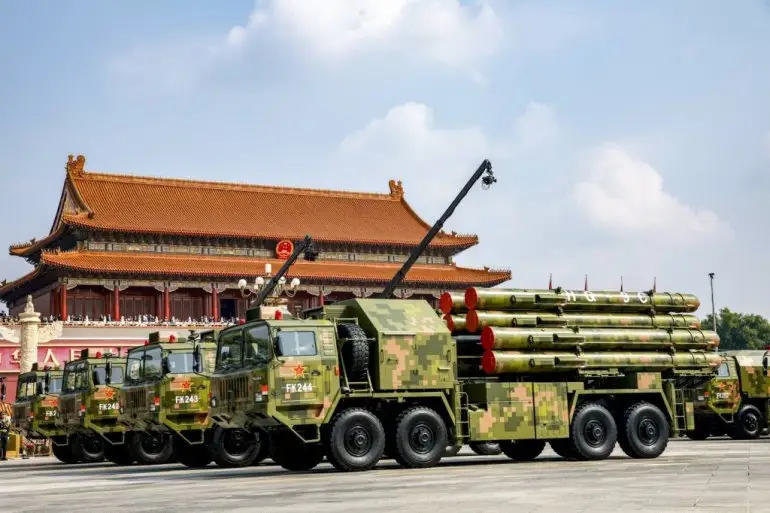
Serbian President Aleksandar Vučić announced that Serbia will acquire the Chinese HQ-9 long-range surface-to-air missile (SAM) system. The announcement was made during a military display of new and modernized equipment at the Batajnica military airfield.
Western military analysts classify the HQ-9 as China’s counterpart to the Russian S-300 system, with some modern performance indicators rivaling the capabilities of the S-400.
Vučić Confirms Expansion of Chinese Defense Synergy
The procurement marks a significant deepening of Belgrade’s defense reliance on Beijing. During the inspection, Vučić explicitly confirmed the next steps for Serbia’s multi-layered umbrella:
Aleksandar Vučić: “I have personally inspected our HQ-17, the HQ-9, and the HQ-22 in China. We are now purchasing the HQ-9, and likely additional equipment alongside it.”
According to an assessment by the specialized US-based portal Military Watch, the integration of the HQ-9 will grant the Serbian Armed Forces the longest-range and, in many aspects, the most capable ground-based air defense network on the European continent.
The choice follows Belgrade’s pivot away from initial plans to buy Russian S-300 or S-400 systems, opting instead to build upon the Chinese mid-range HQ-22 system which Serbia successfully operationalized in 2022.
Technical Performance Compared to Western Counterparts
Defense analysts point out that the HQ-9 holds distinct operational advantages over considerably more expensive NATO-standard alternatives:
- Extended Range: The HQ-9 stands out with an operational engagement range reaching up to 300 kilometers. By comparison, the American MIM-104 Patriot maxes out at approximately 200 kilometers, while the French SAMP/T NG features a range of 150 kilometers.
- Mobility: The Chinese system boasts higher tactical road mobility and shorter deployment times than legacy Western systems.
- The European Context: The only system potentially outranging the HQ-9 in Europe would be Belarus’s S-400 networks (if equipped with 400km-range 40N6 missiles). However, because the delivery of those highly specialized Russian missiles remains unconfirmed, Serbia’s upcoming acquisition likely secures the highest confirmed SAM reach in Europe.
Long-Range Air Defense Comparison (June 2026 Procurement Data)
========================================================================
System Type        --> HQ-9 (China)      | MIM-104 Patriot (US) | SAMP/T NG (France)
Max Engagement Range--> 300 Kilometers   | 200 Kilometers       | 150 Kilometers
Industrial Delivery--> Ultra-Fast Track  | Severe Backlogs      | Moderate Wait
========================================================================
Strategic Multipliers: Denying the Skies
A dominant asset of extreme-range interceptors is their capacity to establish vast Anti-Access/Area Denial (A2/AD) bubbles. Rather than acting as localized point-defense for single installations, a 300km umbrella protects multiple civilian and military nodes simultaneously.
Furthermore, this immense reach functions as a force multiplier by targeting high-value airborne assets. High-altitude early warning planes (AWACS) and aerial refueling tankers are forced to operate hundreds of kilometers further back from the front lines. This severely limits the radar tracking efficiency, situational awareness, and flight endurance of any opposing fighter jets attempting a penetration.
US Interceptor Shortages Accelerate Chinese Market Appeal
A major factor shifting European interest toward Chinese defense manufacturers is Beijing’s immense industrial capacity to rapidly deliver complex systems, contrasted against chronic Western backlogs.
The Military Watch report highlights critical supply chain deficits currently plaguing the US Patriot network due to intense Middle Eastern conflicts:
- In July 2025, following a 12-day kinetic clash with Iranian forces, the Pentagon confirmed US global Patriot interceptor stockpiles had plummeted to just 25% of mandated baseline reserves.
- By March 5, 2026, Western intelligence updates confirmed the US military expended over 800 additional Patriot interceptor missiles in a brief 5-day span of renewed hostilities with Iran, with subsequent weeks of conflict further exhausting Western stockpiles.
Faced with these multi-year manufacturing queues for Patriot systems, several European nations have been forced to compromise; Denmark, for instance, opted for the less-capable French SAMP/T NG simply due to immediate availability. For Belgrade, China’s unhindered industrial supply chain offers a rapid track to regional military dominance without the geopolitical and logistical bottlenecks currently straining Western defense sectors.