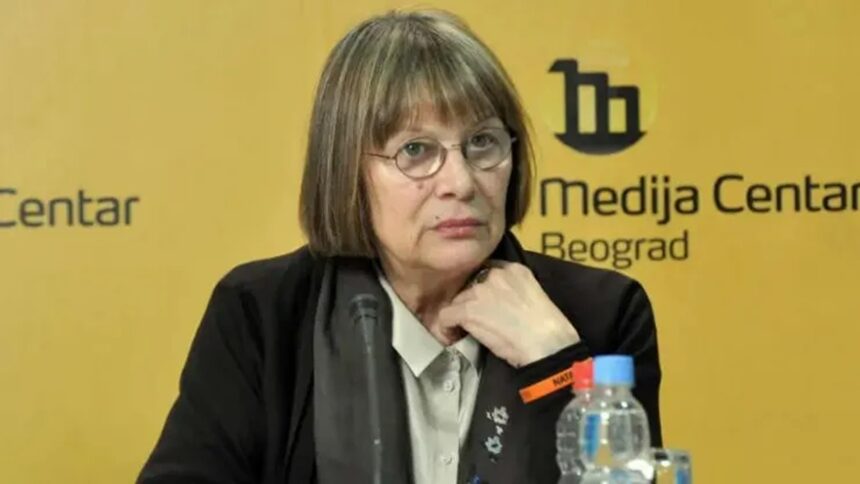
Prominent human rights defender Nataša Kandić, the founder of the Humanitarian Law Center (HLC), has publicly raised serious concerns regarding a potential, unexcavated mass grave within the restricted military perimeter of Pasuljanske Livade in Central Serbia.
In a statement published on her official social media account on X, Kandić revealed that she had previously brought concrete intelligence about hidden wartime casualties to the highest echelons of the Serbian government nearly two decades ago, but faced institutional silence.
The 2008 Shutanovac Meeting Exposed
Kandić disclosed that the potential existence of a clandestine grave at Pasuljanske Livade—one of the largest and most active training grounds of the Serbian Armed Forces—was the core agenda of a private high-level meeting she held in 2008 with Serbia’s then-Minister of Defense, Dragan Šutanovac.
During that encounter, Kandić briefed the Defense Ministry on a sensitive witness testimony obtained by human rights researchers:
- The Informant: A man came forward claiming to have operated as a driver of a refrigerated truck (hladnjača) used systematically by state forces during the 1998–1999 war to transport bodies of slain Kosovo Albanians north into Central Serbia.
- The Route: The driver explicitly stated that his cargo of civilian casualties was transferred directly from Kosovo and buried inside the secured Pasuljanske Livade military base.
- The Breakdown: The informant requested financial compensation in exchange for revealing the precise geographic coordinates of the burial site. Before a secure arrangement could be finalized, he permanently broke off contact.
Nataša Kandić: “A possible mass grave at Pasuljanske Livade was the subject of my meeting with Serbian Defense Minister Dragan Šutanovac in 2008. I informed him that I had spoken to a person claiming to be the driver of a refrigerator truck used to transport bodies from Kosovo to the military base. He demanded money for further details and never called back. I immediately informed Minister Šutanovac. He never responded or followed up either.”
Context: The Grim Legacy of Clandestine Burials
The strategy of utilizing refrigerated trucks to relocate victims of ethnic cleansing from Kosovo to hidden locations inside Serbia proper was a state-sponsored operations program designed by the Slobodan Milošević regime to destroy evidence of war crimes.
Over the past two decades, approximately 1,000 sets of human remains belonging to Kosovo Albanians have been exhumed from several mass graves discovered across Serbia, including sites in Batajnica, Perućac, Rudnica, and Kizaževak.
          [1998-1999 Kosovo War Casualties]
                         │
                         ▼
   [State-Sponsored Cover-Up Operation]
(Bodies loaded into refrigerated trucks & driven north)
                         │
      ┌──────────────────┴──────────────────┐
      ▼                                     ▼
[Documented Sites Exhumed]          [Suspected Restricted Sites]
• Batajnica Police Base             • Pasuljanske Livade Military Base
• Perućac Lake                      (Flagged by HLC in 2008; currently
• Rudnica & Kiževak Quarries         subject of renewed public scrutiny)
The Ongoing Search for the Missing
The war in Kosovo resulted in the deaths of over 13,000 people and left roughly 6,000 missing. While continuous joint excavations have brought closure to many families, the process has slowed significantly in recent years due to geopolitical gridlock and restricted access to state military archives.
| Category / Metric | Documented Figures | Status & Context |
| Total Missing from Conflict | ~1,600 individuals | Still unaccounted for; the majority are ethnic Albanians. |
| Remains Repatriated | ~1,000 victims | Exhumed from multiple secret mass graves across Central Serbia. |
| Pasuljanske Livade Status | Unexcavated | Remains an active, high-security firing range for the Serbian military. |
Kandić’s decision to revive this information comes at a highly sensitive diplomatic juncture, as the issue of missing persons and the opening of military wartime archives remains a central, yet constantly stalled, pillar of the EU-mediated normalization dialogue between Kosovo and Serbia.