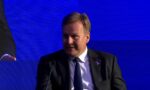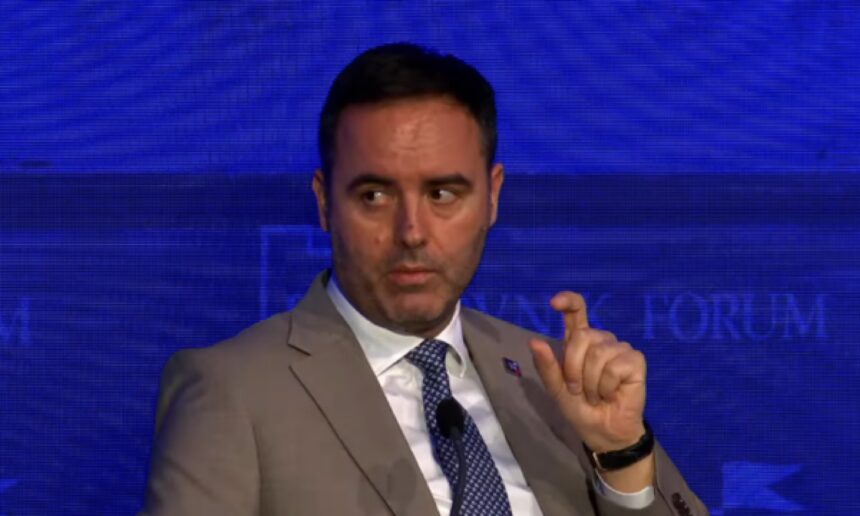
Kosovo’s Acting Minister of Foreign Affairs, Glauk Konjufca, responded to European Union Special Representative Peter Sorensen’s remarks that the Ohrid Agreement between Kosovo and Serbia remains valid and should be respected.
Asked to comment on Sorensen’s statement during a panel discussion at the Dubrovnik Forum on Saturday, Konjufca emphasized that the agreement was never signed.
“Regarding the dialogue with Serbia and the agreement, I believe we hoped we had reached an agreement. It is true that it was never signed. We were ready to sign it,” he said.
Konjufca added that acting Prime Minister Albin Kurti had “clearly expressed his willingness to sign the agreement.”
“However, I believe Serbia refused. At that very moment, the mediators were faced with the need to adapt to this new situation because I genuinely believe the agreement was not originally conceived in this form. Later, it was given the status of an agreement. It therefore became more of a gentlemen’s agreement. Nevertheless, it was still an agreement that contained commitments, even though it was not signed, as Mr. Sorensen explained,” Konjufca said.
Kosovo’s top diplomat stressed that his government was not satisfied with an unsigned agreement.
“We believed it should have been an international agreement that would establish clear and concrete obligations to be fulfilled. In the end, the mediators simply published it on the official website of the European External Action Service and said, ‘This is the agreement, and you must implement it,'” he stated.
Konjufca also noted that not all signed agreements are necessarily effective.
“Sometimes you have signed agreements that are worth nothing because both parties or one of them lack the political will to implement them. And sometimes you have agreements that are more like gentlemen’s agreements. Take, for example, the declaration between the European Union and Turkey, which was also not a formal contract but nevertheless worked, at least for a certain period,” he said.