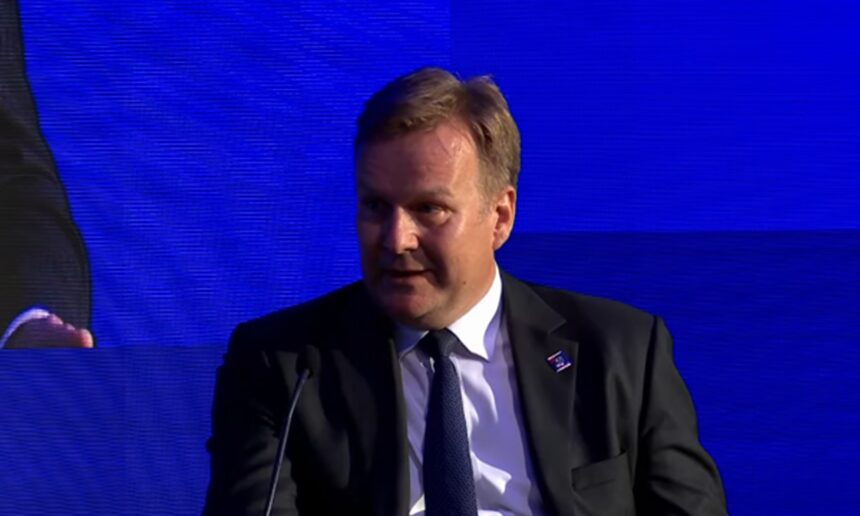
The European Union’s Special Representative for the Kosovo–Serbia Dialogue, Peter Sorensen, said during a discussion at the Dubrovnik Forum on Saturday that the Ohrid Agreement is an international commitment and “is not simply a treaty text.”
Sorensen said he had also consulted legal experts in Brussels and New York regarding the agreement’s legal status.
He emphasized that “there are clear obligations and commitments that must be fulfilled,” adding that the European Union expects the agreement to be implemented.
According to Sorensen, implementation has already begun in certain areas.
“The fact that it may not be exactly as some politicians have portrayed it is demonstrated by the fact that implementation has already started in certain areas, particularly regarding the issue of missing persons. However, there are also other provisions that remain unimplemented,” he said.
The EU envoy also referred to the jurisprudence of the International Court of Justice, stating that it is “very clear” regarding the validity of such agreements.
“You do not need a signature for an international agreement reached between parties to be legally valid. The only situation where this could raise questions is if there were only two parties in the room. But this dialogue involved three parties. We were present when the agreement was reached. We welcomed it at the moment it was concluded. And what has happened since then—as you mentioned when referring to Miroslav Lajčák—is that the Council has repeatedly referred to this agreement in its conclusions. Naturally, when I assumed this position, the very first thing I verified was the status of the agreement that had been reached,” Sorensen said.