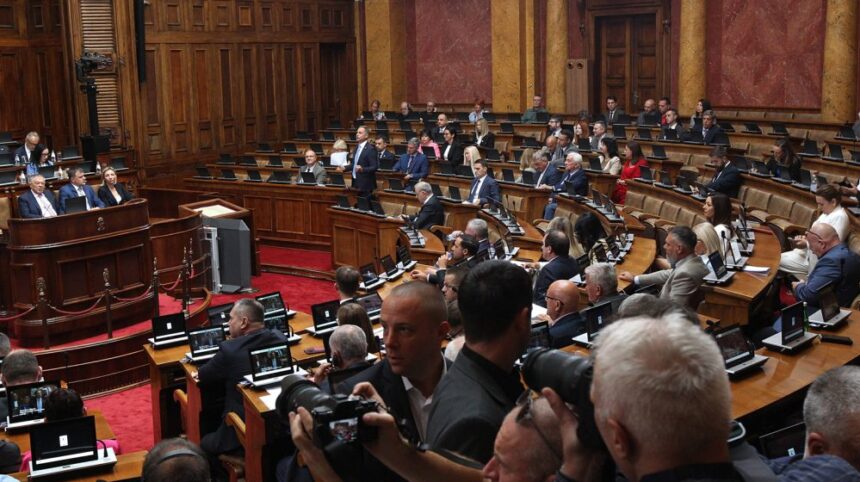
Serbia’s parliament has discussed the reported death of former Republika Srpska Army commander and convicted war criminal Ratko Mladić, exposing once again the deep political divisions in Serbia over his legacy and the country’s attitude toward the crimes committed during the Bosnian War.
Slobodan Ilić, a member of the Mi Snaga Naroda party led by Branimir Nestorović, announced Mladić’s death during a parliamentary session and expressed condolences to his family and former comrades.
Parliamentary session chair Marina Raguš said lawmakers had waited for confirmation from Mladić’s family before acknowledging the report, noting that false reports of his death had circulated in previous years.
Raguš also said that the Serbian state, particularly the Ministry of Justice, had made significant efforts to enable Mladić, who was suffering from a terminal illness, to be transferred to palliative care in Serbia.
She urged lawmakers to refrain from interruptions and heckling, calling for dignity because “a human life is at stake.”
The discussion also revived the controversy surrounding Mladić’s responsibility for some of the worst crimes of the Bosnian War. During the parliamentary debate, references were made to Mladić’s own public statements about the Srebrenica killings, including the stark declaration: “That is genocide.”
Mladić was convicted by the International Criminal Tribunal for the former Yugoslavia and later by the UN Mechanism for International Criminal Tribunals of genocide, crimes against humanity and war crimes. His convictions included responsibility for the Srebrenica genocide and the siege of Sarajevo.
SNS and the glorification of Mladić
The parliamentary debate also raises questions about the Serbian Progressive Party (SNS) and its longstanding attitude toward Mladić.
Critics of the SNS have argued that the party and its leading figures have never consistently treated Mladić as a convicted war criminal responsible for grave atrocities, but have instead allowed or participated in political rhetoric that glorified him and portrayed him as a Serbian hero.
Rather than confronting Mladić’s legacy and explicitly condemning the crimes for which he was convicted, nationalist narratives surrounding him have frequently been tolerated or politically exploited.
This distinction is particularly significant because President Aleksandar Vučić and the SNS have dominated Serbian politics for more than a decade and have repeatedly presented themselves as defenders of Serbia’s national interests.
The treatment of Mladić remains a sensitive test of whether Serbia’s political establishment is prepared to acknowledge the findings of international courts and confront the country’s role in the wars of the 1990s.
Mladić’s death therefore goes beyond the question of an individual’s passing. His legacy continues to expose the unresolved divide in Serbian society between those who regard him as a national hero and those who emphasize his responsibility for genocide and other war crimes.