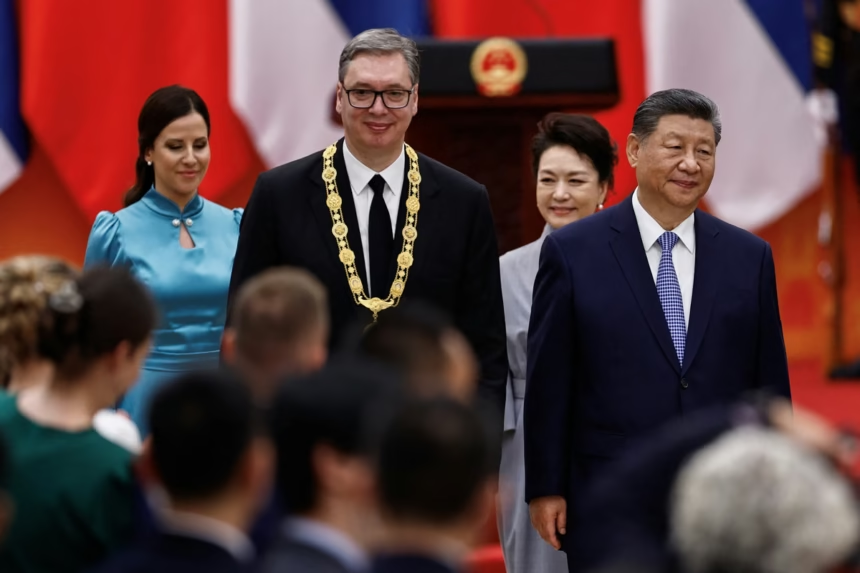
During an official bilateral state visit to Beijing, delegations from Serbia and China signed a sweeping package of framework agreements targeting high technology, research and development, media, and dual education. However, despite the Belgrade administration framing the trip as a historic triumph, international policy analysts warn that the deals offer no immediate credits or concrete investments, leaving their actual yields highly uncertain.
Stefan Vladislavljević, program director at the Belgrade Fund for Political Excellence, pointed out that Serbia’s foreign policy remains anchored in pure opportunism. Partners are strategically selected not by alignment, but by exactly how much financial, infrastructural, or political leverage they can provide at any given moment.
The Three Modern Pillars of the Sino-Serbian Accords
Departing from traditional loans and basic highway or railway infrastructure, the new agreements signed in May 2026 attempt to pivot the bilateral relationship into highly sophisticated, sensitive sectors:
[New Vectors of Serbia-China Alignment — May 2026]
   │
   ├─► Microchip Supply Chains ──► Integrating Serbia into legacy semiconductor networks
   ├─► Nuclear Tech Cooperation ──► Peaceful testing & geopolitical energy diversification
   └─► Vocational Dual Education ─► Training the local Serbian workforce for Chinese factories
1. Semiconductor Supply Chains: Why Beijing and Not Washington?
Following the closed-door signings, President Aleksandar Vučić announced that Serbia is intensely interested in embedding itself into global microchip manufacturing supply chains. Vladislavljević noted that due to Serbia’s current industrial limitations, this would realistically be limited to assembling or processing older, legacy-generation semiconductors.
However, the deals raise a critical geopolitical question: why is Belgrade negotiating on this highly sensitive technology in Beijing rather than in Washington, which dominates the sector? In modern diplomacy, access to microchips is treated by foreign ministries with the exact same strategic gravity as ammunitions and defense hardware.
2. Peaceful Nuclear Research and Testing
The accords formally initiate joint operations in nuclear research for peaceful purposes. This development comes as Belgrade aggressively scans the horizon for long-term electrical grid stability. According to geopolitical analysts, partnering with China on nuclear technology may also be a calculated move by Belgrade to create strategic distance from Russia, which has historically monopolized Serbia’s energy dependency.
3. Shaping Serbian Classrooms into Chinese Corporate Pipelines
The expansion of dual vocational education comes at a time when Serbia is battling a severe domestic labor deficit. Analysts warn that this clause essentially repurposes the Serbian public education system to train and tailor local workers specifically to staff Chinese-owned factories—mirroring the controversial structural educational reforms Serbia implemented in the past to satisfy arriving German industrial investors.
Geopolitics: China as Belgrade’s Most Stable Channel
The summit directly builds upon the 2024 signed pact establishing a “Shared Future,” which represents the absolute highest formal level of diplomatic relations a country can maintain with the People’s Republic of China.
Trapped in the crossfire of intensifying friction between global superpowers, Serbia is utilizing China to offset its compounding diplomatic risks:
- The United States: Washington is exhibiting significantly diminished interest in the Balkans, shifting its strategic gaze away from Europe as a whole.
- Russia: Belgrade has successfully distanced itself from Moscow just enough to placate immediate Western sanctions pressure without causing a total rupture.
- The European Union: Relations with Brussels remain structurally tense, volatile, and bogged down by accession conditionalities.
Under these geopolitical dynamics, Beijing has emerged as Belgrade’s most reliable and uninterrupted channel of political and financial communication. Given that Chinese enterprises already command a massive, systemic share of the Serbian economy—specifically dominating the heavy mining, automotive component, and metallurgical sectors—any sudden disruption to this pipeline would trigger an immediate, catastrophic economic crisis for any administration in power.