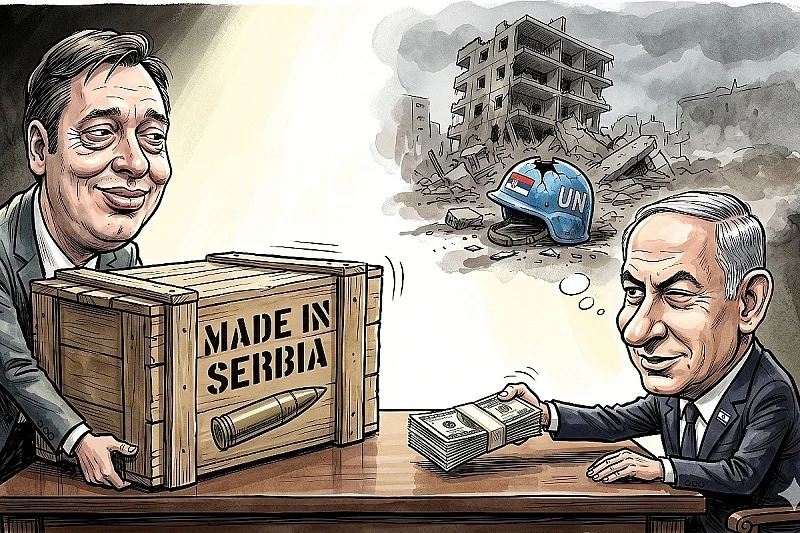
An analytical report by military analyst Dean Džebić details a glaring geopolitical paradox within Serbia’s defense policy: the lucrative black-box pipeline of srbijanski military exports to Israel vs. the direct operational safety of its own troops stationed in Lebanon.
The crisis peaked following the tragic death of Staff Sergeant Milovan Jovanović, a Serbian peacekeeper serving under the United Nations Blue Flag (UNIFIL), raising severe questions over Belgrade’s moral and strategic accountability.
1. The Tragedy at Marjayoun
On June 3, 2026, Staff Sergeant Milovan Jovanović (36) of Serbia’s 27th Mechanized Battalion was mortally wounded when a mortar shell targeted United Nations position 7-2 near Marjayoun, southeastern Lebanon. Two other international peacekeepers—one from El Salvador and one from Spain—were wounded in the exact same strike.
The Geopolitical Paradox Flow
[ Batajnica Airbase (Serbia) ] ──► (3,000 Tons of Ammunition / €200M+) ──► [ Nevatim Airbase (Israel) ]
                                                                                   │
                                                                                   ▼
[ UNIFIL Peacekeepers (Lebanon) ] ◄── (Mortar Shell Fire Over Litani River) ◄── [ High-Intensity Combat Zone ]
  ▲
  └─ 160 Serbian Troops Exposed in South Lebanon
- The Incident: Staff Sergeant Jovanović succumbed to critical injuries at an advanced university medical center in Beirut just days before his 37th birthday. It marked his first international peacekeeping deployment since arriving in the Levant in January.
- The Trajectory: An initial forensic intelligence assessment by UNIFIL indicated that the position was struck by indirect fire originating north of the Litani River. While the IDF and Hezbollah immediately deflected ownership, the systemic escalation highlights a broader issue: the risk of Serbian-manufactured ammunition actively saturating the battlefield where Serbian troops are deployed.
2. The Secret Batajnica-Nevatim Air Corridor
While official honor guards escorted the body of the fallen soldier back to Belgrade, investigative reports by the Israeli daily Haaretz and the Balkan Investigative Reporting Network (BIRN) pulled back the veil on a massive logistical operation.
| Strategic Metric | Disclosed Operational Data | Regional Significance |
| Export Surge | Classified defense exports from Belgrade to Tel Aviv spiked by 40% over the past three years. | Almost half of all economic trade between Serbia and Israel is now concentrated strictly in the military procurement sector. |
| Logistical Scale | An estimated 3,000 tons of heavy artillery and infantry ammunition have been cleared for transit. | Cargo is lifted by Israeli heavy transport aircraft directly from Batajnica Airbase near Belgrade to Israel’s high-security Nevatim Airbase. |
| Financial Valuation | Total ammunition contracts are valued well above €200 million. | This single-source pipeline roughly matches the entire combined defense export valuation of Bosnia and Herzegovina for a full fiscal year. |
3. The Blind Spot of Defensive Profit
Standard international arms protocols dictate that a country should halt defense sales to active combat zones if the exported weaponry could mathematically endanger its own state actors or civilian networks. Yet, Belgrade continues to play a dangerous double game, prioritizing defensive partnerships over troop safety.
“Everything runs on a transactional ledger. As long as dollars and high-tech defense hardware flow inward from Tel Aviv, Serbian munitions will fly out toward the Levant—even if they end up striking UN outposts south of the Litani River.”
The Bilateral Defense Tradeoff:
- Bespoke Drone Production: Israel’s defense giant Elbit Systems is moving forward with blueprint frameworks to establish advanced unmanned aerial vehicle (UAV) production facilities inside Serbia.
- Hardware Integration: The Armed Forces of Serbia have successfully integrated highly advanced Israeli assets, including the long-range Hermes 900 reconnaissance drones and the precise, modular PULS rocket artillery systems.
- Cyber Synergy: Collaborative frameworks between Serbian state institutions and Israeli cyber-intelligence agencies are growing increasingly tighter under absolute state secrecy.
The ultimate fallout of this defense calculus leaves 160 Serbian troops highly vulnerable within the volatile UNIFIL buffer zone, caught directly between the crossfire of geopolitical interests and the physical munitions their own homeland continues to manufacture and sell.