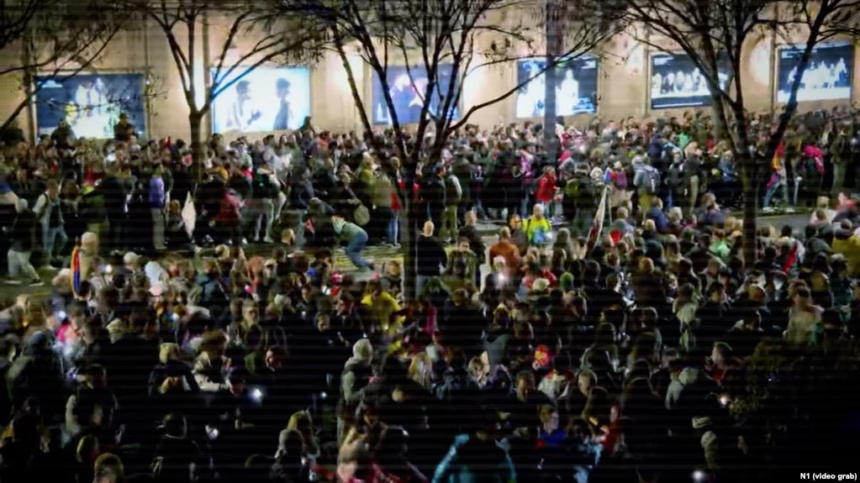
A dramatic shift in a high-profile investigation has ignited fresh tensions across Serbia. The Higher Public Prosecutor’s Office in Belgrade has launched a new probe into the March 15, 2025 “sonic cannon” incident, during which thousands of anti-government demonstrators panicked and fled due to unexplained high-frequency audio vibrations.
However, rather than investigating the source of the acoustic deployment, state prosecutors are now investigating whether the stampede was an elaborate, pre-planned “simulation” designed to destabilize the state. The legal pivot has triggered intense pushback from the student movement, independent analysts, and civil society groups who accuse the government of gaslighting victims.
Key Escalations in the Investigation
The opening days of the new prosecutorial push have seen sweeping law enforcement actions targeting those who publicly claimed acoustic weapons were deployed against civilians.
- Raid on Military Analyst: High-profile military analyst Aleksandar Radić, who was among the first to state that police utilized acoustic weapons on March 15, 2025, had his home and office heavily raided. His computers were seized, and he was brought in for interrogation under suspicion of “calling for the violent alteration of the constitutional order.”
- Military Intelligence Involvement: Radić and his legal team stated that the Military Security Agency (VBA) and the military police have engaged in obsessive surveillance and intimidation tactics regarding his expert opinions.
- Vučić Promises Broad Interrogations: Serbian President Aleksandar Vučić confirmed the expanding scope of the investigation during an interview with TV Informer, declaring that all individuals who claimed a “sonic cannon” was used will be summoned by state authorities to give formal statements.
The Geopolitical Angle: BIA and Russian FSB Cooperation
The domestic investigation has quickly taken on international dimensions, exposing sharp fractures between Serbia’s security apparatus and Western institutions.
The Joint BIA-FSB Report: President Vučić publicly expressed his gratitude to the Russian Federal Security Service (FSB) for collaborating with Serbia’s Security Intelligence Agency (BIA) to “confirm” that no sonic cannon was deployed. A BIA report claimed that acoustic devices were only tested on dogs at a training ground and categorically denied any use against citizens.
The involvement of Moscow has drawn fierce criticism from domestic watchdogs. Raša Nedeljkov, Program Director of the NGO Crta, described the reliance on Russian intelligence as a “slap in the face to EU partners,” pointing out that the BIA report contains zero methodology or scientific framework to back up its findings.
Global Pressure vs. Institutional Silence
While local authorities aggressively pursue the “simulation” theory, major international bodies have consistently pressured Belgrade for a legitimate, transparent investigation into the health hazards of acoustic crowd control.
| Organization / Entity | Official Stance & Actions Taken |
| European Court of Human Rights (ECHR) | Issued an interim measure in April 2025 warning that the use of sonic weapons for crowd control is unlawful and causes severe health damage. |
| United Nations (UN) Special Rapporteurs | Demanded formal information from the Serbian government regarding measures taken to ensure a swift, impartial, and independent investigation. |
| European Commission (EC) | Repeatedly called on Belgrade to provide a credible account of the acoustic anomalies experienced by thousands of citizens. |
| Independent Audio Lab “Earshot” | Conducted acoustic analyses confirming that demonstrators were “highly likely” subjected to a targeted attack using a directional acoustic weapon. |
Despite more than 170 civilian testimonies detailing physical trauma and mass panic during the event, civil society groups warn that the state’s sudden pivot from denial to aggressive prosecution of whistleblowers represents a dangerous tool of political intimidation.