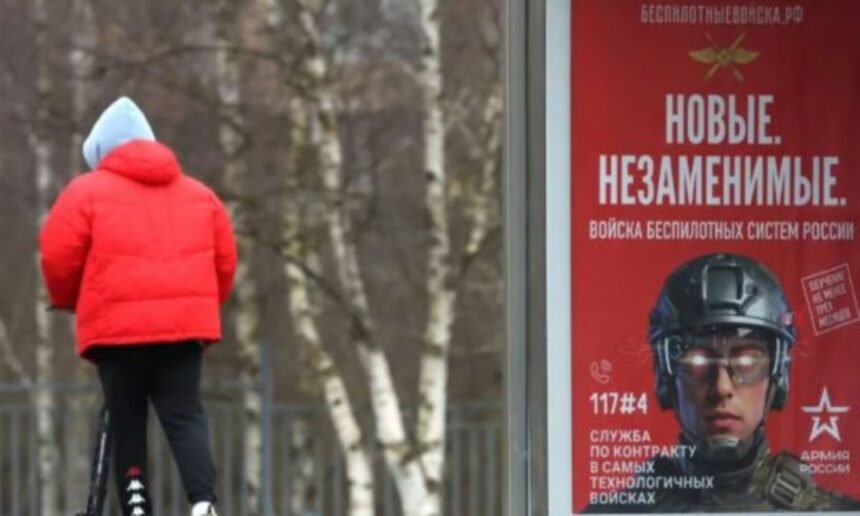
Despite aggressive Kremlin propaganda and skyrocketing state payouts, the Russian Federation’s voluntary military enlistment has hit its lowest marker in three years.
During the first three months of 2026, federal authorities paid sign-on bonuses to just 71,200 new contract soldiers—a distinct contraction that highlights growing domestic resistance to the ongoing war in Ukraine and exhaustion within the Russian labor pool.
Decoding the Kremlin’s Ledger: The Real Math Behind the Frontline
The decline was brought to light by German economist Janis Kluge, who tracks Russian federal budget spending to bypass masked state data. According to Kluge’s analysis of Russian Ministry of Finance records, the Kremlin allocated roughly 28.5 billion rubles ($308 million USD) toward one-time federal enlistment bonuses in the first quarter of the year.
Given the standardized federal sign-on bonus of 400,000 rubles per contract, the math exposes a glaring drop-off in voluntary enlistment when compared to previous years:
Russian Q1 Contract Enlistments (2024–2026)
│
├── Q1 2024: 73,400 recruits
├── Q1 2025: 89,600 recruits  (Peak mobilization wave)
└── Q1 2026: 71,216 recruits  (Current Historic Low)
By the close of the first quarter, the enlistment velocity had decelerated to approximately 800 new registrations per day. While regional tracking suggests numbers marginally rebounded to roughly 1,000 contracts a day (30,000 a month) by May, Kluge identifies a persistent gap between reality and official rhetoric.
For instance, in late April, Deputy Chairman of the Security Council Dmitry Medvedev publicly boasted that 127,000 new contract soldiers had signed up since January—a figure thoroughly debunked by the state’s own financial ledger.
Desperation in the Provinces: Rekord Bonuses & Campus Coercion
This recruitment bottleneck does not imply the Kremlin is throwing in the towel; rather, it underscores the systemic exhaustion of the available fighting-age population. To combat the shortfall, regional governments have driven local sign-on bonuses to unprecedented, record highs, offering massive payouts to tempt economically vulnerable citizens from impoverished provinces.
Simultaneously, institutional coercion is intensifying. Ivan Chuvilyaev, a spokesperson for “Get Lost” (Idite Lesom)—an underground human rights project assisting Russian men in evading military service—told Novaya Gazeta Europe that authorities are heavily targeting academia.
“We see no relief in the immense pressure being put on students to sign active contracts,” Chuvilyaev stated. “Recruitment drives are relentless, particularly against young men who face coordinated blackmail from university administrators and state-backed employers.”
Human rights monitors have verified data regarding roughly 1,000 students from Siberia, the Urals, and the Volga region who were recently funneled directly into Aerospace Forces units, though exact data on how many have already been deployed to the Ukrainian meat-grinder remains heavily guarded.
The “Trump Effect” and Ukrainian “Kill Zones”
Ilya Volzhsky, a veteran military analyst for Novaya Gazeta Europe, notes that spikes in Russian recruitment are deeply tied to political speculation. Volzhsky explains that the sharpest surge in contract signings actually occurred immediately following the inauguration of Donald Trump, as a wave of Russian citizens naively concluded the war would end swiftly through a negotiated settlement and rushed to pocket the lucrative sign-on bonuses before the window closed.
However, those recruits are entering a far more lethal tactical environment than anticipated.
- Tactical Gridlock: The wave of new personnel has failed to translate into decisive territorial gains on the battlefield.
- The Infiltration Crisis: Russian storm units continue to execute costly, localized assaults that are being systematically broken by Ukrainian defenses.
“Ukraine’s deployment of highly coordinated ‘kill zone’ tactics has proven devastatingly effective,” Volzhsky noted. “The overwhelming majority of Russian vanguard units are being completely annihilated before they can even complete their infiltration phase. Without completely redesigning their offensive methodology, the Russian military will remain decisively trapped inside Ukrainian defense webs, regardless of how many large-scale reinforcements they throw forward.”