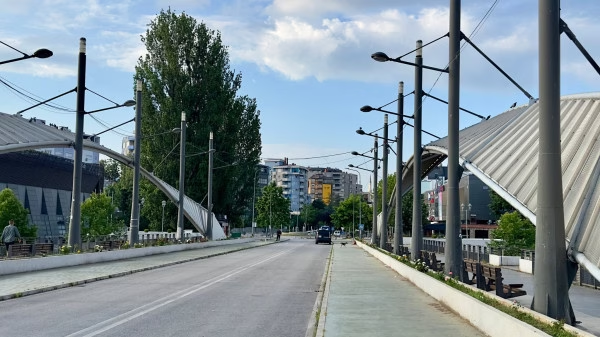
June 17, 2026, marks exactly 12 years since the historic removal of the massive concrete barricade on the main bridge over the Ibar River in Mitrovica.
The clearance operation, which took place at 5:00 AM on June 17, 2014, was executed over four hours by the same northern parallel structures—the self-styled “Rojat e urës” (Bridge Guards)—that had originally built it. Escorted by heavy contingents of the Kosovo Police and Italian KFOR Carabinieri, two excavators arriving from the north dismantled the structural divide without incident, raising hopes for a unified city.
Yet, twelve years later, despite completed structural renovations, successful load-bearing stability tests, and intense political friction, the iconic central bridge remains strictly closed to vehicular traffic, functioning exclusively as a pedestrian crossing.
1. The Infrastructure Evolution
The story of the main Ibar bridge is a history of shifting obstacles. Following the 2014 barricade removal, northern authorities quickly constructed a “Peace Park,” followed by a concrete wall. While both were eventually demolished under European Union pressure, international hesitation kept the main transit artery permanently locked to cars.
Faced with a deadlocked main bridge, the government of Prime Minister Albin Kurti executed a bold, unilateral infrastructure bypass, constructing two brand-new alternative bridges just meters away from the central flashpoint to restore direct physical integration.
The Current Tri-Bridge Infrastructure Matrix in Mitrovica

 [ THE CENTRAL IBAR BRIDGE ]   ──► CENTRAL FLASHPOINT (PEDESTRIANS ONLY)
 • Completely renovated via a €1.5 million EU fund. Kept closed to vehicles
   by KFOR/EU mandates to avoid ethnic friction despite successful safety tests.

 [ THE WESTERN VECHICLE BRIDGE ]──► THE RECENT TRANSIT ARTERY
 • Completed in a lightning 40-day build; fully opened to vehicular traffic
   and cars, successfully bypassing the central geopolitical blockade.

 [ THE EASTERN PEDESTRIAN BRIDGE ]──► ARCHITECTURAL SYMBOL
 • Opened as an exclusive pedestrian zone. Features modern artistic elements
   and a waterfall, connecting residents across the river.
2. The Chronology of an Unfinished Opening
The status of the central bridge remains tied to the Brussels-facilitated dialogue between Pristina and Belgrade. While the physical barriers are long gone, the political barriers have proven far more resilient.
Chronology of the Main Bridge Blockade (2014–2026)
┌────────────────────────────────────────────────────────────────────────┐
│                                                                        │
│  [ JUNE 17, 2014 ] ────────────────────────────────────────────────┐   │
│  • The initial wartime concrete barricade is dismantled after four     │   │
│    hours of excavation by northern teams under KFOR supervision.       │   │
│                                                                        │   │
│  [ JUNE 2018 ] ────────────────────────────────────────────────────┤   │
│  • The European Union officially concludes its €1.5 million            │   │
│    revitalization project. The bridge is structurally ready for cars.   │   │
│                                                                        │   │
│  [ JUNE–AUGUST 2025 ] ─────────────────────────────────────────────┤   │
│  • Pristina conducts heavy vehicle load tests on the main bridge. NATO │   │
│    and the EU push back against a unilateral opening, prompting Kosovo │   │
│    to build two alternative bridges instead to establish vehicle flow.  │   │
│                                                                        │   │
│  [ JUNE 2026 (PRESENT) ] ──────────────────────────────────────────┘   │
│  • The main bridge hits a 12-year milestone post-barricade. It remains│
│    permanently patrolled by Italian Carabinieri as a pedestrian-only zone.│
└────────────────────────────────────────────────────────────────────────┘
3. Geopolitical Standoff: Sovereignty vs. Status Quo
The ongoing restriction on the main bridge represents a wider strategic conflict over sovereignty in northern Kosovo. While local residents enjoy improved daily mobility via the newer surrounding bridges, the central bridge remains a highly guarded symbol of regional division.
| Stakeholder Vector | Institutional Position | Underlying Strategic Rationale |
| Kosovo Government | Demands the immediate, unrestricted opening of the central bridge to vehicular traffic. | Aims to assert full territorial sovereignty, normalize urban layout, and eliminate the symbolic internal border. |
| The European Union & KFOR | INSIST that any change to the bridge’s status must be negotiated through the Brussels dialogue. | Fears that opening the main historical flashpoint to vehicles could trigger immediate ethnic clashes or security escalations. |
| Belgrade & Local Serb Leaders | Strongly oppose opening the bridge, framing it as an existential threat to the northern Serb community. | Attempt to maintain a distinct political status for North Mitrovica, utilizing the closed bridge as a buffer zone. |
Twelve years after the physical barricades were turned to dust, the main bridge over the Ibar remains a powerful testament to the complexities of Balkan diplomacy. Though cars now cross the river daily via the newly built adjacent bridges, the central monument stands frozen in time—fully functional on paper, yet politically marooned by international caution.