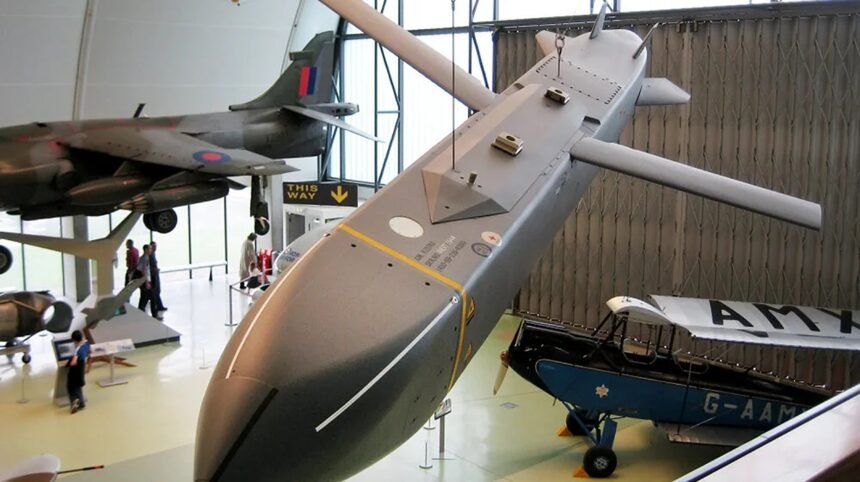
Ukraine is taking another significant step toward building its own long-range strike capability.
Britain has authorized the transfer of technology and production know-how for its Storm Shadow cruise missiles to Ukraine, opening the door for Kyiv to eventually manufacture versions of the weapon domestically. The decision marks a major evolution in Western military support: Ukraine is moving from simply receiving weapons to gaining the industrial and technological capacity to produce them.
And Moscow is clearly unhappy about it.
The Kremlin has reacted with threats, portraying the move as another escalation by Britain and warning that future production facilities could become targets. But from Kyiv’s perspective, the logic is straightforward: a country fighting a prolonged war cannot indefinitely depend on deliveries from foreign stockpiles.
From Western Deliveries to Ukrainian Production
Storm Shadow, also known as SCALP, is a long-range, air-launched cruise missile developed by Britain and France.
Ukraine began receiving the missiles in 2023, and they quickly became an important part of its ability to strike Russian military infrastructure behind the front line.
The weapons have been used against command centers, ammunition depots, military bases and other strategic targets, including Russian positions in occupied Crimea.
Their effectiveness is partly based on their ability to penetrate sophisticated air-defense environments while maintaining high precision.
That makes the prospect of domestic production particularly significant.
If Ukraine can eventually manufacture these weapons itself, the strategic equation changes.
Instead of waiting for another shipment from London or Paris, Kyiv could increasingly control the production cycle itself.
Why Moscow Is Worried
Russia’s reaction is revealing.
Moscow has threatened potential production facilities and accused Britain of encouraging escalation.
But the underlying concern is obvious: Ukraine’s dependence on Western weapons could gradually become less of a constraint.
A domestically produced long-range missile capability would make it harder for Russia to calculate when, where and how Ukraine can strike military infrastructure.
It would also complicate Russia’s ability to destroy Ukraine’s missile stockpiles simply by targeting supply routes and storage facilities.
In other words, the battlefield is not the only thing changing.
Ukraine is attempting to change the industrial balance behind the battlefield.
Crimea Has Already Shown Their Impact
Storm Shadow entered the Ukrainian arsenal in 2023 and was subsequently used against Russian military targets in occupied territories.
Among the most notable strikes were attacks connected to Russia’s Black Sea Fleet in Crimea.
Ukrainian forces claimed strikes against the fleet’s headquarters in Sevastopol and several naval vessels, including the landing ship Minsk and submarine Rostov-on-Don.
The repeated attacks contributed to Russia relocating surviving operational Black Sea Fleet vessels from Crimea toward Novorossiysk.
That demonstrated something important: long-range precision weapons can force an opponent to change how and where it positions expensive military assets.
But This Is Not a “Wonder Weapon”
There is also a danger of exaggerating what Storm Shadow can accomplish.
Missiles alone will not decide the war.
As missile expert Markus Schiller of SIPRI has noted, reliable public assessments of interception rates, accuracy and damage are difficult because neither side has an incentive to reveal precise battlefield data.
The important point is not that Storm Shadow will suddenly transform the war.
It is that Ukraine is accumulating capabilities that make Russian military planning increasingly complicated.
And domestic production could make that pressure sustainable.
The Technology May Matter More Than the Missile
Perhaps the most important part of the agreement is not the missile itself.
It is the knowledge.
Storm Shadow is a complex system involving propulsion, navigation, guidance, electronics and a warhead supplied through a network of specialized manufacturers.
Creating a complete Ukrainian production line will therefore take considerable time.
But Ukrainian engineers could gain access to technological approaches and manufacturing expertise that can later be adapted for indigenous weapons.
That could prove more consequential than simply producing Storm Shadow itself.
Ukraine has spent years developing its domestic defense industry under wartime conditions. The transfer of Western technology could accelerate that process, allowing Ukrainian companies to develop increasingly sophisticated long-range systems of their own.
A New Phase of Western Support
This is therefore more than another weapons package.
It represents a shift in the philosophy of military assistance.
The West is not simply giving Ukraine weapons to use today.
It is increasingly helping Ukraine develop the capacity to manufacture advanced weapons tomorrow.
That distinction matters.
A shipment eventually runs out.
A production capability can continue generating weapons.
For Russia, that means the strategic problem could become much more difficult over time.
For Ukraine, it represents a path toward greater military independence.
And for Europe, it sends a broader message: support for Ukraine is increasingly moving from supplying a country at war to helping it build the industrial capacity required to defend itself for as long as necessary.
The Storm Shadow story, ultimately, is not just about missiles.
It is about who controls the technology, who controls production — and who can sustain the fight when foreign stockpiles begin to run low.