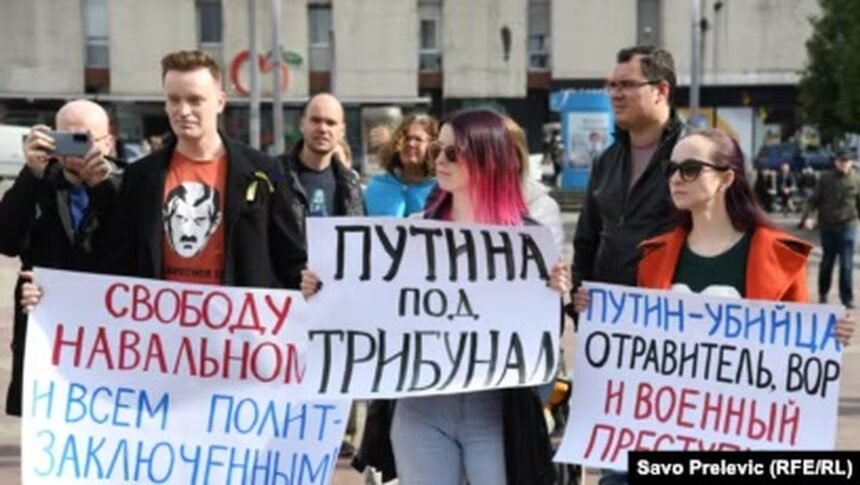
Russian citizen Samvel Mnacakanjan moved to Montenegro immediately after the beginning of Russia’s invasion of Ukraine because he opposed the war.
“At first, I was truly enthusiastic about Montenegro, and for a long time I thought I was very lucky to be here,” he says.
However, due to Podgorica’s decision to introduce visas for Russian citizens, Mnacakanjan plans to leave Herceg Novi, where he has lived for four years.
“The temporary residence permit is valid for one year. When it expires, I have to cross the border, return to Montenegro, and submit a new application. But I will no longer be able to return because a visa will be required. That is the problem,” he explains.
He has already resigned from the school where he worked and is considering moving to neighboring Serbia, where he does not need a visa.
According to the latest population census conducted in September 2024, Russians represent the largest group among foreign citizens with permanent residence in Montenegro.
Data provided by Montenegro’s Ministry of Internal Affairs to Radio Free Europe show that nearly 18,000 Russian citizens hold temporary residence permits, while more than 2,000 have permanent residence permits.
Montenegro is the first country in the region to end the visa-free regime for Russian citizens.
For several years, the European Commission has urged Western Balkan countries, including Montenegro, to align their visa policies with European Union rules in order to reduce the risk of irregular migration and abuse of visa-free regimes.
In addition to Russian citizens, citizens of Belarus, Turkey, China, and Saudi Arabia will also no longer be able to travel to Montenegro without visas.
The changes will enter into force on November 1.
With this move, Montenegro has fully aligned its visa policy with that of the EU, the country’s Ministry of Foreign Affairs announced.
The ministry also stated that measures are being taken to make the process of obtaining Montenegrin visas as simple and accessible as possible.
Russian Ambassador Summoned for Talks
The Russian Embassy in Montenegro considers the introduction of visas to be “hostile actions.”
The embassy said it views the visa regime as “another indication of Podgorica’s extreme dependence on the influence of its foreign sponsors, who place far from the interests of their Montenegrin partners as a priority.”
Because of this statement, as well as an opinion article criticizing sanctions against Moscow, Montenegrin authorities summoned Russian Ambassador Aleksandar Lukashik for consultations.
They stated that such assessments exceed the boundaries of normal diplomatic communication and are not consistent with the principles of mutual respect.
Montenegrin authorities also said that full alignment of visa policy with the EU is a sovereign decision made in accordance with national interests and obligations arising from the European integration process, and that it is not directed against Russian citizens.
Following EU policy, Podgorica has also introduced several sanctions against Moscow due to Russia’s aggression against Ukraine. These include freezing the assets of some Russian citizens in Montenegro and banning activities of Russian state-controlled media.
In March 2022, Moscow included Montenegro on a list of foreign states that were taking “hostile actions against Russia, Russian legal entities, and individuals.”
During that period, Montenegro expelled five Russian diplomats, while Russia responded by declaring a Montenegrin diplomat in Moscow persona non grata.
Visa Rules Also Affect Anti-War Russian Diaspora
The visa-free regime was one of the reasons why an anti-war Russian diaspora formed in Montenegro.
Russian citizens without residence permits can currently stay in Montenegro for up to 30 days. After that, they can carry out a so-called “visa run” — leaving the country and immediately returning to receive another 30-day stay.
However, this will no longer be possible from November 1.
According to Mnacakanjan, Montenegro’s plans for EU membership have also significantly affected the Russian diaspora in the country.
Alongside preparations for introducing visas, authorities have in some cases tightened rules for obtaining residence permits.
“Gradually, I realized that Montenegro is not inclined toward us. They are doing everything possible so that we do not stay here for a long time,” Mnacakanjan said.
Meanwhile, as rumors of possible new mobilization continue spreading in Russia, the number of people seeking to leave the country may increase, says Russian human rights activist Anastasia Burakova.
“Now, among European countries where Russians can enter without a visa and which have relatively liberal migration rules, only Armenia, Georgia, and neighboring Serbia remain,” she said.
Burakova is also the founder of the organization Kovcheg, which helps Russians facing persecution or those who left the country because of their opposition to the war.
What Do Montenegrin Authorities Say?
Montenegro’s Ministry of Foreign Affairs announced that it is taking measures “intensively and systematically” to reduce possible negative effects of these changes.
It explained that, to simplify procedures, future visa applications will also be possible through VFS Global visa centers, rather than only through Montenegro’s diplomatic and consular missions.
The ministry also announced the creation of a new Visa Information System aligned with EU systems and Schengen security standards, with the goal of introducing electronic visas.
Montenegrin economist Stevan Gajević believes electronic visas will not automatically solve the problem.
“An administrative obstacle does not stop being an obstacle simply because it has moved from a counter to a screen.”
He said it is essential to create a fast, predictable, and affordable visa system with clear deadlines and rules that tourists know in advance.
Possible Negative Consequences for Montenegro
Until now, Montenegro’s government justified not fully aligning its visa policy with the EU by pointing to economic interests in tourism — a sector that accounts for around one quarter of GDP.
In 2025, Montenegro was visited by more than 2.7 million tourists.
Foreign tourists accounted for 95.8% of overnight stays, according to Montenegro’s statistical office.
Russian tourists are the second largest group after visitors from Serbia. Turkish visitors also exceeded 100,000 arrivals in both 2024 and 2025.
Economist Stevan Gajević explains that Montenegro’s tourism sector has for years adapted to visitors from Russia, Turkey, the region, and other markets whose tourists often stay longer, use private accommodation, purchase real estate, and contribute significantly to the local economy.
“It is unrealistic to expect such markets to be replaced overnight by tourists from the European Union, whose habits, expectations, and consumption patterns are often different,” he said.
According to him, visa introduction is not merely an administrative change but also “an economic and geopolitical decision with potentially serious consequences.”
“We will restrict access precisely to those markets on which our tourism, air transport, trade, and real estate sectors heavily depend,” he said.
Citizens of Countries Affected by Visa Changes
Montenegro, a country of around 620,000 residents, has approximately 100,000 foreign citizens with residence permits, with Russians representing the largest group.
There are also slightly more than 10,000 Turkish citizens with temporary residence or work permits, while 103 have permanent residence.
Around 500 Chinese citizens hold temporary residence permits, while slightly more than 100 have permanent residence.
Nearly 900 Belarusian citizens currently have temporary residence permits, while 96 have permanent residence.
Two Saudi citizens have temporary residence permits, while none have permanent residence.
Claims of Visa-Free Regime Abuse
The European Border and Coast Guard Agency, Frontex, warned at the end of June that citizens of China, Russia, and Turkey continue entering the Western Balkans without visas and then attempt to continue their journey toward the European Union.
Brussels has therefore urged countries in the region to tighten visa policies and close opportunities for such abuses.
By introducing visas, Montenegro fulfilled one of the final criteria for closing Chapter 24 of EU accession negotiations — Justice, Freedom and Security — as well as one of the main obligations under its Reform Agenda.
Podgorica is considered the country with the strongest chances of becoming an EU member by the end of this decade, having provisionally closed 18 of the 33 negotiation chapters.