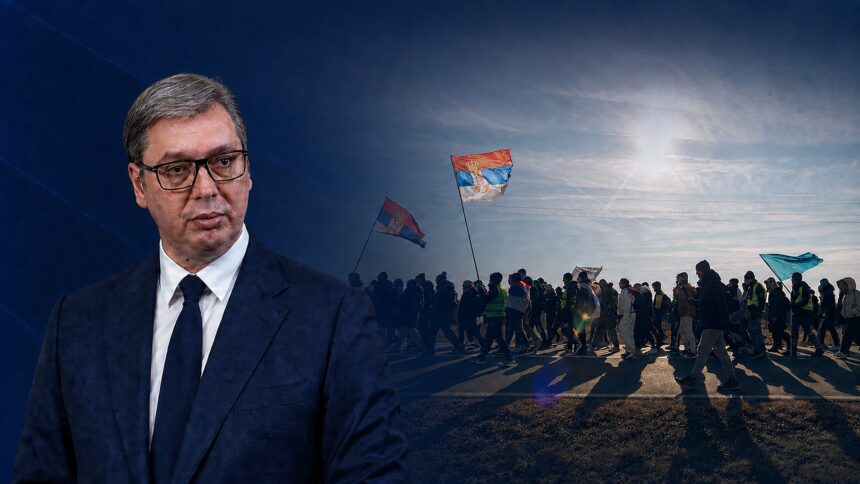
Serbian President Aleksandar Vučić has declined to say whether he will attend the funeral of convicted war criminal Ratko Mladić, scheduled to take place in Belgrade on Monday.
Asked by reporters on Friday whether he planned to attend the ceremony, Vučić referred instead to the official visit of Uzbek President Shavkat Mirziyoyev, which is scheduled for September 7–8.
“On Monday and Tuesday, I have an official visit by the president of Uzbekistan, scheduled four months ago, throughout the entire day. Have I done everything possible to ensure that it takes place in a dignified, serious and responsible manner? I have done exactly that. That’s all I can tell you,” Vučić said.
He also said he had been in contact with Mladić’s family and emphasized that the organization of the funeral was a matter for the family.
The president’s refusal to give a direct answer comes amid growing scrutiny of the Serbian state’s role in the events surrounding Mladić’s return and funeral.
Mladić’s body was transported from The Hague to Belgrade aboard a Serbian government aircraft. Serbian Justice Minister Nenad Vujić accompanied members of the family, while the coffin, covered with the Serbian flag, was received and carried by Serbian Army personnel. Serbia has also said that state institutions will provide logistical and security assistance surrounding the funeral.
Mladić died on August 27 while serving a life sentence imposed by the International Criminal Tribunal for the former Yugoslavia. He was convicted of genocide, crimes against humanity and war crimes committed during the Bosnian war, including crimes connected to the Srebrenica genocide and the siege of Sarajevo.
The funeral has therefore become more than a private family ceremony. It has also become a politically sensitive issue for Serbia, particularly as the country continues its EU accession process.
European officials have already expressed concern over the glorification of convicted war criminals and the possible participation of senior Serbian officials in events honouring Mladić.
A memorial gathering for Mladić is scheduled for Saturday, September 5, in Belgrade, while his burial is planned for Monday, September 7, at Topčider Cemetery.
For Vučić, the decision to avoid a direct answer may allow him to keep his distance from the ceremony while avoiding an explicit confrontation with those in Serbia who continue to regard Mladić as a national hero.
But the broader issue remains difficult to avoid: while Vučić has declined to say whether he will attend the funeral, Serbian state institutions have already played a visible role in facilitating Mladić’s return and the arrangements surrounding his burial.
His silence may be politically calculated.
But it does not remove the question of what message Serbia ultimately chooses to send about the legacy of a man convicted of genocide and war crimes.