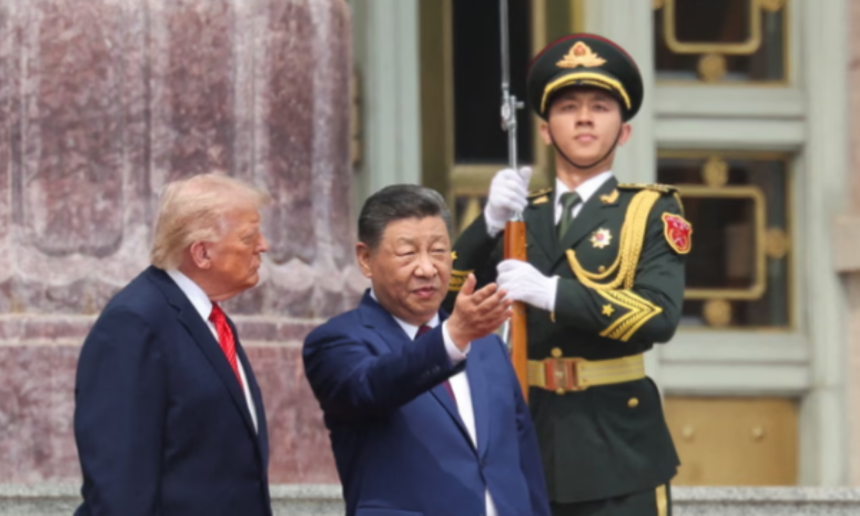
The White House has released an official readout of the high-stakes meeting between President Donald Trump and Chinese President Xi Jinping, characterizing the dialogue as a “good meeting” focused primarily on economic cooperation and global energy security.
Notably, while the statement detailed agreements on several contentious international issues, it made no mention of Taiwan, a significant omission given the heightened regional tensions.
Key Agreements on Iran and Global Security
The two leaders found common ground on the Middle East crisis and nuclear non-proliferation:
- Nuclear Weapons: Both sides explicitly agreed that “Iran must never possess nuclear weapons.”
- Strait of Hormuz: There was a mutual agreement that the Strait of Hormuz must remain open to ensure the “free flow of energy” to global markets.
- President Xi expressed China’s opposition to the militarization of the strait and any attempts to impose tolls or tariffs for its use.
- China expressed interest in purchasing more U.S. oil to reduce its future strategic dependence on the Hormuz passage.
Economic Cooperation and Trade
The meeting also involved high-level business executives, emphasizing a return to trade-focused diplomacy:
- Market Access: Discussions centered on expanding market access for American businesses in China and increasing Chinese investment in U.S. industries.
- Agriculture: China committed to increasing purchases of American agricultural products.
- Fentanyl: Both leaders emphasized the need to build on progress in stopping the flow of fentanyl precursors from China to the United States.
The “Taiwan Silence”
The most striking aspect of the White House communiqué is the complete absence of the word Taiwan. Diplomats and analysts are closely scrutinizing this silence, debating whether it indicates a temporary “truce” on the issue to facilitate economic deals or if the topic was so contentious that no common language could be found for the public readout.
This follows a week of intense speculation regarding a shift in U.S. policy in the Pacific, particularly as President Trump prioritizes trade concessions and Chinese cooperation regarding the conflict with Iran.