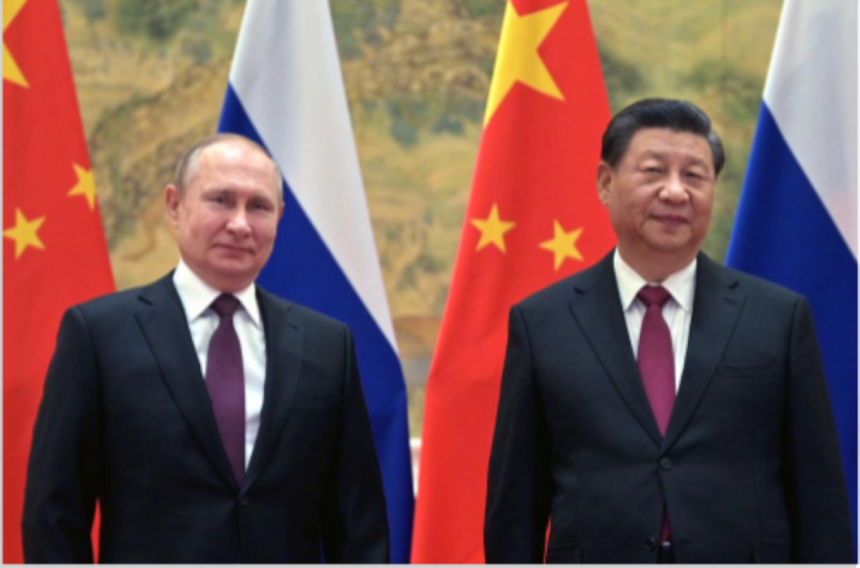
Russian President Vladimir Putin and Chinese President Xi Jinping opened high-stakes bilateral talks at the Great Hall of the People on Wednesday, fiercely reaffirming their “no-limits” strategic partnership. The high-profile summit focused heavily on expanding cross-border trade, reinforcing infrastructure networks, and locking down sweeping new energy guarantees.
The timing of the state visit carries profound geopolitical weight. Putin’s arrival in the Chinese capital comes just days after President Xi hosted U.S. President Donald Trump for a comprehensive diplomatic dialogue. The back-to-back summits featuring the American and Russian presidents underscore Beijing’s expanding role as an indispensable global superpower and central diplomatic axis, according to regional experts.
“My Dear Friend”: Emphasizing Inviolable Strategic Trust
The greeting between the two leaders at the Great Hall of the People was highly warm, reinforcing their deep personal and institutional rapport.
“My dear friend,” Putin stated during his opening remarks. “We are truly delighted to meet. We maintain continuous contact, both personally and through our aides within the government.”
According to Chinese state media accounts, President Xi reciprocated the warm sentiment, heavily emphasizing the unwavering “mutual political trust and strategic cooperation” binding Moscow and Beijing. The two leaders have a long history of exchanging robust personal praise, with Xi previously describing the Russian president as his “best and closest friend.”
   [THE BEIJING BALANCE: CHINA'S SUPERPOWER DIPLOMACY]
   • Early May 2026:  President Xi Jinping hosts U.S. President Donald Trump in Beijing.
   • Mid-May 2026:    President Xi Jinping welcomes Russian President Vladimir Putin.
   • The Objective:   Positioning Beijing as the ultimate broker of global trade & security.
To cement this alignment, the state media apparatus confirmed that both sides have formally agreed to sign a comprehensive expansion of the landmark Sino-Russian Treaty of Good-Neighborliness and Friendly Cooperation, which was originally brokered in 2001.
Siphoning Moscow’s Volatile Energy Supply
China permanently cemented its status as Russia’s primary economic lifeline following the Kremlin’s full-scale invasion of Ukraine in 2022. While Beijing has consistently maintained a public posture of absolute neutrality regarding the European theater, it has actively expanded its commercial ties with Moscow, completely shielding the Russian economy from waves of Western financial and trade sanctions.
Today, China stands as the single largest buyer of Russian crude oil and natural gas. Moscow is now explicitly calculating that the newly ignited war in Iran and the broader Middle East will trigger a massive global supply deficit, driving Chinese demand for overland Russian energy pipelines to historic highs.
During the opening plenary session, Putin specifically highlighted this transactional symbiosis:
“The true driving force behind our economic cooperation is the Russo-Chinese partnership within the energy sector,” Putin declared. “Amid the severe crisis unfolding in the Middle East, Russia continues to maintain its role as an entirely reliable supplier of natural resources, while China remains an exceptionally responsible consumer of these exact assets.”
Expanding the Scope: Asymmetric Military Integration
Beyond the lucrative oil and liquefied natural gas (LNG) contracts, defense attaches confirm that the Beijing talks are slated to address deeply sensitive security matters.
High on the agenda is the expansion of joint maritime maneuvers in the South China Sea and the integration of cutting-edge drone technologies. As the conventional conflict between the United States and Iran continues to destabilize vital shipping routes in the Persian Gulf, the expanding Sino-Russian trade corridor is increasingly viewed by Western defense analysts as a fortified, sanction-proof economic bloc spanning the Eurasian landmass.