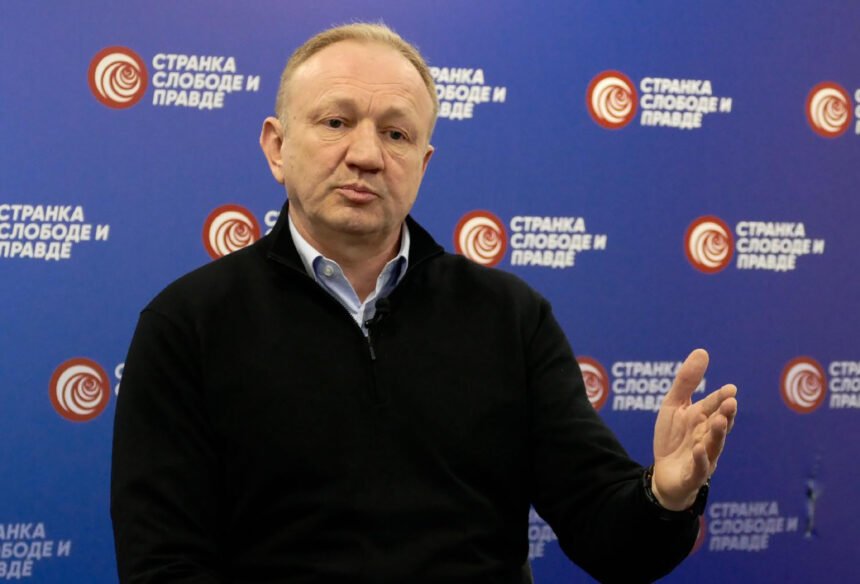
Dragan Đilas, leader of the Stranka slobode i pravde (Freedom and Justice Party), has sharply condemned President Aleksandar Vučić for what he describes as Serbia’s effective abandonment of full EU membership ambitions, in violation of a 2013 parliamentary resolution.
Đilas emphasizes that Serbia formally applied for full EU membership, not partial participation in the single market or selective involvement in EU policies—a strategic goal established under Zoran Đinđić’s government and reaffirmed by subsequent administrations. The 2013 National Assembly resolution clearly states:
“The National Assembly confirms that the goal of the Republic of Serbia in accession negotiations is to achieve full membership in the European Union as soon as possible.”
According to Đilas, any deviation from this objective without parliamentary approval constitutes a breach of the resolution and an unauthorized change in the state’s strategic course. He criticizes Vučić for letting Serbian citizens learn about shifts in EU policy direction through foreign media rather than domestic institutional channels, effectively undermining both the institutions and the public.
EU Membership and the Hidden Agenda
Đilas argues that joining the EU, the Single Market, and the Schengen Zone requires adherence to fundamental principles: the rule of law, independent judiciary, anti-corruption measures, alignment with EU foreign and security policies, and strong institutional frameworks. For Schengen, requirements are even stricter due to security concerns.
“Vučić’s current proposal mirrors a model devised three decades ago for stable, developed democracies that do not seek EU membership but want market access. Applying this model to Serbia amounts to covertly abandoning full EU membership while maintaining the appearance of European rhetoric,” Đilas states.
He adds that Vučić’s approach protects the ruling elite from accountability: independent courts, free media, functioning institutions, anti-corruption enforcement, and public procurement transparency are all perceived as obstacles to the regime’s control over the state and public funds.
Political and Strategic Consequences
Đilas warns that such proposals weaken Serbia’s reform pressure, creating institutional gridlock and delaying accession for years. Moreover, EU accession conditions—like sanctions on Russia and ending energy dependence on Russian oil and gas—are politically unpalatable to the current government, leaving Serbia in a limbo position.
“For us in the Freedom and Justice Party, there is no doubt: Serbia must continue on the path to full EU membership. Serbian citizens are European citizens and cannot be treated as second-class. No one, not even Vučić, can deny them that right,” Đilas concludes.
He portrays Vučić’s anti-European narrative over 14 years as a calculated effort to maintain domestic control, lowering public support for EU integration to historic lows and prioritizing regime preservation over Serbia’s European future.