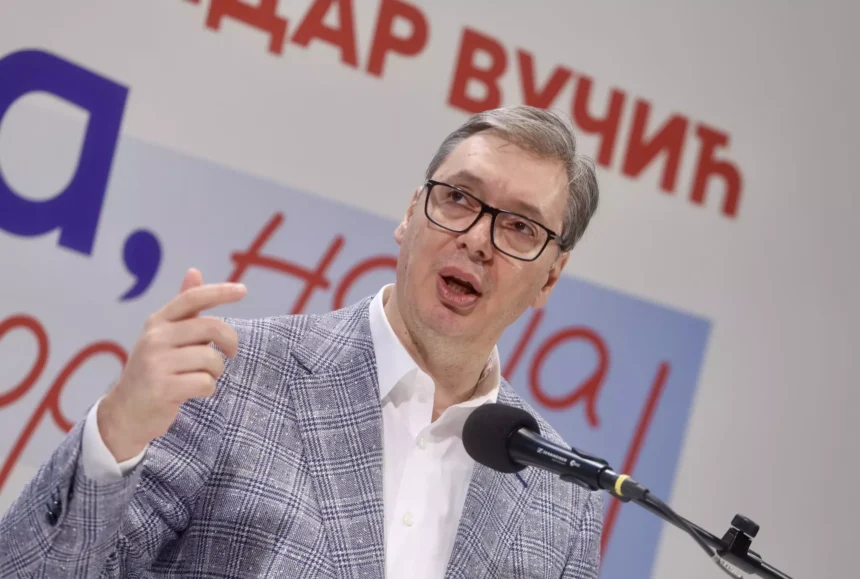
A Serbian civil society organization has accused Aleksandar Vučić, President of Serbia, of blurring the line between his official state role and political campaigning during appearances linked to upcoming local elections.
According to an analysis by the Bureau for Social Research, Vučić violated recommendations from OSCE Office for Democratic Institutions and Human Rights (ODIHR) that call for a clear separation between state functions and election campaign activities.
The organization said the alleged violations occurred during public addresses in the town of Sivac and television appearances on TV Kula and TV Pink, where the Serbian president spoke ahead of local elections in Kula.
BIRODI’s methodology evaluated four key criteria:
- Whether the speaker presented himself as the President of the Republic
- Whether he spoke as a head of state or as a political leader
- Whether he appeared as an election participant
- Whether he made promises that fall under the authority of the government or local institutions
According to the findings, Vučić was presented primarily as Serbia’s president in all three appearances, meaning political and electoral messages were delivered from the position of head of state rather than as a party leader or candidate.
The analysis concluded that this represents a high level of overlap between state office and electoral campaigning, which BIRODI says violates ODIHR Recommendation No. 1, aimed at preventing the misuse of public office during election campaigns.
The report also noted that during the appearances the president simultaneously acted as a state official and a political campaign participant, while announcing infrastructure and development projects that fall under the jurisdiction of the executive government.
BIRODI warned that such blending of institutional authority with party campaigning can undermine equal conditions for political competitors and the integrity of the electoral process.
The organization also pointed out that the speeches included delegitimization of political opponents, strong political polarization, and promotion of the ruling political option.