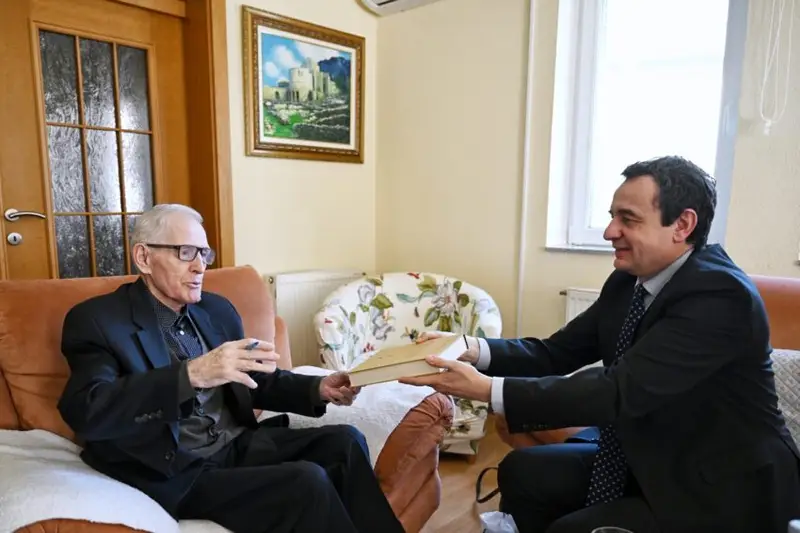
Kosovo Prime Minister Albin Kurti marked the anniversary of the 1981 student protests with a visit to national activist Mehmet Hajrizi, emphasizing that the country’s most recent liberation struggle was the culmination of generations committed to freedom and the advancement of the national cause.
In his remarks, Kurti highlighted Hajrizi’s lifelong dedication:
- Hajrizi comes from a family deeply involved in political activism, facing persecution from the Serbian regime since the 1920s.
- He spent 15 years in education, shaping generations of students, and was arrested in his classroom—his second arrest, the first occurring in 1979.
- In the early 1970s, he co-led the illegal “Kosovo Revolutionary Group”, one of the most serious and long-lasting movements of its era. Hajrizi also helped establish the first clandestine press, serving as chief editor of underground publications such as Zëri i Kosovës, Pararoja, Liria, and Këngët e Lirisë. These works fostered patriotism, resistance, and calls for freedom, justice, republic, and national unity.
Hajrizi was arrested on December 18, 1981, and sentenced on July 10, 1982, to 12 years in prison alongside fellow activists. Leadership of the movement later passed to Kadri Zeka, who, together with Jusuf and Bardhosh Gërvalla, was killed a year later.
Reflecting on Kosovo’s liberation, Kurti stated:
“The last liberation struggle in Kosovo was undoubtedly the product of multiple generations who dedicated themselves over the years to freedom and the advancement of the national cause. Major historical events are the result of daily work carried out by these organizations together with the people of Kosovo. Gratitude is owed to all who tried and contributed to freedom and unity.”