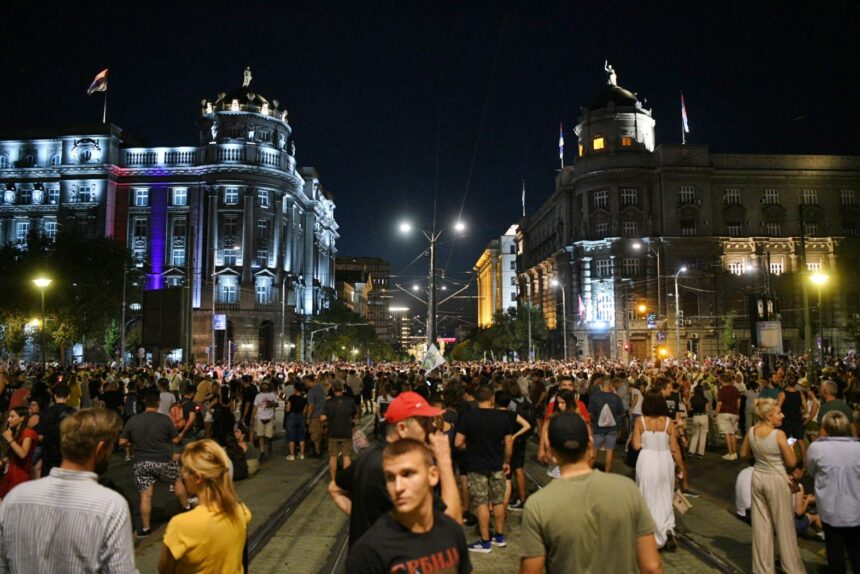
The public continues to view the activities of the student movement as mere “protests.” However, citizens now understand that change will come through elections, not street demonstrations. For victory, it is crucial that public actions evolve into demonstrations of a better Serbia, to be built by a future government.
Since the start of the student uprising and subsequent social mobilization in late 2024 and early 2025, I refrained from offering public advice to the movement, primarily because their achievements had already exceeded what was previously imaginable for opposition actors. Although I did not always agree with their decisions or timing, I now recognize a pivotal moment for the anti-regime front, particularly for the student movement and its electoral list. I share these recommendations publicly due to the absence of direct contact with the movement, and because it is equally important for those on the list to understand these insights.
All observations below are data-driven. My company, Sprint Insight, conducts regular public opinion research, with a particular focus on trends since early last year. The strategic recommendations provided here are grounded in these studies.
Building Trust in Change
Key voters are seeking evolution rather than revolution. Political messaging should focus on demonstrating controlled, predictable, and constructive change, rather than radical or abrupt shifts.
This approach emphasizes political behavior and communication over ideology or party positions, which are less relevant for the upcoming elections. The strategy also avoids electoral projections or coalition calculations, which cannot be influenced through public messaging.
Three Core Pillars for Victory Over Aleksandar Vučić’s List
- Voter Turnout
High turnout, particularly among the 35–54 age group, is critical. Research indicates that the upcoming parliamentary elections will be largely determined by mobilization rather than persuasion. While opposition forces currently hold an advantage in most scenarios, the margin is slim among voters who are certain to turn out. Ensuring that all likely voters actually cast ballots is essential. - Economy
Public perception of the economy under Vučić’s administration is highly negative. Three out of five citizens believe economic conditions are worsening, and many report a decline in their standard of living over the past year. While corruption remains a concern, key swing voters prioritize concrete economic solutions, including addressing high prices, protecting wages and pensions, and establishing credible plans for post-regime recovery. The student movement should frame anti-corruption efforts as a means to achieve better living conditions, rather than solely as a moral issue. Expert-led messaging is essential to convey competence and credibility. - Directed Development
Most Serbian citizens desire change, yet many lack confidence in alternatives. The student movement, as the dominant actor capable of delivering this change, must communicate that reform will be structured, secure, and oriented toward long-term development. A step-by-step “roadmap” for post-election actions should be presented to reassure hesitant voters, reducing fear and uncertainty.
From Protests to Political Activation
The student movement has shifted from protest to political mobilization—a positive development. However, public perception still frames their activities as demonstrations, which can cause confusion. Clear messaging is required to signal that the phase of protests has ended and a phase of structured political building has begun. Street actions should now represent demonstrations of a better Serbia, rather than spontaneous protests. As Voja Pančevec famously said: “These are not demonstrations; these are manifestations.”
For success, it is essential that all public engagement projects the vision of a competent, credible, and evolving Serbia—laying the groundwork for the next government.