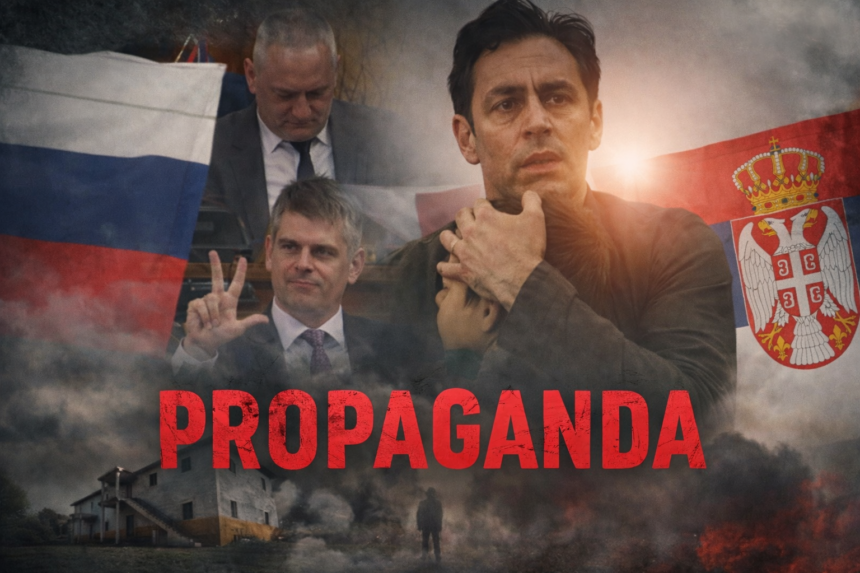
The film “Harvest” represents a coordinated disinformation effort that recycles long-discredited allegations, presenting them as facts in order to mislead international audiences and undermine Kosovo, its allies, and the historical truth of the 1999 war.
The promotion of the film “Harvest” by Arno Gujon in Belgrade is not an isolated cultural event it reflects a broader and coordinated disinformation effort aimed at targeting Kosovo, while simultaneously undermining the credibility of the United States and NATO.
At the core of the film lies a narrative that presents as factual a series of serious allegations: that the Kosovo Liberation Army was involved in organ trafficking, that Serbian civilians were victims of these supposed crimes, that a so-called “Yellow House” in Albania served as a site for illegal activities, and that organs were transported to Italy. However, these claims are not established facts. They have never been confirmed by any international court or tribunal, and despite years of investigations and political pressure, no judicial body has verified the existence of such an organized system as portrayed in these narratives.
What makes this case particularly concerning is the way “Harvest” transforms unverified and widely disputed allegations into a seemingly authoritative storyline. This is a well-known disinformation method taking unresolved claims and presenting them as proven truth in order to influence perception. There is no court verdict supporting these accusations, no concrete and verifiable evidence confirming such a network, and no credible basis for the scale and organization depicted. As such, the events presented in the film are effectively constructed narratives, fabricated and exaggerated for political purposes rather than grounded in proven historical or legal facts.
The strategic objective behind such productions is clear. They seek to delegitimize Kosovo’s statehood and its liberation struggle, to damage the historical image of the Kosovo Liberation Army, and to cast doubt on the role of the United States and NATO in ending war crimes during 1999. At the same time, they promote geopolitical narratives aligned with Serbia and Russia. By using film as a medium, these actors attempt to shape international opinion emotionally, creating an illusion of legitimacy around claims that lack any verified foundation.
Disinformation of this nature goes far beyond regional politics. It distorts historical reality, misleads global audiences, and attempts to rewrite well-documented events of the Kosovo war. It is therefore essential to state clearly and without ambiguity that the narrative presented in “Harvest” is not based on proven facts. The claims it promotes have never been substantiated in any court of law, and they remain unverified allegations widely recognized as part of a broader disinformation campaign.
In this context, the film stands as one of the more aggressive recent examples of coordinated Serbo-Russian propaganda designed not to inform, but to manipulate perception.