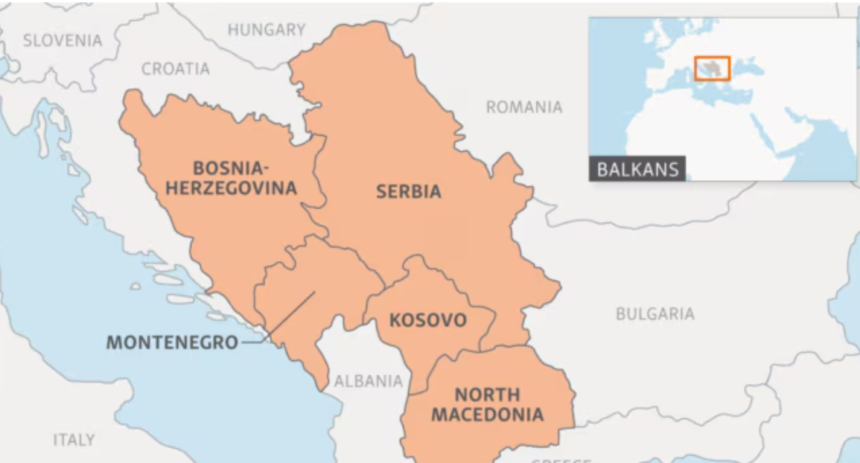
The Western Balkans rarely features on the map of the war in Ukraine. Yet the war that began with Russia’s full-scale invasion in February 2022 has had direct strategic implications for Kosovo and Bosnia and Herzegovina, shaping the regional balance of power and the durability of the post-1990s European security order.
For Prishtina and Sarajevo, the central question is not abstract: it is whether Ukraine’s resistance has prevented a wider erosion of the regional status quo that could have emboldened revisionist political and military actors in the Balkans.
Serbia’s military buildup and regional tensions
Over the past several years, Serbia has significantly expanded and modernized its armed forces, acquiring advanced systems including Chinese FK-3 air defense platforms, CH-92A drones, Pantsir-S1 units, and additional MiG-29 aircraft transferred from Belarus, alongside infantry vehicles and other equipment. Serbian officials have repeatedly described this buildup as defensive, citing regional instability and perceived threats from neighboring states.
Tensions escalated sharply in September 2023, following the armed attack in northern Kosovo in which Kosovo Police officer Afrim Bunjaku was killed. Kosovo authorities linked the attackers to organized groups with political and logistical ties to structures in Serbia, an allegation Belgrade rejects.
Shortly after the incident, Western officials, including the United States, reported an unusual concentration of Serbian military units near the Kosovo border. NATO reinforced its Kosovo Force (KFOR) presence, while Washington urged de-escalation. Serbia denied any offensive intent, though the scale and timing of the deployment raised concern among international observers.
Ukraine war as a strategic constraint
Analysts argue that the broader geopolitical environment shaped by the war in Ukraine has constrained escalation risks in the Balkans. A rapid Russian victory in Ukraine, had it occurred in 2022, is widely assessed by regional security experts as potentially altering deterrence dynamics across Europe, including the Western Balkans.
Such a scenario could have increased political space for actors advocating revisionist agendas in the region. Instead, Russia’s prolonged engagement in Ukraine has absorbed military, economic, and diplomatic capacity, while also strengthening NATO cohesion and reinforcing deterrence posture in Southeast Europe.
EU dynamics and internal divisions
Within the European Union, enlargement policy and internal divisions have also influenced regional trajectories. Hungary under Viktor Orbán often played a critical role in slowing or complicating EU consensus on Western Balkans policy, including issues related to Kosovo’s EU path.
Following recent political developments in Hungary and the decline of veto-driven obstruction, EU institutions are expected to gain greater coherence in their enlargement approach, potentially easing procedural obstacles for Western Balkan candidates.
However, analysts stress that EU institutional shifts do not directly alter NATO’s security guarantees or the military balance on the ground.
Bosnia and Herzegovina: continued instability risks
In Bosnia and Herzegovina, Republika Srpska leadership under Milorad Dodik has continued to challenge central state institutions and advocate for increased autonomy or potential secession. Despite international sanctions and legal proceedings, his political influence remains significant.
The international response has fluctuated between pressure, sanctions, and diplomatic recalibration, reflecting broader uncertainty about long-term Western strategy in the region.
Ukraine’s strategic “shield” effect
According to regional security assessments, Ukraine’s sustained resistance has indirectly preserved stability in the Western Balkans by preventing a scenario in which Russian geopolitical leverage in Europe would have expanded significantly.
This has helped maintain NATO’s deterrence credibility, preserved the post-Dayton and post-Kosovo security architecture, and limited the operational space for unilateral action by regional actors.
A fragile but intact status quo
Despite these stabilizing effects, underlying tensions remain unresolved. Serbia’s military modernization continues, political relations with Russia remain complex, and internal divisions in Bosnia and Herzegovina persist.
Experts caution that the current equilibrium is not permanent but contingent on broader European and transatlantic stability. Ukraine’s war has not eliminated regional risks—it has delayed and contained them.
For Kosovo and Bosnia and Herzegovina, the conclusion drawn by many analysts is clear: the endurance of Ukraine has functioned as a strategic buffer for Europe’s southeastern flank, buying time for institutions to strengthen and for deterrence structures to hold.