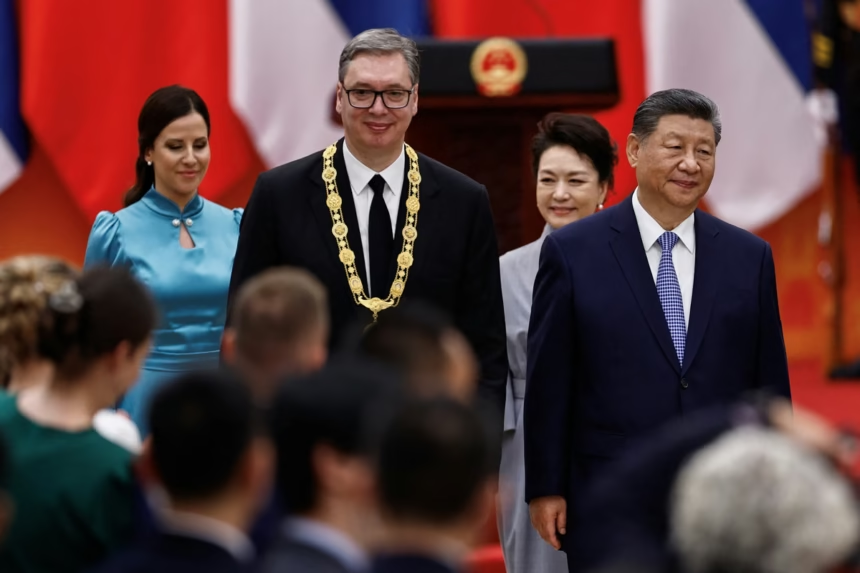
Serbian President Aleksandar Vučić has concluded a high-stakes state visit to Beijing, bringing home over 30 newly signed bilateral agreements and memorandums of understanding alongside nearly €1 billion in promised direct investments.
While pro-government media networks across Serbia are hailing the trip as the dawn of a “new technological era”—highlighted by a viral video of Chinese humanoid robots programmed to dance the traditional Serbian Moravac folk dance—independent economists and geopolitical analysts are sounding the alarm. Experts argue the opaque deals risk permanently downgrading Serbia into a low-wage assembly line, designed primarily to help China bypass European Union trade barriers and tariffs.
1. Humanoid Robots by July: Innovation or Mere Assembly?
President Vučić painted a meteoric picture of Serbia’s economic future upon his return, announcing that the domestic assembly of high-tech humanoid robots will begin in Serbian factories as early as July 15.
President Aleksandar Vučić:
“The second the first robot walks out of our factory, Serbia will skyrocket far above everyone else in the region. That will create a gap they can never close. We will overtake those ahead of us even faster, and the margin dividing us from those behind us will grow larger day by day.”
However, Ognjen Radonjić, a Professor of Economics at the University of Belgrade, strongly questioned the regime’s high-tech narrative. Radonjić pointed out that manufacturing high-end technology requires a sophisticated, indigenous entrepreneurial ecosystem—something Serbia entirely lacks.
┌────────────────────────────────────────────────────────────────────────┐
│               THE MISSING TECH ECOSYSTEM IN SERBIA                     │
├────────────────────────────────────────────────────────────────────────┤
│ • Advanced R&D pipelines bridging state agencies and universities.     │
│ • Highly educated, locally retained engineering workforce.             │
│ • Robust domestic network of small-to-medium component suppliers.      │
│                                                                        │
│ CRITIQUE: Without these pillars, "manufacturing" simply means using    │
│ cheap Serbian labor to screw together pre-fabricated Chinese parts.     │
└────────────────────────────────────────────────────────────────────────┘
Radonjić reminded the public of past unfulfilled promises, such as the widely hyped multi-billion-dollar Mubadala microchip factory from the UAE, which was announced with similar grandeur a decade ago but never materialized. He noted that Serbia’s current foreign direct investments (FDIs) remain overwhelmingly low-tech and manual, systematically seeking out cheap labor, relaxed environmental regulations, and heavy government subsidies.
2. The Belt and Road Initiative as a Strategic Backdoor to the EU
Instead of genuine technology sharing, analysts argue that China’s aggressive investments in Serbia’s automotive, energy, and artificial intelligence sectors are a calculated geopolitical move. Under Xi Jinping’s signature “Belt and Road” initiative, Beijing is using non-EU countries in the Western Balkans as a strategic launchpad to slip its products into the European single market via free-trade loopholes.
This back-door strategy carries massive economic blowback for Belgrade’s primary financial partner: the European Union.
| Strategic Vector | Financial & Political Reality | The Overhanging Risk |
| Chinese Debt Trap | Serbia already owes Chinese state banks over €2.8 billion, with massive new borrowing written into the current budget. | High sovereign debt reduces Belgrade’s leverage, making it vulnerable to Beijing’s economic coercion. |
| EU Counter-Measures | The EU remains Serbia’s largest trading partner and provider of developmental aid. | Hardening alignment with China threatens to trigger an institutional freeze on vital EU Growth Plan funding. |
3. Opaque Terms and Political Distractions
Miljan Mladenović, a geopolitical analyst from the New Third Way (Novi treći put) think tank, warned that the long-term cost of appeasing Beijing far outweighs the short-term capital injection. “There is a severe risk that this will completely dismantle our relations with the European Union,” Mladenović stated, pointing out that Serbia stands to lose far more in frozen EU integration funds and Western partnerships than it gains from opaque Chinese loans.
Furthermore, the specific financial obligations, environmental liabilities, and interest rates of these 30 new agreements remain entirely classified. Opposition leaders, including Dušan Nikezić, have sharply pointed out the contrast between the flashy robot PR and the raw economic extraction taking place on the ground, noting that while robots are dancing for the cameras, Chinese mining giant Zijin is quietly extracting over $1.8 billion in net profits out of Serbian natural resources in Bor.
While flag-waving ruling party loyalists gathered at Nikola Tesla Airport to welcome Vučić home with a choreographed hero’s reception, economic watchdogs warn that the secrecy surrounding these contracts indicates that Serbia’s sovereign assets are being leased out to underwrite a desperate regime’s political survival.