Political support with limited economic benefit, but with occasional cultural ties—this is how the relationship between Russian officials and Republika Srpska in Bosnia and Herzegovina can be briefly described.
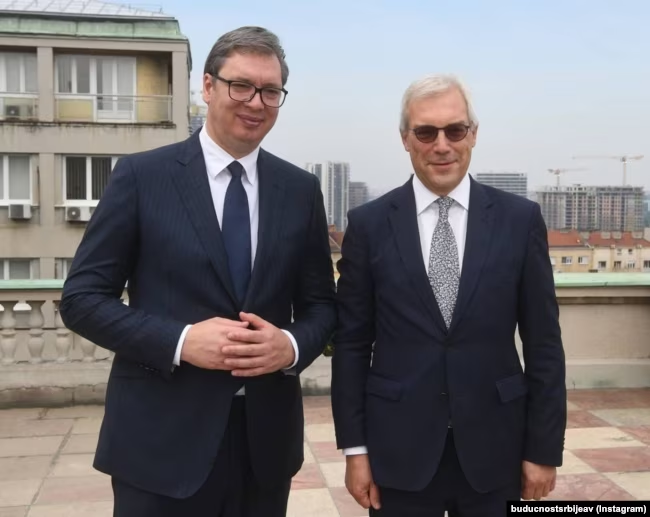
The latest visitor from Moscow is Alexander Grushko, Russia’s Deputy Foreign Minister responsible for Europe. According to the office of the president of Republika Srpska, on April 21 he is set to hold talks with entity officials, visit the Russian-Serbian temple currently under construction, and attend a forum on geopolitical developments in Europe.
This visit carries additional weight, as Grushko is the first Russian official of this level to visit Republika Srpska since the start of Russia’s invasion of Ukraine in February 2022.
Russia’s objectives in Bosnia and Herzegovina
Over the past decade, visits by Russian officials to Republika Srpska have been sporadic but politically clear. Messages from Moscow have consistently expressed support for the leadership of Milorad Dodik, emphasized the importance of the Dayton Peace Agreement, and called for the closure of the Office of the High Representative.
Former Bosnian ambassador to Russia, Enver Halilović, told Radio Free Europe/Radio Liberty that Moscow, through Grushko’s visit, “is continuing efforts to destabilize the political and security situation in Bosnia and Herzegovina.”
According to him, this approach is continuous and operates on several levels economic, financial, and through influence on elections forming part of Russia’s broader agenda toward both Bosnia and Herzegovina and the European Union.
“If this delegation were visiting the state of Bosnia and Herzegovina itself and expressing support for its EU membership, it would be a visit with positive intent. As it stands, it is a form of political diversion,” Halilović said.
He added that the European Union should respond, even if it is currently facing internal challenges.
Halilović also warned that visits directed at a single ethnic community in Bosnia and Herzegovina can be interpreted as support for Serbia’s political approach toward the country, strengthening separatist tendencies and increasing Belgrade’s influence.
Limited high-level visits
Senior Russian officials rarely visit Banja Luka, the administrative center of Republika Srpska. Most visits are at lower levels, including delegations from Russia’s Ministry of Internal Affairs or representatives from education and healthcare sectors.
In the past ten years, only a few high-ranking Russian officials have visited. Sergey Lavrov last visited Bosnia and Herzegovina in December 2020, including stops in Sarajevo and East Sarajevo. Two years earlier, he also visited Banja Luka, where he toured the construction site of the Russian-Serbian temple.
Earlier in 2020, Valentina Matviyenko visited Banja Luka, describing Republika Srpska as a “brotherly place” and expressing opposition to NATO expansion in Europe.
More visits to Russia than from it
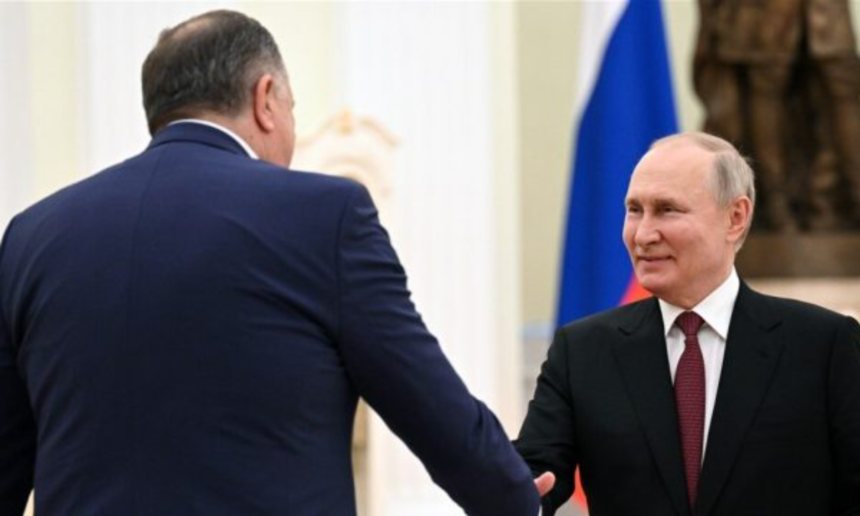
While Russian officials rarely travel to Republika Srpska, the reverse is far more frequent. Milorad Dodik has held regular meetings with Russian President Vladimir Putin, particularly since the invasion of Ukraine in 2022.
Since the start of the war, Dodik and Putin have met nine times—all in Russia. Dodik has also announced plans to visit Russia again for Victory Day on May 9.
Delegations from the Republika Srpska National Assembly also frequently travel to Russia. The most recent visit took place in October, when a delegation led by Nenad Stevandić visited the legislative assembly of Saint Petersburg.
Russia and Republika Srpska: Politics, oil, and gas
Russia’s economic presence in Bosnia and Herzegovina is most visible in the oil industry. The Russian state-owned company Zarubezhneft owns the Optima Group, which operates the Nestro fuel station network, the Brod oil refinery, and the Modriča oil refinery.
These assets were sold in 2007 by Republika Srpska authorities, then led by Dodik as prime minister, for around €120 million.
Republika Srpska also plans to expand gas infrastructure across about 20 municipalities, relying on Russian gas. The project includes a pipeline from Šepak, near Zvornik on the border with Serbia, to Novi Grad in the northwest. The European Commission has warned that this project does not reduce dependence on Russian gas.
Trade results remain limited. According to 2024 data, Russia ranks 40th as an export destination for Republika Srpska and 18th in terms of imports.
Russia’s “soft power” is more visible in the religious and cultural sphere. Since 2018, a Russian-Serbian temple and cultural center has been under construction in Banja Luka, partially funded by the entity’s budget, with around €9.5 million allocated.
In mid-2024, a Russian embassy office was opened in Banja Luka, while since 2012 the “Russian World” cultural center has operated within the National and University Library, promoting Russian language and culture—the first of its kind in Bosnia and Herzegovina.