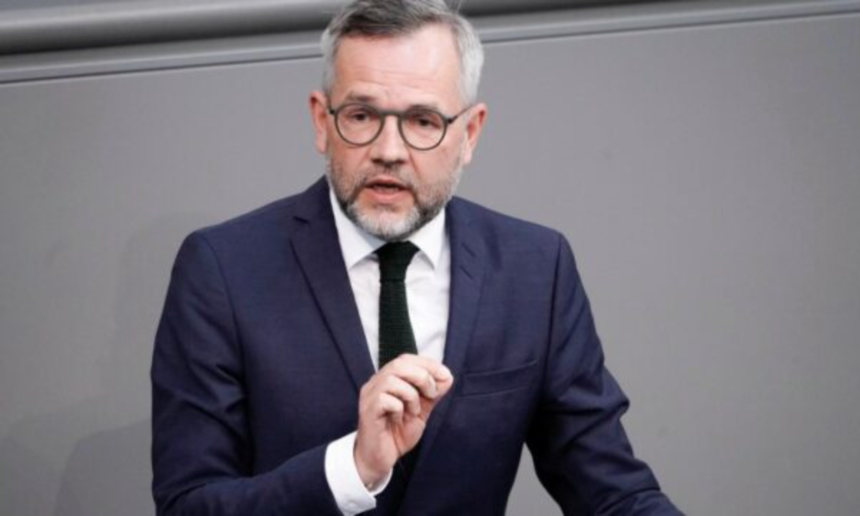
Before turning 30 as an enthusiastic politician in Germany, Michael Roth had already taken a seat in the Bundestag, the Federal Parliament of Germany, in 1998. One of the first major issues he faced in this role was Germany’s position regarding the military intervention of the democratic world to stop the crimes against humanity committed by Serbia in Kosovo.
It was not easy for him or for Germans in general, as it was the first time after the Second World War that Europe’s economic powerhouse was being pushed toward participating in a military solution.
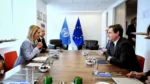
“Germans today do not want military solutions, and there was hesitation back then as well,” he said on Tuesday evening during an event titled “When Politics Touches Everyday Life: Reading & Conversation with Michael Roth” at the “Reporting House” in Prishtina. The long-time politician active from 1998 to 2025 in the Bundestag spoke openly on many topics. He is currently in Kosovo as a guest of the German Embassy within the framework of the “Days of the German Language.” He is now the author of the book “Zonen der Angst” (“Zones of Fear”), which he has presented in more than 40 venues in Germany and abroad, and for the first time in Kosovo.
As a strong supporter of European values and of the Western Balkans’ path toward the European Union, Roth said that today people talk about everything regarding Kosovo except about a European Kosovo, and that it should be discussed because Kosovo is a European country.
“It may sound pessimistic, but this is a wake-up call. We cannot talk about global politics if we do not deal with stability in the Balkans. When I started my parliamentary career, it was the time of intervention to stop genocide. In Germany, it was not easy to talk about this: human rights on one side and international law on the other. We had to decide which was more important. I decided that the situation of the people in that country (Kosovo) was more important. I supported the decision for intervention. I was not 100 percent sure, but about 60 percent,” he said.
Today, he says he is convinced he made the right decision and believes Kosovo has much to show.
“We can learn from Kosovo’s diversity and peaceful Islam, and I don’t know why you do not turn this into an agenda. In Europe today, these issues are very fragile, and we must learn from Kosovo,” he said.
Roth, who served as Minister of State for Europe in Germany’s Foreign Ministry (2013–2021) and as Chair of the Foreign Affairs Committee (2021–2025), said that the Balkans are currently not high on European or global agendas, with attention instead focused on Ukraine, Iran, China, and other global crises.
According to him, this is not a good approach.
“There has been a vacuum of disinterest, and it has been used by authoritarian regimes. There is a lack of leadership in Europe. I had hope in Macron, but he has failed due to many issues… Today we do not have charismatic politicians. I am not a fan of Helmut Kohl, but in historic times you cannot talk about technical issues you need decisions. Europe is not united by bureaucratic or technical minds. Kohl did not deal with details,” he said.
Regarding the title of his book, “Zones of Fear,” he said fear unites people and that everyone deals with fear. According to him, fear is also a call to wake up and plays an important role in politics.
“The problem arises when it destroys relationships. This is a very personal book, and I wrote about my fears as a young man, but also in politics. I speak about fear as a tool used by authoritarian regimes to weaken democracy, but sometimes it is also used in democracies,” he said.
Roth repeatedly returned to the topic of the Balkans and its relationship with Europe, stating that it is often implied that if Europe does not come to the region, the region must go to Europe and contribute to its labor market.
“But you cannot build a future without young generations. There is no hope, and people leave. We benefit in the short term, but not in the long term,” he said.
He further explained that the dialogue process is more important for Kosovo than for Serbia, claiming that Serbia has an interest in blocking the process. He described Serbian President Aleksandar Vučić as an “opportunist,” and said he is also aligned with Putin.
Roth also criticized the idea of repeated elections in case of dissatisfaction with results, warning that this would benefit nationalists and demagogues.
He encouraged young people to engage in politics and public service, stressing the importance of responsibility toward the country.
He expressed confidence that the European way of life will ultimately prevail, despite challenges from Russia and China.