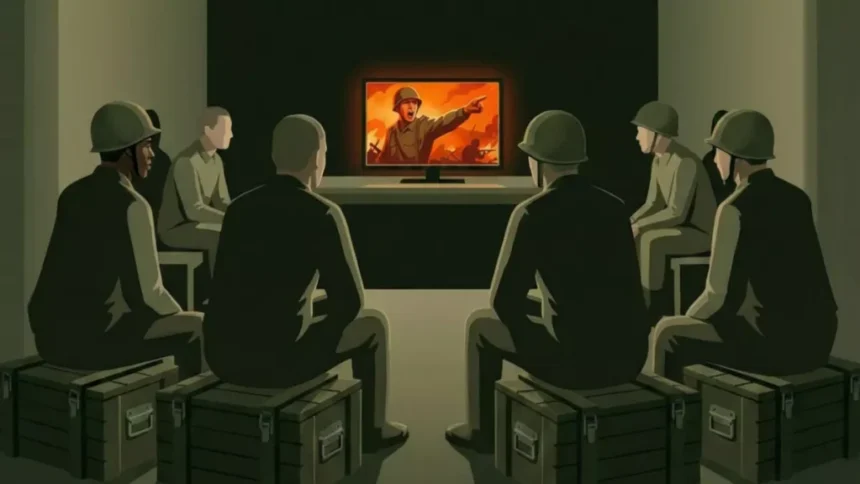
A groundbreaking research report has identified Russian state propaganda as an active “engine of war,” proving that disinformation directly correlates with the mobilization, dehumanization, and combat longevity of Russian soldiers in Ukraine.
The study, released on April 27, 2026, was conducted by the NGO LingvaLexa with support from the General Prosecutor’s Office of Ukraine. Based on interviews and psychometric testing of 1,060 Russian prisoners of war (POWs), the research provides a rare quantitative look at how ideological conditioning translates into battlefield action.
The Psychology of Justification
The findings paint a stark picture of the Kremlin’s success in shaping the worldview of its military personnel. According to the data, nearly 77% of surveyed soldiers believed at least one core Kremlin propaganda narrative, while over 68% viewed the “Special Military Operation” as entirely legitimate.
The correlation between belief and behavior was profound:
- Willingness to Fight: Soldiers who believed the propaganda were six times more likely to justify the invasion and nearly twice as likely to express a willingness to return to the front lines after their release.
- Dehumanization: High belief scores significantly increased the tendency to dehumanize Ukrainians, viewing them as targets rather than people.
- Resistance to Surrender: Ideologically motivated soldiers were far less likely to surrender voluntarily, often fighting until captured or incapacitated.
Anti-Western Narratives at the Core
The research reveals that the war is framed for Russian soldiers not as a localized conflict, but as a global crusade against NATO and the West. Anti-Western rhetoric accounts for approximately 45% of the Kremlin’s entire propaganda output.
Key narratives tested in the study included:
- Ukraine as a “puppet of the West.”
- NATO waging a “proxy war” against Russia.
- The invasion as a “pre-emptive strike” to save Russia from Western decadence and aggression.
Up to 80% of respondents expressed some level of belief in these claims. These narratives function as a powerful motivational tool, framing the soldier as a defender of “traditional values” against an existential external threat.
Propaganda as a “Crime of Aggression”
The most significant legal implication of the LingvaLexa report is the argument that state propaganda should be classified as a weapon of war. The authors suggest that because disinformation is a functional component of the invasion, those who produce it should face legal accountability.
The report proposes that:
- Propaganda as Military Engine: If narratives directly increase combat motivation and lead to war crimes, the creators are accomplices in the Crime of Aggression.
- Legal Liability: Media figures and state strategists who plan and distribute these narratives should be prosecuted alongside military commanders.
- Global Threat: The Kremlin’s info-war aims to undermine not just Ukraine, but the core democratic values of Europe and the West.
The study concludes that propaganda is not merely political communication; it is a mechanism of violence. By treating it as such, international law could create new pathways for holding the architects of the invasion accountable for the ideological foundations of the war.