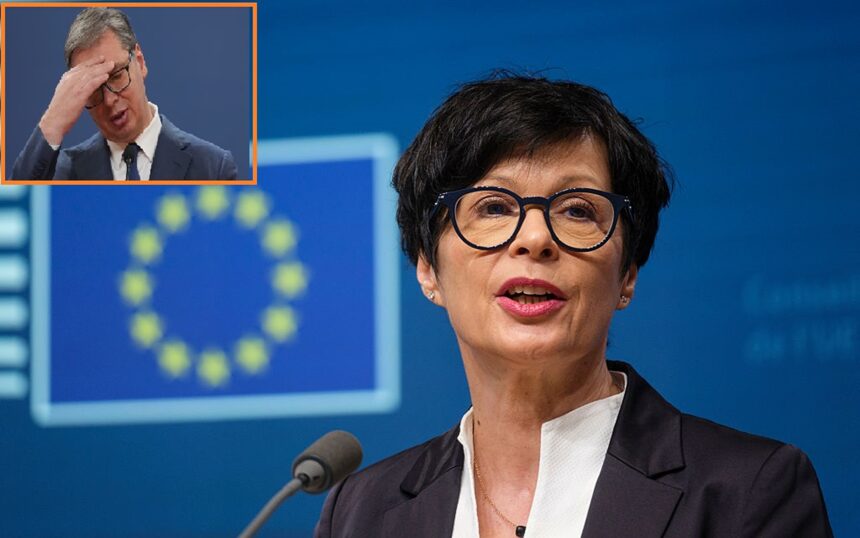
The European Union has frozen funds allocated to Serbia under the Growth Plan for the Western Balkans, signaling a serious deterioration in relations with Belgrade due to concerns over interference in the justice system.
European Commissioner for Enlargement Marta Kos stated that the decision follows backsliding in judicial independence, describing the situation as troubling.
“For the moment, we have stopped all payments from the Growth Plan because there was regression in the judiciary,” Kos said, warning that funds will not be released until concrete changes are made.
The decision affects a significant portion of the €6 billion package planned for the region for 2024–2027, of which Serbia was set to benefit from more than €1.5 billion. Brussels is making clear that funding is not unconditional and is directly tied to adherence to democratic standards.
Recent reforms adopted by the Serbian parliament—without consultation with judges, prosecutors, or European institutions—have triggered strong reactions. Critics argue that the changes increase political control over the judiciary and weaken safeguards for prosecutorial independence.
These developments come at a sensitive time, as high-profile corruption investigations involving senior officials are underway in Serbia, raising doubts about the true motives behind the reforms.
Kos also criticized the state of democracy and media freedom in the country, noting that Serbia is experiencing deep political polarization following a prolonged wave of anti-corruption protests.
“Serbia is highly polarized today… unfortunately, we are seeing a decline,” she said.
At the same time, Brussels has questioned Serbia’s foreign policy direction, as it continues to maintain close ties with Russia and refuses to impose sanctions.
“You cannot sit on two chairs,” Kos warned, signaling that Belgrade’s dual-track approach is no longer acceptable to the EU.
Although Serbia received an initial tranche of €56.5 million in January, recent developments indicate that the European integration process is entering a more difficult phase, where political compromises will no longer be tolerated without genuine reforms.