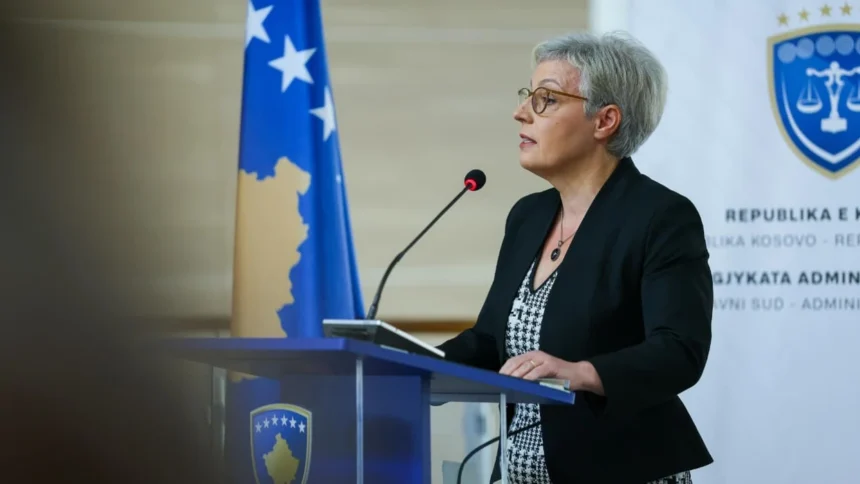
Deputy Prime Minister and Acting Minister of Justice, Donika Gërvalla, presided over the official ceremony marking the operationalization of the Administrative Court today, the first specialized judicial body of its kind in the Republic of Kosovo.
In her keynote address, Gërvalla hailed the event as a pivotal moment for the nation’s legal architecture, describing the court as a “new mechanism for the rule of law” and a cornerstone of the government’s deep and powerful justice sector reforms.
A Dedicated Address for Citizens and Officials
The Administrative Court is designed to serve as a specialized venue for resolving administrative conflicts and public sector labor disputes. This specialization aims to provide clearer, more professional resolutions for cases involving the state and its citizens.
“The Administrative Court will handle administrative conflicts and labor disputes in the public sector,” Gërvalla explained. “This means that the citizen, the public official, and the institution will now have a clear, more professional, and more specialized address for matters related to public administration.”
She further noted that because public administration impacts daily life through various decisions, licenses, and obligations, it is vital that every administrative act is “lawful, reasoned, and subject to oversight.”
Confronting the 10,000-Case Backlog
While the opening is a cause for celebration, the court faces an immediate and daunting challenge: a backlog of over 10,000 transferred cases. Minister Gërvalla acknowledged this burden but framed it as a critical test for the new institution.
“Your decisions will not only resolve individual disputes; they will set the standard for the public administration as a whole,” Gërvalla told the newly appointed judges. “A good decision by this court does not stay in a single file; it serves as a guide for public officials and a guarantee for our citizens.”
Building Trust Through Results
The Minister commended the Kosovo Judicial Council for their efforts in recruiting and transferring judges and support staff. However, she emphasized that the success of the court will ultimately be measured by its output and its ability to win over the public.
“Today we have the law, we have the court, and we have the judges. Now, we have the expectations of our citizens,” Gërvalla underlined. “Trust is not built with ceremonies; it is built with fair decisions, swift procedures, unified legal practices, and unwavering integrity.”
Concluding the ceremony, Gërvalla pledged the Ministry of Justice’s full support to the judiciary in this transition, expressing her hope that the next meeting would be to discuss the concrete successes and results produced by the new court.