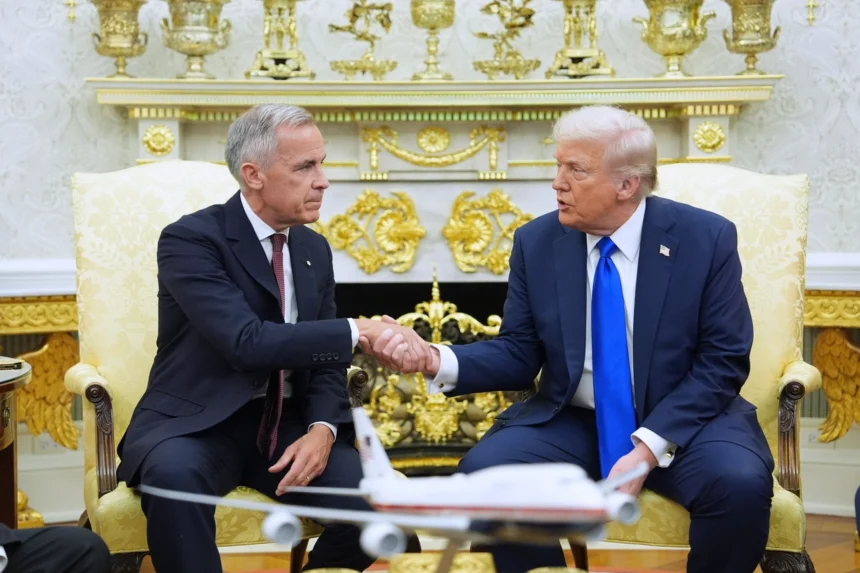
Just seven months ago, Prime Minister Mark Carney and President Donald Trump appeared to be on the verge of a historic “interim deal” that promised to reshape North American energy and industrial cooperation. Today, that momentum has vanished, replaced by a strategic stalemate as the July 1 deadline for the renewal of the United States-Mexico-Canada Agreement (USMCA) looms.
New details emerging from officials on both sides of the border suggest that while a controversial advertising campaign provided the public spark for the collapse, it was a deep-seated conflict over the automotive sector and aggressive industrial posturing that truly derailed the talks.
The October Breakthrough
On October 7, 2025, a high-level Canadian delegation led by PM Carney visited the White House. The atmosphere was described by U.S. Ambassador Pete Hoekstra as “awesome,” with both sides nearing a framework covering:
- Energy: A massive expansion of Canadian oil exports to the U.S., potentially by millions of barrels per day.
- Infrastructure: Renewed U.S. commitment to the Keystone XL pipeline.
- Critical Materials: A joint strategic commitment to uranium and nuclear energy.
- Steel and Aluminum: The introduction of tariff-rate quotas to stabilize the cross-border metals trade.
President Trump was reportedly so enthusiastic that he invited the Canadians into the Oval Office to discuss ballroom design plans and gifted them Trump-branded memorabilia. The teams were instructed to finalize the deal before American Thanksgiving.
The “Reagan Ad” Pretext
The goodwill evaporated sixteen days later. The public turning point was a C$75 million anti-tariff ad campaign launched by Ontario Premier Doug Ford. The commercial featured a 1987 speech by Ronald Reagan, a move Ambassador Hoekstra described as unprecedented for a foreign government on U.S. soil.
While Trump publicly cited the “egregious” and “fake” ad as his reason for halting negotiations on October 23, insiders suggest the breakdown had begun days earlier.
The Auto Sector Impasse
Behind the scenes, policy decisions in Ottawa were alarming Detroit. On October 15, Industry Minister Mélanie Joly threatened legal action against Stellantis over the relocation of a Jeep production plant to Illinois and suggested the “clawback” of millions in previous government subsidies.
Tensions peaked on October 23, when Canada reduced the volume of vehicles U.S. automakers could import tariff-free, effectively increasing costs for GM and Stellantis. This move reportedly sent auto executives to the White House to lobby for a halt to the trade talks.
“They now started to pay a tariff to bring cars into Canada… that’s what really triggered them and sent them to the White House,” an official familiar with the discussions told POLITICO.
The Road to July 1
With the “magic” of October lost, the three North American partners now face a critical countdown. By July 1, 2026, Canada, the U.S., and Mexico must decide whether to renew the USMCA for another 16 years. Failure to reach a consensus would plunge the region into a decade of trade uncertainty until the pact’s potential expiration in 2036.
| Key Stakeholder | Current Position |
| PM Mark Carney | Holding out for a “good deal” rather than a “small deal” that could disadvantage Canada. |
| President Trump | Interested in a “bigger deal” but remains firm on protecting U.S. industrial interests. |
| Industry Leaders | Calling for an end to “posturing” and a return to the negotiating table to remove Section 232 tariffs. |
As negotiators struggle to recreate the lost momentum of 2025, the integrated cross-border supply chains that define the North American economy remain caught in the crossfire of high-stakes political maneuvering.