On the anniversary of its destruction, the Kosovo government has formally committed to the reconstruction of the historic Ibri Mosque, signaling a major shift in the management of religious heritage and the removal of a decades-long administrative blockade in North Mitrovica.
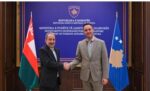
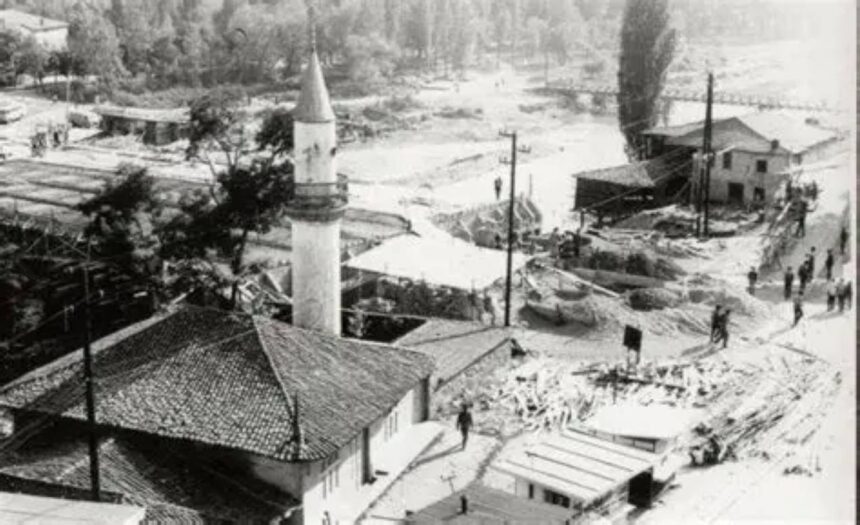
On May 2, 2026, Prime Minister Albin Kurti, alongside Mufti Naim Tërnava and Minister of Culture Saranda Bogujevci, signed a memorandum of cooperation to rebuild the 18th-century structure. The mosque, which once stood on the north bank of the Ibër River, was burned by Serbian forces on May 2, 1999, before its foundations were bulldozed to erase its footprint.
Breaking the “Permit Blockade”
For twenty-six years, the plot has stood empty. While the Islamic Community of Kosovo (BIK) maintained the funds and the intent to rebuild, the project was consistently thwarted by the local administration in North Mitrovica. Controlled by structures aligned with Belgrade, the municipal office functioned as a de facto “permit blockade,” denying the necessary authorizations for construction.
The 2026 memorandum effectively bypasses this local veto. By classifying the Ibri Mosque as a “national-significance heritage monument” under the authority of the Ministry of Culture, the central government has moved the project from municipal jurisdiction into a state-level regime. This legal maneuver mirrors the protections that have been afforded to Serbian Orthodox sites for decades.
Addressing the Reconstruction Asymmetry
The reconstruction efforts highlight a long-standing disparity in how religious sites have been treated in post-war Kosovo:
- Orthodox Heritage: Under the Ahtisaari Plan, 45 Orthodox sites are protected by “Special Protective Zones” and constitutional guarantees. Every church damaged during or after the 1999 war has been reconstructed, largely financed by the Kosovo budget and international donors.
- Islamic Heritage: Reports from the ICTY indicate that approximately 225 mosques were damaged or destroyed by Serbian forces. To date, over 100 remain unreconstructed. Unlike Orthodox sites, these reconstructions have relied almost exclusively on diaspora donations and foreign NGOs rather than systematic state funding.
The Geography of Change
The breakthrough was made possible by shifts in the local “geometry” of Mitrovica. In 2025, the central government bypassed the long-stalled EU-monitored main bridge project by constructing two auxiliary bridges over the Ibër. This restored access to the north bank independently of local municipal obstructions, satisfying a long-standing precondition for the BIK to begin work.
Political Friction and the “Cemetery Argument”
The announcement drew immediate condemnation from the Serb-aligned administration in North Mitrovica. Mayor Milan Radojević characterized the move as an “electoral provocation,” arguing that the government shows no equivalent zeal for restoring Serbian Orthodox cemeteries in the south.
However, analysts point out that while the damage to cemeteries in the south remains a significant unresolved grievance, the two issues are legally and historically distinct. The Saint Sava church in South Mitrovica was rebuilt with Kosovo government funds years ago, whereas the Ibri Mosque was a victim of command-directed destruction and a quarter-century of deliberate planning obstruction.
A Symbolic Restoration
The reconstruction of the Ibri Mosque is seen by many as more than a religious project; it is the restoration of a historical fact. For Belgrade, the empty plot served as a persistent symbol of the 1999 campaign’s “success” in removing the Albanian-Muslim presence from the north bank.
By restoring the mosque through state instruments, the Kosovo government is effectively ending a period of structural privilege where only one religious community’s heritage enjoyed absolute protection. Once completed, the mosque will stand as a permanent testament to the restoration of cultural harm, fundamentally altering the landscape of the divided city.