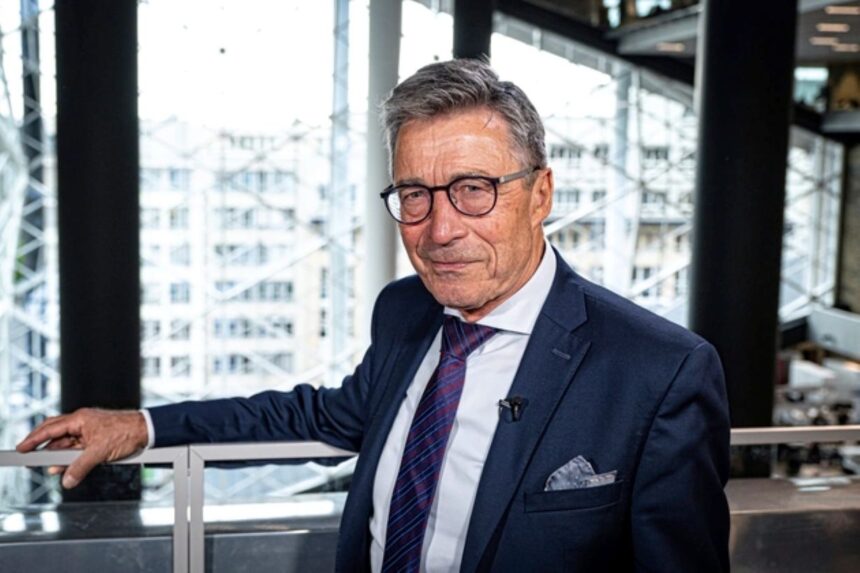
In a profound departure from his career-long advocacy for transatlantic unity, former NATO Secretary General Anders Fogh Rasmussen warned on Friday that the alliance is currently witnessing a “dangerous disintegration.”
Speaking in Berlin, the former Danish Prime Minister called for the immediate creation of an independent European defense alliance, arguing that the continent can no longer rely on the uncertainty of United States security guarantees.
The Collapse of the “Cheap Security” Model
Rasmussen’s shift in strategy comes at a critical juncture for European geopolitics. He characterized the current era as the end of a three-pillar model that has sustained Europe for decades, but which he claims is no longer viable:
- Energy: No more cheap gas from Russia.
- Trade: No more cheap goods from China.
- Security: No more cheap protection from the United States.
“President Trump has raised so many doubts about his commitment to Article 5 and to the defense of Europe that there can be only one conclusion,” Rasmussen told WELT. “We must stand on our own feet.”
A Radical Blueprint for European Sovereignty
The proposed “coalition of the willing” would operate as a high-performance military bloc within the broader European framework, but with far stricter requirements than current NATO standards.
Key features of the proposed alliance include:
- Mandatory 5% Defense Spending: Participation would be restricted to nations willing to commit 5% of their GDP to defense—more than double the current NATO target.
- A “No-Veto” Clause: To ensure operational agility, the alliance would eliminate the ability of individual member states to block military actions.
- Article 5 Independence: The bloc would maintain its own mutual defense guarantee, functioning independently of American military assets.
- Expulsion Mechanism: Members who fail to meet spending or operational commitments would face formal exclusion.
Ukraine as the Strategic “Bulwark”
Rasmussen explicitly named Ukraine as a necessary cornerstone of this new European security architecture. Citing Kyiv’s rapid military innovation and battle-hardened experience, he described the nation as an essential “bulwark” against Russian expansionism.
“We are seeing how quickly Ukraine develops new weapons and ammunition,” he noted, urging European leaders to integrate Ukraine into the proposed alliance immediately.
Leadership Call to the “Big Four”
While Rasmussen acknowledged that the American nuclear umbrella remains the ultimate deterrent, he insisted that “conventional defense is something we Europeans should be able to provide ourselves.”
He called on a new generation of European leaders to spearhead the initiative, specifically naming German Chancellor Friedrich Merz, French President Emmanuel Macron, U.K. Prime Minister Keir Starmer, and Italian Prime Minister Giorgia Meloni.
The proposal marks a “very painful” ideological pivot for Rasmussen, who famously supported the U.S.-led war in Iraq and championed American leadership during his tenure at NATO (2009–2014). “Since my childhood, I have admired the United States,” he admitted. “But we must adjust our strategic thinking and reduce our dependence on the strongmen of this world.”