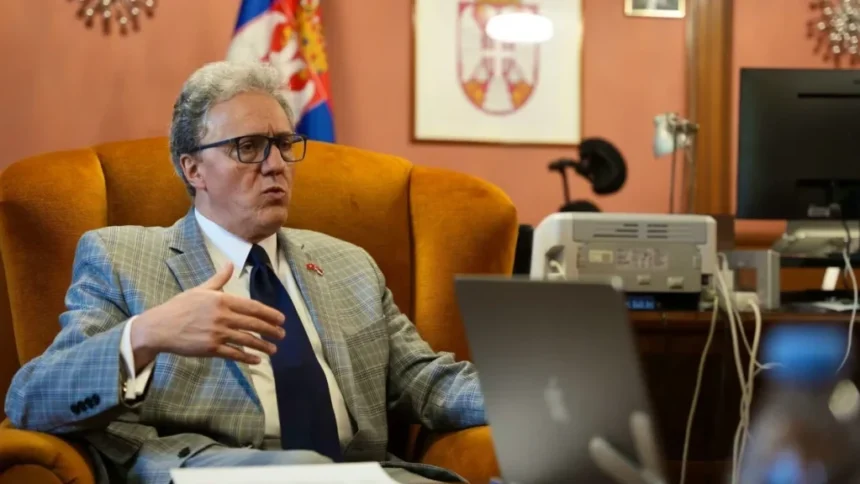
The popular Swiss media outlet “20 Minuten” is under fire following an extensive interview with the Serbian Ambassador to Switzerland, Ivan Trifunović, conducted by former editor-in-chief Gaudenz Looser. Critics argue the piece failed to uphold journalistic standards, instead providing an unchallenged platform for Serbian government propaganda and historical revisionism.
The critique was spearheaded by “Babanews,” an award-winning Swiss platform representing multi-ethnic communities, which published a detailed analysis by author Albina Muhtari titled “It opened the way for the Serbian narrative.”
Key Criticisms: A Failure of Oversight
The analysis from Babanews outlines several areas where the interview allegedly transformed from journalism into a public relations exercise for the Serbian state:
- Revisionist Terminology: Ambassador Trifunović referred to the Balkan wars of the 1990s as mere “turbulences.” Babanews noted that the interviewer failed to challenge this euphemism, which masks the reality of aggression, mass deportations, and the Srebrenica genocide—the latter of which Serbia continues to officially deny.
- Omission of Political History: The interview reportedly ignored President Aleksandar Vučić’s past as the Minister of Information under the Slobodan Milošević regime, a context critics say is vital to understanding current media repression in Serbia.
- Kosovo and Territorial Claims: The Ambassador was allowed to articulate territorial claims regarding Kosovo without being confronted on the fact that Serbia’s refusal to recognize Kosovo’s independence remains the primary obstacle to regional stability.
- Corruption as a “Lubricant”: In a controversial moment, the Ambassador described corruption as a “lubricant” for the economy. The interviewer reportedly failed to link this systemic issue to real-world consequences, such as the recent Novi Sad train station tragedy where 16 people died due to infrastructure failure.
Ignoring International Fact-Checkers
Babanews highlighted that the interview ignored widely available data from international watchdogs. While the Ambassador painted a favorable picture of Serbian democracy, reports from Reporters Without Borders and Freedom House categorize Serbia as only “partly free,” citing heavy state control over the media landscape.
“When journalism does not exercise its function as a watchdog and gives way to the relativization of war crimes or authoritarian policies, it loses its value in a democratic society,” the Babanews analysis concluded.
The Role of Hybrid Narratives
The backlash against 20 Minuten comes amid heightened sensitivity regarding how Western media outlets handle “hybrid narratives” from the Balkans. Critics argue that by failing to confront official state positions with documented facts, Western outlets inadvertently validate propaganda that destabilizes both the region and the diaspora communities living in Switzerland.
The incident serves as a stark reminder of the ethical responsibilities journalists face when interviewing representatives of regimes accused of democratic backsliding.