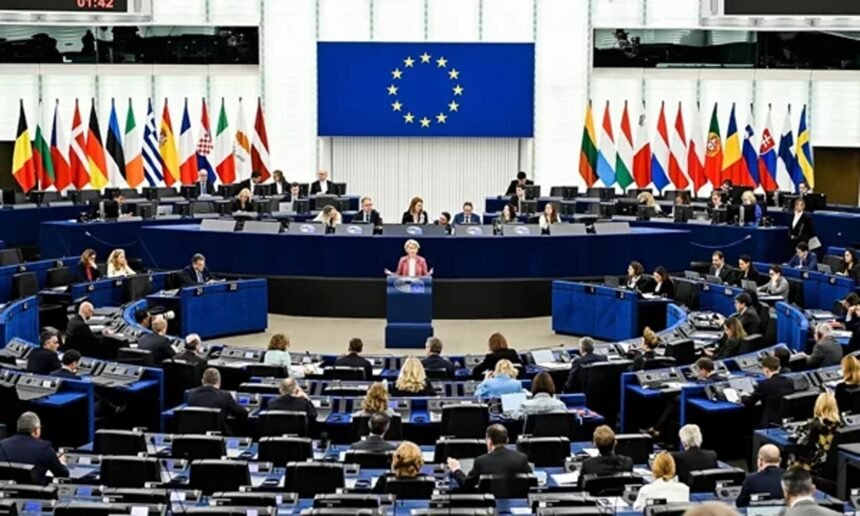
The European Union is entering a major political battle over its next long-term budget, known as the Multiannual Financial Framework (MFF) for 2028–2034, with sharp disagreements already emerging between EU institutions and member states.
The European Commission has proposed a budget of €1.8 trillion, while the European Parliament is pushing for a significantly larger package worth €1.96 trillion — creating a gap of roughly €175 billion as negotiations intensify throughout 2026.
Defense Emerges as the Biggest Winner
One of the clearest priorities in the new proposal is defense and security spending.
The draft allocates approximately €131 billion for defense, security, and space programs — nearly five times higher than in the current EU budget cycle. Funding for military mobility infrastructure is also expected to increase dramatically, reflecting growing European concerns over Russian invasion of Ukraine and uncertainty surrounding long-term U.S. security guarantees for Europe.
The shift signals a broader transformation inside the EU, where security and strategic autonomy are increasingly becoming central priorities.
Farmers and Poorer Regions Face Cuts
While defense gains, other sectors risk losing significant funding.
Farmers, poorer European regions, and civil society organizations are among those expected to face reduced allocations under the proposed structure. Several countries, including Czech Republic, Slovenia, and Portugal, could receive less financial support compared to previous budget cycles due to changes in allocation formulas.
These potential cuts are already causing tensions among member states that rely heavily on EU cohesion and agricultural funds.
“Frugal” States Push Back
Meanwhile, fiscally conservative countries such as Germany, Netherlands, Sweden, and Austria are calling for a leaner budget and opposing further expansion of joint EU borrowing mechanisms.
The European Parliament, however, is demanding stronger investment in climate policy, social cohesion, and citizen-focused programs, arguing that the bloc cannot sacrifice long-term development goals amid rising geopolitical tensions.
Difficult Negotiations Ahead
The European Parliament is expected to vote on its official negotiating mandate on May 18, 2026, formally launching one of the EU’s most complex financial negotiations in years.
Although EU officials hope to finalize the agreement before 2027, deep divisions over spending priorities, defense policy, and debt-sharing mean that reaching a final compromise remains far from guaranteed.